Department of Health and Human Performance, Middle Tennessee State University, Murfreesboro, TN 37132, USA.
Department of Public Health, University of Tennessee, Knoxville, TN 37996, USA.
Int J Environ Res Public Health. 2021 Apr 20;18(8):4369. doi: 10.3390/ijerph18084369.
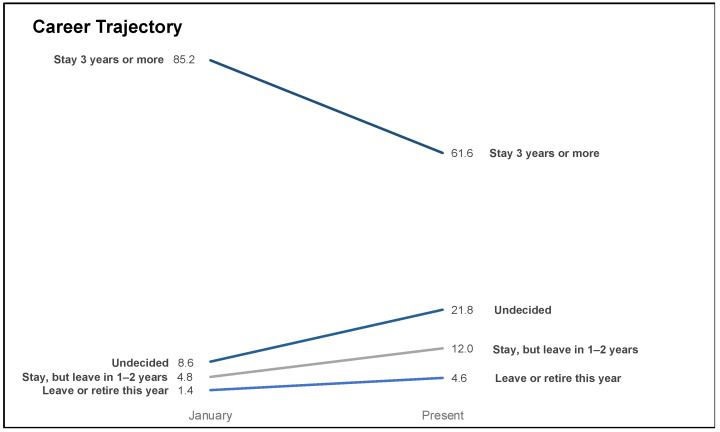
While the health impacts of the COVID-19 pandemic on frontline health care workers have been well described, the effects of the COVID-19 response on the U.S. public health workforce, which has been impacted by the prolonged public health response to the pandemic, has not been adequately characterized. A cross-sectional survey of public health professionals was conducted to assess mental and physical health, risk and protective factors for burnout, and short- and long-term career decisions during the pandemic response. The survey was completed online using the Qualtrics survey platform. Descriptive statistics and prevalence ratios (95% confidence intervals) were calculated. Among responses received from 23 August and 11 September 2020, 66.2% of public health workers reported burnout. Those with more work experience (1-4 vs. <1 years: prevalence ratio (PR) = 1.90, 95% confidence interval (CI) = 1.08-3.36; 5-9 vs. <1 years: PR = 1.89, CI = 1.07-3.34) or working in academic settings (vs. practice: PR = 1.31, CI = 1.08-1.58) were most likely to report burnout. As of September 2020, 23.6% fewer respondents planned to remain in the U.S. public health workforce for three or more years compared to their retrospectively reported January 2020 plans. A large-scale public health emergency response places unsustainable burdens on an already underfunded and understaffed public health workforce. Pandemic-related burnout threatens the U.S. public health workforce's future when many challenges related to the ongoing COVID-19 response remain unaddressed.
虽然 COVID-19 大流行对一线医护人员的健康影响已有详细描述,但 COVID-19 应对措施对美国公共卫生劳动力的影响尚未得到充分描述,而美国公共卫生劳动力受到大流行长期公共卫生应对措施的影响。我们对公共卫生专业人员进行了横断面调查,以评估大流行应对期间的心理健康和身体健康、倦怠的风险和保护因素,以及短期和长期职业决策。该调查使用 Qualtrics 调查平台在线完成。计算了描述性统计数据和患病率比(95%置信区间)。在 2020 年 8 月 23 日至 9 月 11 日收到的回复中,66.2%的公共卫生工作者报告出现倦怠。那些具有更多工作经验(1-4 年与<1 年:患病率比(PR)=1.90,95%置信区间(CI)=1.08-3.36;5-9 年与<1 年:PR=1.89,CI=1.07-3.34)或在学术环境中工作(与实践相比:PR=1.31,CI=1.08-1.58)的人最有可能报告倦怠。截至 2020 年 9 月,与他们在 2020 年 1 月的回顾性报告相比,计划在美国公共卫生劳动力中再工作 3 年或更长时间的受访者减少了 23.6%。一场大规模的公共卫生紧急事件给本已资金不足和人手不足的公共卫生劳动力带来了难以承受的负担。与正在进行的 COVID-19 应对相关的许多挑战仍未得到解决,与大流行相关的倦怠威胁着美国公共卫生劳动力的未来。