Soma Fumiyuki, Takahashi Fuminori, Yamaguchi-Shinozaki Kazuko, Shinozaki Kazuo
Laboratory of Plant Molecular Physiology, Graduate School of Agricultural and Life Sciences, The University of Tokyo, 1-1-1 Yayoi, Bunkyo-ku, Tokyo 113-8657, Japan.
Gene Discovery Research Group, RIKEN Center for Sustainable Resource Science, 3-1-1 Koyadai, Tsuku-ba, Ibaraki 305-0074, Japan.
Plants (Basel). 2021 Apr 13;10(4):756. doi: 10.3390/plants10040756.
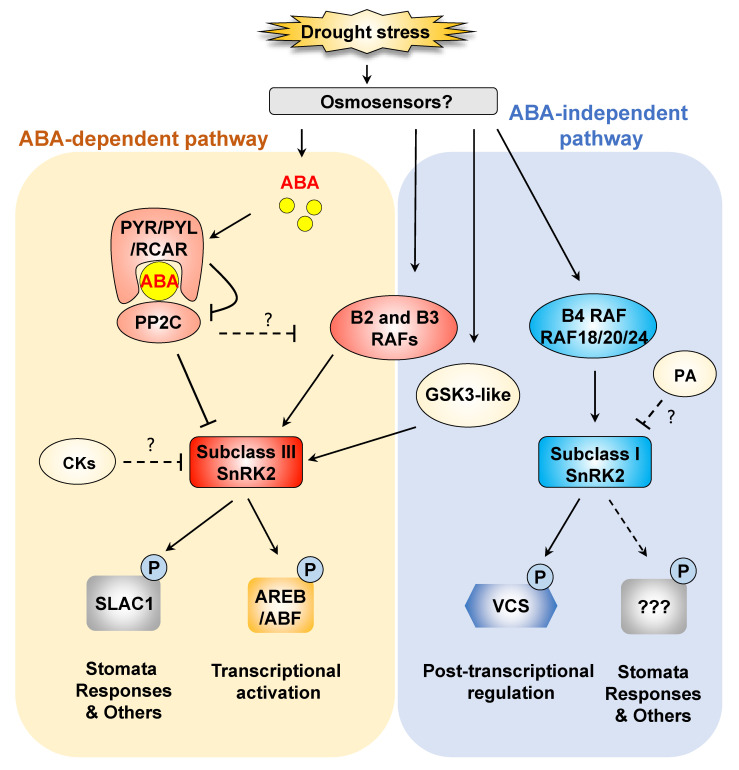
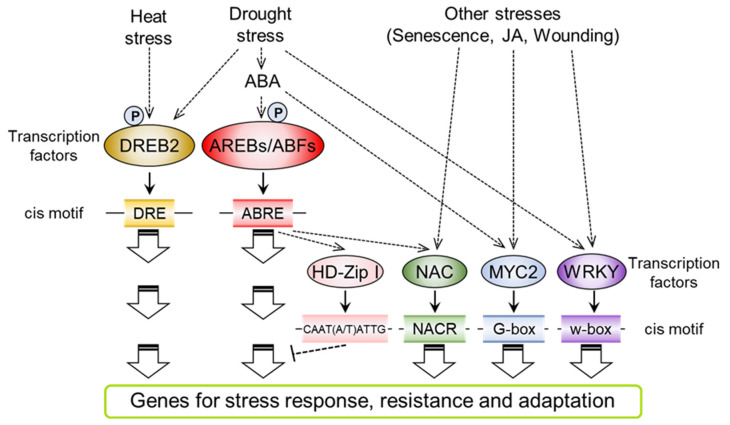
Drought is a severe and complex abiotic stress that negatively affects plant growth and crop yields. Numerous genes with various functions are induced in response to drought stress to acquire drought stress tolerance. The phytohormone abscisic acid (ABA) accumulates mainly in the leaves in response to drought stress and then activates subclass III SNF1-related protein kinases 2 (SnRK2s), which are key phosphoregulators of ABA signaling. ABA mediates a wide variety of gene expression processes through stress-responsive transcription factors, including ABA-RESPONSIVE ELEMENT BINDING PROTEINS (AREBs)/ABRE-BINDING FACTORS (ABFs) and several other transcription factors. Seed plants have another type of SnRK2s, ABA-unresponsive subclass I SnRK2s, that mediates the stability of gene expression through the mRNA decay pathway and plant growth under drought stress in an ABA-independent manner. Recent research has elucidated the upstream regulators of SnRK2s, RAF-like protein kinases, involved in early responses to drought stress. ABA-independent transcriptional regulatory systems and ABA-responsive regulation function in drought-responsive gene expression. DEHYDRATION RESPONSIVE ELEMENT (DRE) is an important cis-acting element in ABA-independent transcription, whereas ABA-RESPONSIVE ELEMENT (ABRE) cis-acting element functions in ABA-responsive transcription. In this review article, we summarize recent advances in research on cellular and molecular drought stress responses and focus on phosphorylation signaling and transcription networks in and crops. We also highlight gene networks of transcriptional regulation through two major regulatory pathways, ABA-dependent and ABA-independent pathways, that ABA-responsive subclass III SnRK2s and ABA-unresponsive subclass I SnRK2s mediate, respectively. We also discuss crosstalk in these regulatory systems under drought stress.
干旱是一种严重且复杂的非生物胁迫,会对植物生长和作物产量产生负面影响。为了获得干旱胁迫耐受性,许多具有不同功能的基因会在干旱胁迫响应中被诱导表达。植物激素脱落酸(ABA)在干旱胁迫下主要在叶片中积累,然后激活III类SNF1相关蛋白激酶2(SnRK2s),它们是ABA信号传导的关键磷酸调节因子。ABA通过应激反应转录因子介导多种基因表达过程,包括ABA反应元件结合蛋白(AREBs)/ABRE结合因子(ABFs)以及其他几种转录因子。种子植物还有另一种类型的SnRK2s,即ABA不敏感的I类SnRK2s,它通过mRNA降解途径介导基因表达的稳定性,并以ABA非依赖的方式调控干旱胁迫下的植物生长。最近的研究阐明了SnRK2s的上游调节因子,即RAF样蛋白激酶,其参与干旱胁迫的早期反应。ABA非依赖的转录调控系统和ABA响应调控在干旱响应基因表达中发挥作用。脱水响应元件(DRE)是ABA非依赖转录中的一个重要顺式作用元件,而ABA响应元件(ABRE)顺式作用元件在ABA响应转录中发挥作用。在这篇综述文章中,我们总结了细胞和分子水平上干旱胁迫响应研究的最新进展,并重点关注植物和作物中的磷酸化信号传导和转录网络。我们还强调了分别由ABA响应的III类SnRK2s和ABA不敏感的I类SnRK2s介导的通过ABA依赖和ABA非依赖两条主要调控途径的转录调控基因网络。我们还讨论了干旱胁迫下这些调控系统中的相互作用。