Nakashima Kazuo, Yamaguchi-Shinozaki Kazuko, Shinozaki Kazuo
Biological Resources and Post-harvest Division, Japan International Research Center for Agricultural Sciences Tsukuba, Japan.
Laboratory of Plant Molecular Physiology, Graduate School of Agricultural and Life Sciences, The University of Tokyo Tokyo, Japan.
Front Plant Sci. 2014 May 16;5:170. doi: 10.3389/fpls.2014.00170. eCollection 2014.
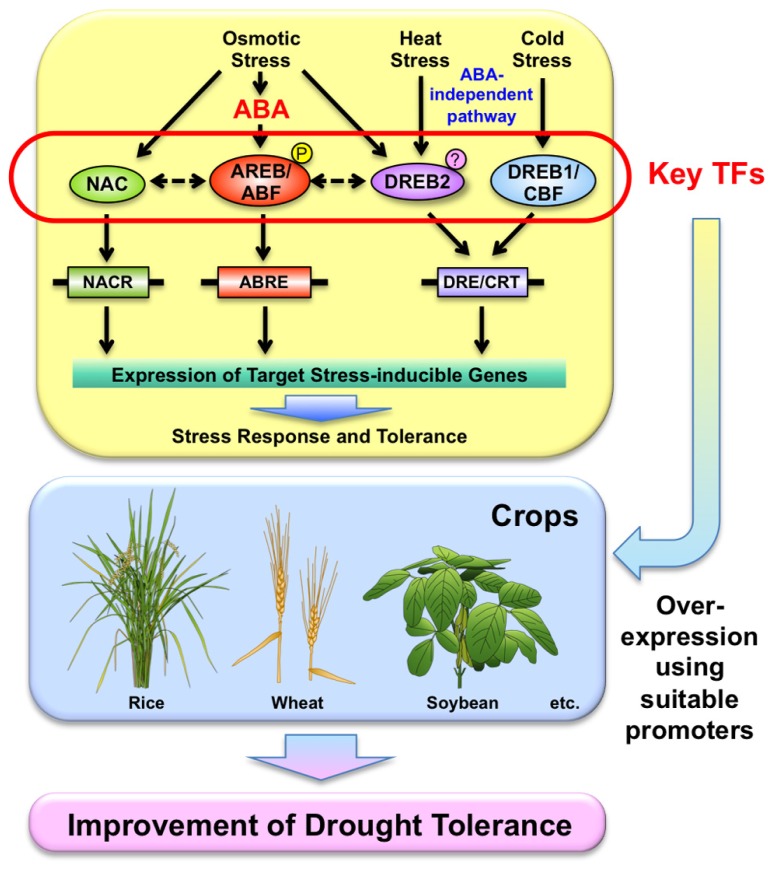
Drought negatively impacts plant growth and the productivity of crops around the world. Understanding the molecular mechanisms in the drought response is important for improvement of drought tolerance using molecular techniques. In plants, abscisic acid (ABA) is accumulated under osmotic stress conditions caused by drought, and has a key role in stress responses and tolerance. Comprehensive molecular analyses have shown that ABA regulates the expression of many genes under osmotic stress conditions, and the ABA-responsive element (ABRE) is the major cis-element for ABA-responsive gene expression. Transcription factors (TFs) are master regulators of gene expression. ABRE-binding protein and ABRE-binding factor TFs control gene expression in an ABA-dependent manner. SNF1-related protein kinases 2, group A 2C-type protein phosphatases, and ABA receptors were shown to control the ABA signaling pathway. ABA-independent signaling pathways such as dehydration-responsive element-binding protein TFs and NAC TFs are also involved in stress responses including drought, heat, and cold. Recent studies have suggested that there are interactions between the major ABA signaling pathway and other signaling factors in stress responses. The important roles of these TFs in crosstalk among abiotic stress responses will be discussed. Control of ABA or stress signaling factor expression can improve tolerance to environmental stresses. Recent studies using crops have shown that stress-specific overexpression of TFs improves drought tolerance and grain yield compared with controls in the field.
干旱对全球植物生长和作物生产力产生负面影响。了解干旱响应中的分子机制对于利用分子技术提高耐旱性至关重要。在植物中,脱落酸(ABA)在干旱引起的渗透胁迫条件下积累,并在胁迫响应和耐受性中起关键作用。全面的分子分析表明,ABA在渗透胁迫条件下调节许多基因的表达,而ABA响应元件(ABRE)是ABA响应基因表达的主要顺式元件。转录因子(TFs)是基因表达的主要调节因子。ABRE结合蛋白和ABRE结合因子TFs以ABA依赖的方式控制基因表达。已证明SNF1相关蛋白激酶2、A组2C型蛋白磷酸酶和ABA受体控制ABA信号通路。脱水响应元件结合蛋白TFs和NAC TFs等非ABA信号通路也参与包括干旱、高温和低温在内的胁迫响应。最近的研究表明,在胁迫响应中,主要的ABA信号通路与其他信号因子之间存在相互作用。将讨论这些TFs在非生物胁迫响应相互作用中的重要作用。控制ABA或胁迫信号因子的表达可以提高对环境胁迫的耐受性。最近对作物的研究表明,与田间对照相比,TFs的胁迫特异性过表达提高了耐旱性和谷物产量。