Department of Oncology, McMaster University, Hamilton, ON L8S 4L8, Canada.
Institute for Clinical Evaluative Sciences, Toronto, ON M4N 3M5, Canada.
Curr Oncol. 2021 Apr 28;28(3):1641-1651. doi: 10.3390/curroncol28030153.
To describe the trajectory of physical symptoms among cancer decedents who were receiving home care in the six months before death.
An observational cohort study of cancer decedents in Ontario, Canada, who received home care services between 2007 and 2014. To be included, decedents had to use at least one home care service in the last six months of life. Outcomes were the presence of pain and several other physical symptoms at each week before death.
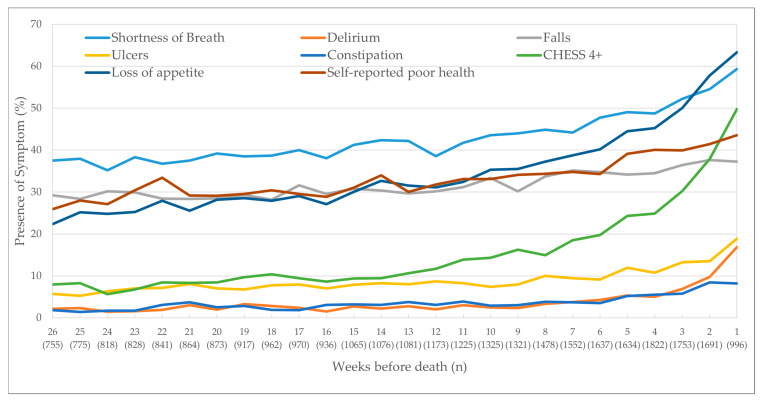
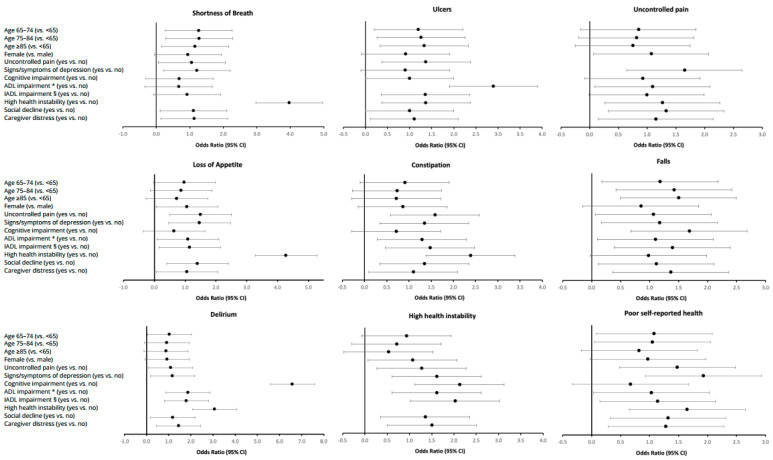
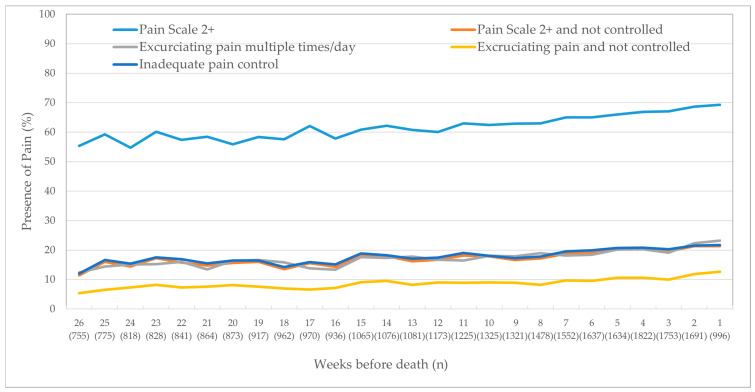
Our cohort included 27,295 cancer decedents (30,368 assessments). Forty-seven percent were female and 56% were age 75 years or older. The prevalence of all physical symptoms increased as one approached death, particularly in the last month of life. In the last weeks of life, 69% of patients reported having moderate-severe pain; however, only 20% reported that the pain was not controlled. Loss of appetite (63%), shortness of breath (59%), high health instability (50%), and self-reported poor health (44%) were also highly prevalent in the last week of life. Multivariate regression showed that caregiver distress, high health instability, social decline, uncontrolled pain, and signs of depression all worsened the odds of having a physical symptom in the last 3 months of life.
In this large home care cancer cohort, trajectories of physical symptoms worsened close to death. While presence of moderate-severe pain was common, it was also reported as mostly controlled. Covariates, such as caregiver distress and social decline, were associated with having more physical symptoms at end of life.
描述在死亡前六个月接受家庭护理的癌症患者的身体症状轨迹。
这是一项在加拿大安大略省进行的观察性队列研究,纳入了 2007 年至 2014 年间接受家庭护理服务的癌症患者。为了纳入研究,患者必须在生命的最后六个月内至少使用一次家庭护理服务。结局是在死亡前的每一周都存在疼痛和其他几种身体症状。
我们的队列包括 27295 名癌症患者(30368 次评估)。47%为女性,56%年龄在 75 岁或以上。随着接近死亡,所有身体症状的患病率都在增加,特别是在生命的最后一个月。在生命的最后几周,69%的患者报告有中重度疼痛;然而,只有 20%的患者报告疼痛未得到控制。食欲丧失(63%)、呼吸急促(59%)、健康不稳定高(50%)和自我报告健康状况差(44%)在生命的最后一周也高度普遍。多变量回归显示,照顾者的困扰、健康不稳定高、社会衰退、疼痛未得到控制以及抑郁的迹象都增加了在生命的最后 3 个月出现身体症状的几率。
在这项大型家庭护理癌症队列研究中,身体症状的轨迹在接近死亡时恶化。虽然中度至重度疼痛的发生率较高,但也有报告称疼痛得到了控制。协变量,如照顾者的困扰和社会衰退,与生命末期出现更多身体症状有关。