CIRI-Centre International de Recherche en Infectiologie, Université de Lyon, Université Claude Bernard Lyon 1, Inserm, U1111, CNRS, UMR5308, ENS Lyon, 46 allée d'Italie, 69007 Lyon, France.
Université de Lyon, VetAgro Sup, 69280 Marcy-l'Étoile, France.
Viruses. 2021 Apr 28;13(5):784. doi: 10.3390/v13050784.
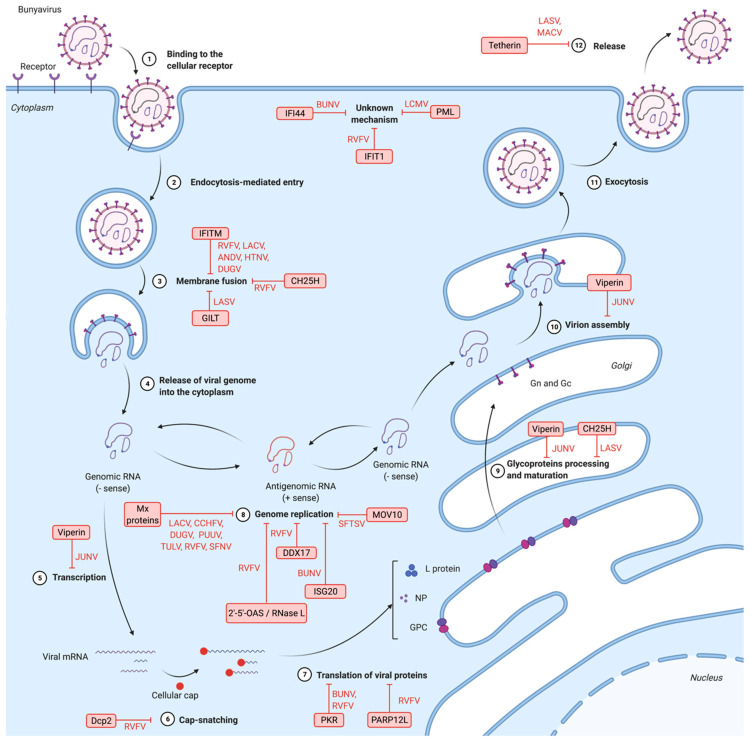
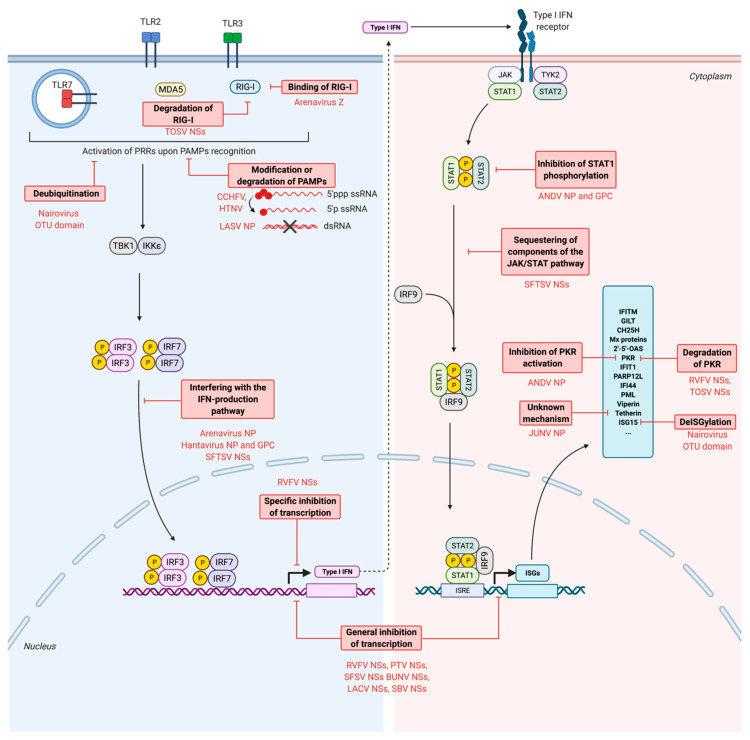
The order comprises more than 500 viruses (generally defined as bunyaviruses) classified into 12 families. Some of these are highly pathogenic viruses infecting different hosts, including humans, mammals, reptiles, arthropods, birds, and/or plants. Host cell sensing of infection activates the innate immune system that aims at inhibiting viral replication and propagation. Upon recognition of pathogen-associated molecular patterns (PAMPs) by cellular pattern recognition receptors (PRRs), numerous signaling cascades are activated, leading to the production of interferons (IFNs). IFNs act in an autocrine and paracrine manner to establish an antiviral state by inducing the expression of hundreds of IFN-stimulated genes (ISGs). Some of these ISGs are known to restrict bunyavirus infection. Along with other constitutively expressed host cellular factors with antiviral activity, these proteins (hereafter referred to as "restriction factors") target different steps of the viral cycle, including viral entry, genome transcription and replication, and virion egress. In reaction to this, bunyaviruses have developed strategies to circumvent this antiviral response, by avoiding cellular recognition of PAMPs, inhibiting IFN production or interfering with the IFN-mediated response. Herein, we review the current knowledge on host cellular factors that were shown to restrict infections by bunyaviruses. Moreover, we focus on the strategies developed by bunyaviruses in order to escape the antiviral state developed by the infected cells.
该订单包含 500 多种病毒(通常定义为布尼亚病毒),分为 12 个科。其中一些是高度致病性病毒,感染不同的宿主,包括人类、哺乳动物、爬行动物、节肢动物、鸟类和/或植物。宿主细胞对感染的感知激活了先天免疫系统,旨在抑制病毒的复制和传播。当细胞模式识别受体(PRR)识别病原体相关分子模式(PAMPs)时,会激活许多信号级联反应,导致干扰素(IFNs)的产生。IFNs 通过诱导数百种干扰素刺激基因(ISGs)的表达,以自分泌和旁分泌的方式发挥作用,建立抗病毒状态。其中一些 ISGs 已知可以限制布尼亚病毒的感染。与其他具有抗病毒活性的组成型表达的宿主细胞因子一起,这些蛋白质(以下简称“限制因子”)针对病毒周期的不同步骤,包括病毒进入、基因组转录和复制以及病毒粒子的出芽。作为对此的反应,布尼亚病毒已经开发出了规避这种抗病毒反应的策略,包括避免细胞对 PAMPs 的识别、抑制 IFN 的产生或干扰 IFN 介导的反应。在此,我们综述了宿主细胞因子的最新知识,这些因子被证明可以限制布尼亚病毒的感染。此外,我们还重点关注了布尼亚病毒为逃避感染细胞建立的抗病毒状态而开发的策略。