Shahhosseini Nariman, Babuadze George Giorgi, Wong Gary, Kobinger Gary P
Département de Microbiologie-Infectiologie et d'Immunologie, Université Laval, Québec City, QC G1V4G2, Canada.
Department of Biological Sciences, Sunnybrook Research Institute, University of Toronto, Toronto, ON M4N3M5, Canada.
Microorganisms. 2021 Apr 26;9(5):926. doi: 10.3390/microorganisms9050926.
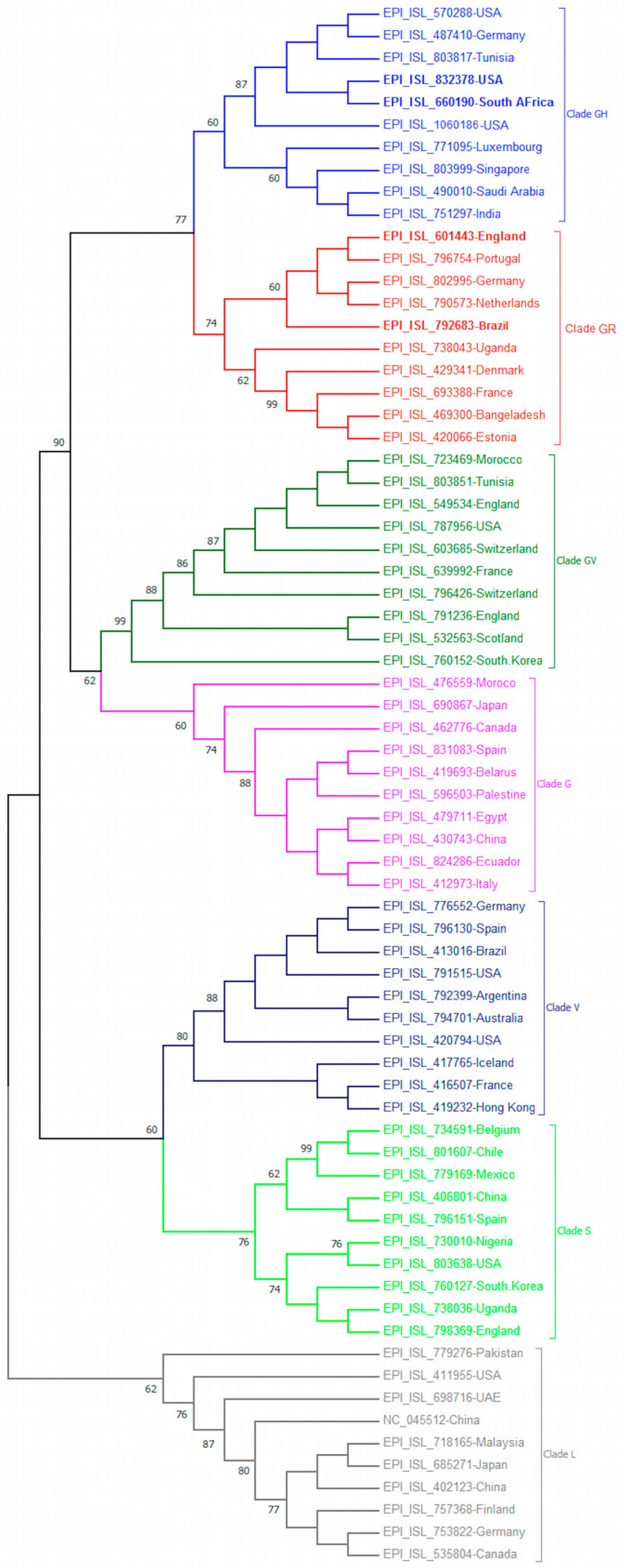
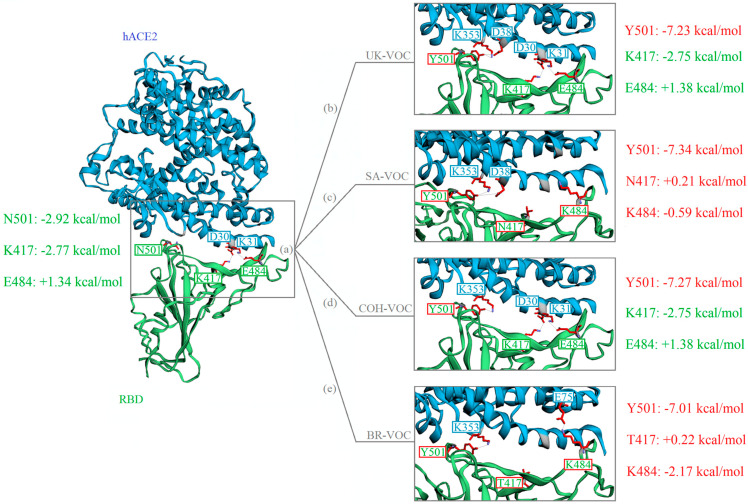
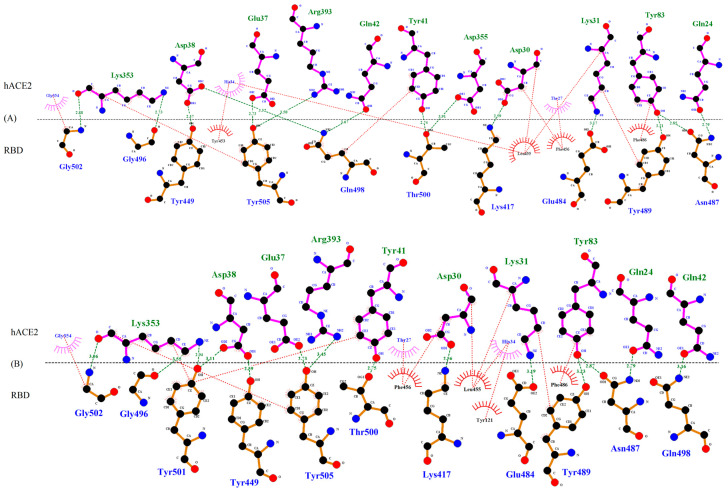
One year since the first severe acute respiratory syndrome coronavirus 2 (SARS-CoV-2) was reported in China, several variants of concern (VOC) have appeared around the world, with some variants seeming to pose a greater thread to public health due to enhanced transmissibility or infectivity. This study provides a framework for molecular characterization of novel VOC and investigates the effect of mutations on the binding affinity of the receptor-binding domain (RBD) to human angiotensin-converting enzyme 2 (hACE2) using in silico approach. Notable nonsynonymous mutations in RBD of VOC include the E484K and K417N/T that can be seen in South African and Brazilian variants, and N501Y and D614G that can be seen in all VOC. Phylogenetic analyses demonstrated that although the UK-VOC and the BR-VOC fell in the clade GR, they have different mutation signatures, implying an independent evolutionary pathway. The same is true about SA-VOC and COH-VOC felling in clade GH, but different mutation signatures. Combining molecular interaction modeling and the free energy of binding (FEB) calculations for VOC, it can be assumed that the mutation N501Y has the highest binding affinity in RBD for all VOC, followed by E484K (only for BR-VOC), which favors the formation of a stable complex. However, mutations at the residue K417N/T are shown to reduce the binding affinity. Once vaccination has started, there will be selective pressure that would be in favor of the emergence of novel variants capable of escaping the immune system. Therefore, genomic surveillance should be enhanced to find and monitor new emerging SARS-CoV-2 variants before they become a public health concern.
自中国首次报告严重急性呼吸综合征冠状病毒2(SARS-CoV-2)以来的一年里,全球出现了几种值得关注的变异株(VOC),其中一些变异株由于传播性或传染性增强,似乎对公众健康构成了更大威胁。本研究提供了一个新型VOC分子特征描述的框架,并使用计算机模拟方法研究了突变对受体结合域(RBD)与人血管紧张素转换酶2(hACE2)结合亲和力的影响。VOC的RBD中值得注意的非同义突变包括在南非和巴西变异株中可见的E484K和K417N/T,以及在所有VOC中都可见的N501Y和D614G。系统发育分析表明,尽管英国变异株(UK-VOC)和巴西变异株(BR-VOC)属于GR分支,但它们具有不同的突变特征,这意味着它们有独立的进化途径。南非变异株(SA-VOC)和哥伦比亚变异株(COH-VOC)属于GH分支也是如此,但突变特征不同。结合VOC的分子相互作用建模和结合自由能(FEB)计算,可以假设突变N501Y在所有VOC的RBD中具有最高的结合亲和力,其次是E484K(仅对BR-VOC),这有利于形成稳定的复合物。然而,K417N/T位点的突变显示会降低结合亲和力。一旦开始接种疫苗,就会产生有利于出现能够逃避免疫系统的新型变异株的选择压力。因此,应加强基因组监测,以便在新出现的SARS-CoV-2变异株成为公共卫生问题之前发现并监测它们。