Institut Pasteur, CNRS UMR3525, 25 rue du Docteur Roux, 75015 Paris, France.
Cells. 2021 Apr 26;10(5):1019. doi: 10.3390/cells10051019.
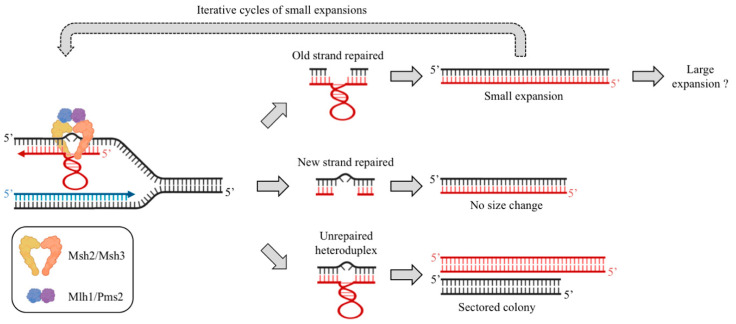
Trinucleotide repeats are a peculiar class of microsatellites whose expansions are responsible for approximately 30 human neurological or developmental disorders. The molecular mechanisms responsible for these expansions in humans are not totally understood, but experiments in model systems such as yeast, transgenic mice, and human cells have brought evidence that the mismatch repair machinery is involved in generating these expansions. The present review summarizes, in the first part, the role of mismatch repair in detecting and fixing the DNA strand slippage occurring during microsatellite replication. In the second part, key molecular differences between normal microsatellites and those that show a bias toward expansions are extensively presented. The effect of mismatch repair mutants on microsatellite expansions is detailed in model systems, and in vitro experiments on mismatched DNA substrates are described. Finally, a model presenting the possible roles of the mismatch repair machinery in microsatellite expansions is proposed.
三核苷酸重复是一类特殊的微卫星,其扩展负责约 30 种人类神经或发育障碍。导致这些扩展的人类分子机制尚未完全理解,但酵母、转基因小鼠和人类细胞等模型系统的实验提供了证据,表明错配修复机制参与了这些扩展的产生。本文综述的第一部分总结了错配修复在检测和修复微卫星复制过程中发生的 DNA 链滑动的作用。第二部分广泛介绍了正常微卫星和表现出扩展偏向性的微卫星之间的关键分子差异。在模型系统中详细描述了错配修复突变体对微卫星扩展的影响,并描述了在错配 DNA 底物上的体外实验。最后,提出了一个模型,提出了错配修复机制在微卫星扩展中的可能作用。