Lebbad Marianne, Winiecka-Krusnell Jadwiga, Stensvold Christen Rune, Beser Jessica
Department of Microbiology, Public Health Agency of Sweden, 171 82 Solna, Sweden.
Department of Bacteria, Parasites and Fungi, Statens Serum Institut, DK-2300 Copenhagen S, Denmark.
Pathogens. 2021 Apr 26;10(5):523. doi: 10.3390/pathogens10050523.
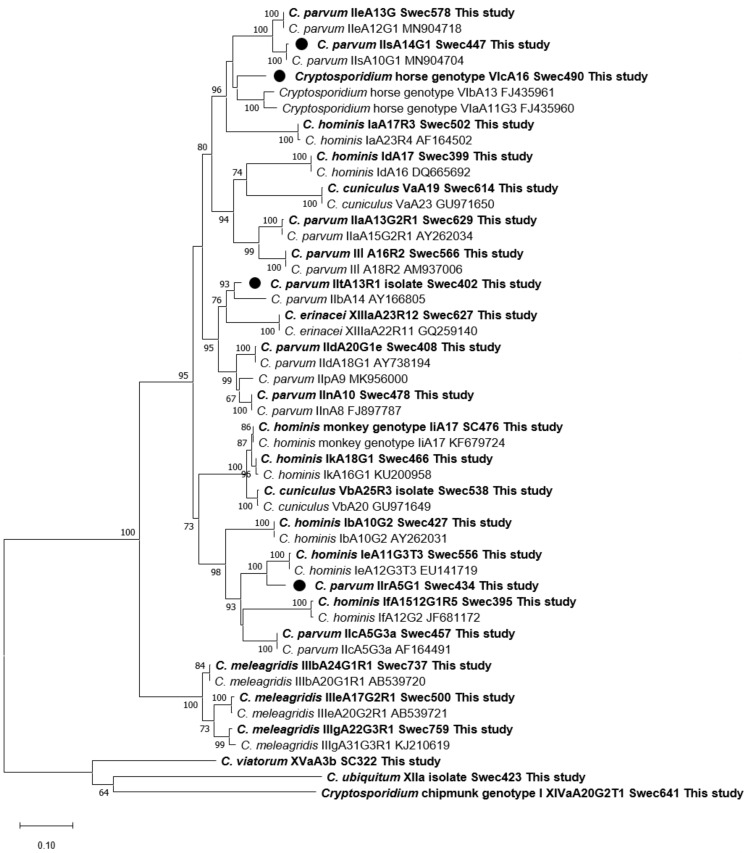
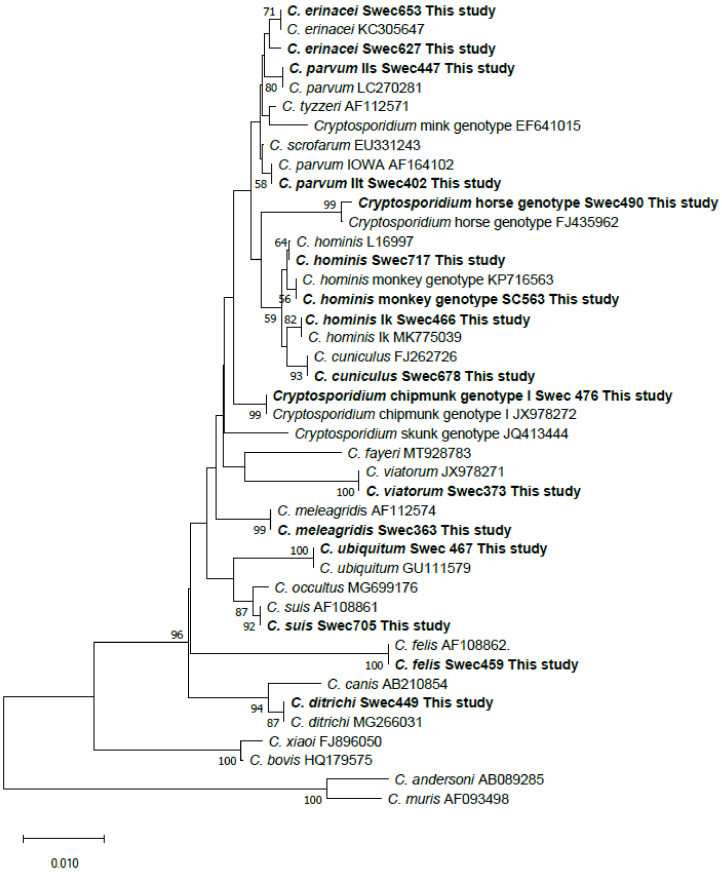
The intestinal protozoan parasite is an important cause of diarrheal disease worldwide. The aim of this study was to expand the knowledge on the molecular epidemiology of human cryptosporidiosis in Sweden to better understand transmission patterns and potential zoonotic sources. -positive fecal samples were collected between January 2013 and December 2014 from 12 regional clinical microbiology laboratories in Sweden. Species and subtype determination was achieved using small subunit ribosomal RNA and 60 kDa glycoprotein gene analysis. Samples were available for 398 patients, of whom 250 (63%) and 138 (35%) had acquired the infection in Sweden and abroad, respectively. Species identification was successful for 95% (379/398) of the samples, revealing 12 species/genotypes: ( = 299), ( = 49), ( = 8), ( = 5), chipmunk genotype I ( = 5), ( = 4), ( = 2), ( = 2), and one each of , , , and horse genotype. One patient was co-infected with and . Subtyping was successful for all species/genotypes, except for , and revealed large diversity, with 29 subtype families (including 4 novel ones: IIr, IIs, IIt, and horse genotype Vic) and 81 different subtypes. The most common subtype families were IIa ( = 164) and IId ( = 118) for and Ib ( = 26) and Ia ( = 12) for . Infections caused by the zoonotic subtype families IIa and IId dominated both in patients infected in Sweden and abroad, while most cases were travel-related. Infections caused by non- and non- species were quite common (8%) and equally represented in cases infected in Sweden and abroad.
肠道原生动物寄生虫是全球腹泻病的一个重要病因。本研究的目的是拓展瑞典人体隐孢子虫病分子流行病学的知识,以更好地了解传播模式和潜在的人畜共患病源。2013年1月至2014年12月期间,从瑞典12个地区临床微生物实验室收集了隐孢子虫阳性粪便样本。通过小亚基核糖体RNA和60 kDa糖蛋白基因分析进行物种和亚型鉴定。共有398例患者的样本可供分析,其中250例(63%)和138例(35%)分别在瑞典和国外感染。95%(379/398)的样本成功进行了物种鉴定,共发现12种/基因型:微小隐孢子虫(n = 299)、人隐孢子虫(n = 49)、牛隐孢子虫(n = 8)、鼠隐孢子虫(n = 5)、花栗鼠基因型I(n = 5)、犬隐孢子虫(n = 4)、猫隐孢子虫(n = 2)、猪隐孢子虫(n = 2),以及鹿隐孢子虫、火鸡隐孢子虫、马基因型隐孢子虫各1例。1例患者同时感染了微小隐孢子虫和人隐孢子虫。除微小隐孢子虫外,所有物种/基因型的亚型分型均成功,显示出高度的多样性,有2个亚型家族(包括4个新的:IIr、IIs、IIt和马基因型Vic)和81种不同的亚型。微小隐孢子虫最常见的亚型家族是IIa(n = 164)和IId(n = 118),人隐孢子虫是Ib(n = 26)和Ia(n = 12)。由人畜共患的微小隐孢子虫亚型家族IIa和IId引起的感染在瑞典和国外感染的患者中均占主导,而大多数人隐孢子虫病例与旅行有关。由非微小隐孢子虫和非人隐孢子虫物种引起的感染相当常见(8%),在瑞典和国外感染的病例中比例相当。