Departamento de Terapia Médica Intensiva, Hospital General de México, Dr. Eduardo Liceaga, Ciudad de México, México; Facultad de Medicine, Universidad Nacional Autónoma de México, Ciudad de México, México.
Laboratorio 103, Sección de Estudios de Posgrado e Investigación, Escuela Superior de Medicina, Instituto Politécnico Nacional, Ciudad de México, México.
Arch Med Res. 2021 Oct;52(7):738-745. doi: 10.1016/j.arcmed.2021.04.001. Epub 2021 Apr 12.
It has been observed that subjects with comorbidities related to metabolic syndrome (MetS) as hypertension, obesity, cardiovascular disease (CVD), and diabetes mellitus (DM2) show severe cases and a higher mortality by COVID-19. To date, there is little information available on the impact of the interaction between these comorbidities in the risk of death by COVID-19.
To evaluate the impact of the combinations of MetS components in overall survival (OS) and risk of death among COVID-19 patients.
Using public data of the Ministry of Health, suspected, and confirmed COVID-19 cases from February 25-June 6, 2020 was analyzed. Mortality odds ratio (OR) was calculated with a univariate analysis (95% CI) and attributable risk. Interactions between components and survival curves were analyzed and a multivariate logistics regression analysis was conducted.
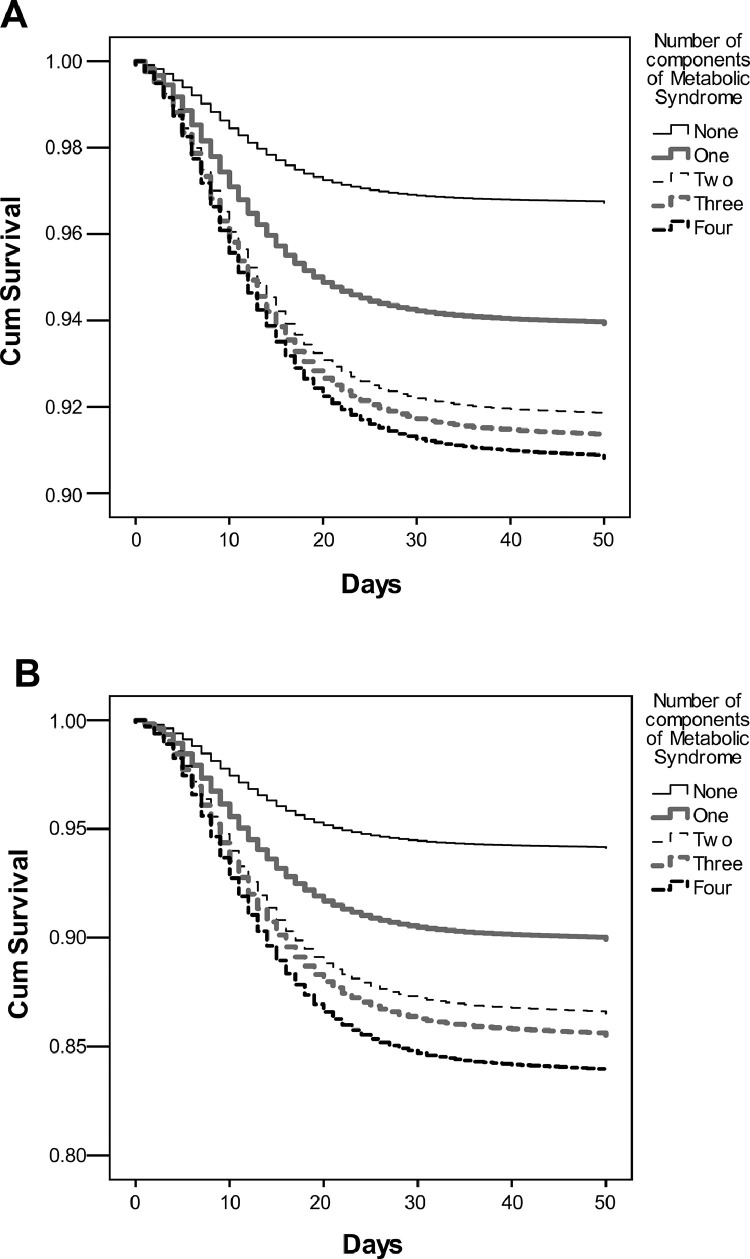
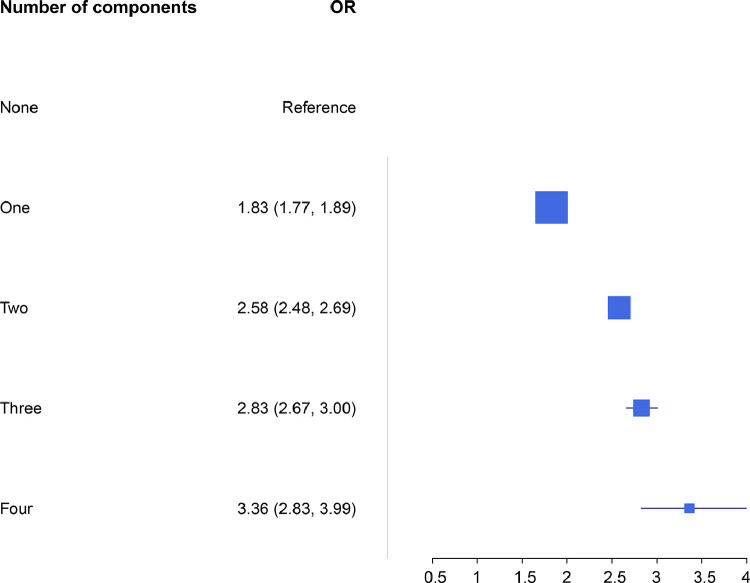
The analysis included 528,651 cases out of which 202,951 were confirmed for COVID-19. Probabilities of OS among confirmed patients were 0.93, 0.89, 0.87, 0.86, and 0.83 while the OR of multivariate analysis was 1.83 (1.77-1.89), 2.58 (2.48-2.69), 2.83 (2.66-3.01), and 3.36 (2.83-3.99) for zero, one, two, three, and four MetS components, respectively. The combination with the highest risk was DM2 + hypertension at 2.22 (2.15-2.28), and the attributable risk for any component was 9.35% (9.21-9.49). Only the combination obesity + CVD showed no significant interaction.
The presence of one MetS component doubles the risk of death by COVID-19, which was higher among patients with DM2 + hypertension. Only obesity and CVD do not interact significantly.
已经观察到患有代谢综合征(MetS)相关合并症的患者,如高血压、肥胖、心血管疾病(CVD)和 2 型糖尿病(DM2),在 COVID-19 方面表现出严重病例和更高的死亡率。迄今为止,关于这些合并症相互作用对 COVID-19 死亡风险的影响,信息很少。
评估 MetS 成分组合对 COVID-19 患者总生存率(OS)和死亡风险的影响。
使用公共卫生部数据,分析了 2020 年 2 月 25 日至 6 月 6 日期间疑似和确诊的 COVID-19 病例。使用单变量分析(95%CI)和归因风险计算死亡率比值比(OR)。分析了成分之间的相互作用和生存曲线,并进行了多变量逻辑回归分析。
分析包括 528651 例病例,其中 202951 例确诊为 COVID-19。确诊患者的 OS 概率分别为 0.93、0.89、0.87、0.86 和 0.83,而多变量分析的 OR 分别为 1.83(1.77-1.89)、2.58(2.48-2.69)、2.83(2.66-3.01)和 3.36(2.83-3.99)对于零、一、二、三和四个 MetS 成分,分别。风险最高的组合是 DM2+高血压,为 2.22(2.15-2.28),任何成分的归因风险为 9.35%(9.21-9.49)。只有肥胖+CVD 的组合没有显著的相互作用。
存在一个 MetS 成分会使 COVID-19 的死亡风险增加一倍,而 DM2+高血压患者的风险更高。只有肥胖和 CVD 没有显著的相互作用。