Centre for Protein Science, Design and Engineering, Department of Biological Sciences, and Department of Chemical Sciences, Indian Institute of Science Education and Research (IISER), Mohali, India.
Research group Translational Structural Biology, German Center for Neurodegenerative Diseases (DZNE), Göttingen, Germany.
Protein Sci. 2021 Jul;30(7):1294-1314. doi: 10.1002/pro.4093. Epub 2021 May 14.
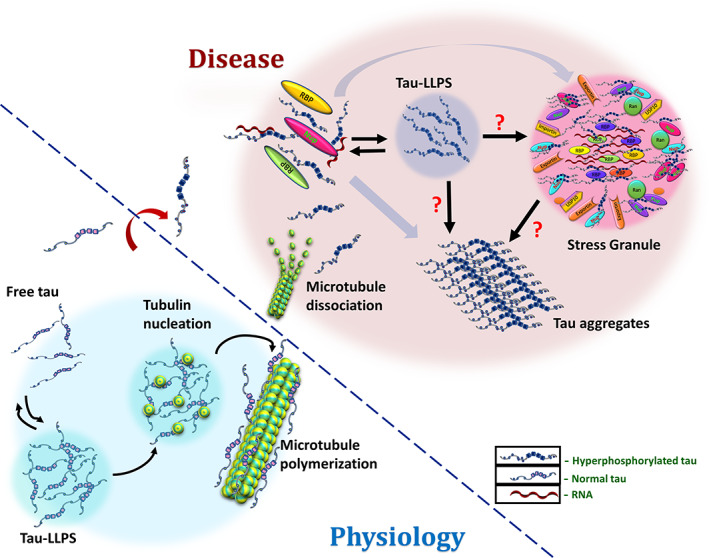
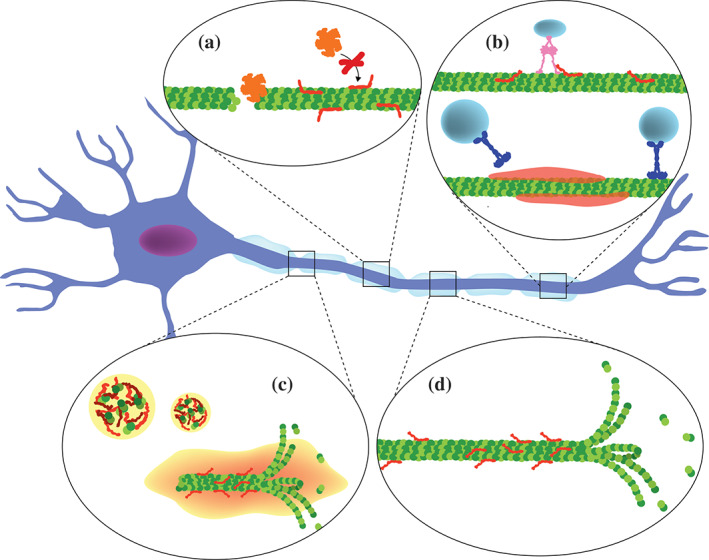
Biomolecular condensation via liquid-liquid phase separation (LLPS) of intrinsically disordered proteins/regions (IDPs/IDRs), with and without nucleic acids, has drawn widespread interest due to the rapidly unfolding role of phase-separated condensates in a diverse range of cellular functions and human diseases. Biomolecular condensates form via transient and multivalent intermolecular forces that sequester proteins and nucleic acids into liquid-like membrane-less compartments. However, aberrant phase transitions into gel-like or solid-like aggregates might play an important role in neurodegenerative and other diseases. Tau, a microtubule-associated neuronal IDP, is involved in microtubule stabilization, regulates axonal outgrowth and transport in neurons. A growing body of evidence indicates that tau can accomplish some of its cellular activities via LLPS. However, liquid-to-solid transition resulting in the abnormal aggregation of tau is associated with neurodegenerative diseases. The physical chemistry of tau is crucial for governing its propensity for biomolecular condensation which is governed by various intermolecular and intramolecular interactions leading to simple one-component and complex multi-component condensates. In this review, we aim at capturing the current scientific state in unveiling the intriguing molecular mechanism of phase separation of tau. We particularly focus on the amalgamation of existing and emerging biophysical tools that offer unique spatiotemporal resolutions on a wide range of length- and time-scales. We also discuss the link between quantitative biophysical measurements and novel biological insights into biomolecular condensation of tau. We believe that this account will provide a broad and multidisciplinary view of phase separation of tau and its association with physiology and disease.
生物分子通过无序蛋白质/区域(IDPs/IDRs)的液-液相分离(LLPS)凝聚,有或没有核酸,由于相分离凝聚物在广泛的细胞功能和人类疾病中的快速展开作用而引起了广泛关注。生物分子凝聚物通过瞬态和多价分子间力形成,将蛋白质和核酸隔离到类似液体的无膜隔室中。然而,异常的凝胶或固态相转变可能在神经退行性疾病和其他疾病中发挥重要作用。Tau 是一种微管相关的神经元 IDP,参与微管稳定,调节神经元中的轴突生长和运输。越来越多的证据表明,Tau 可以通过 LLPS 完成其一些细胞活性。然而,导致 Tau 异常聚集的液-固转变与神经退行性疾病有关。Tau 的物理化学性质对于控制其生物分子凝聚倾向至关重要,这由各种分子间和分子内相互作用控制,导致简单的单组分和复杂的多组分凝聚物。在这篇综述中,我们旨在揭示 Tau 相分离的迷人分子机制,捕捉当前的科学状态。我们特别关注现有和新兴生物物理工具的融合,这些工具在广泛的长度和时间尺度上提供独特的时空分辨率。我们还讨论了定量生物物理测量与 Tau 生物分子凝聚的新生物学见解之间的联系。我们相信,这一描述将提供 Tau 相分离及其与生理学和疾病关联的广泛和多学科的观点。