Calabrese Edward J, Kozumbo Walter J, Kapoor Rachna, Dhawan Gaurav, Lara Pedro C, Giordano James
Department of Environmental Health Sciences, Amherst, USA.
7 West Melrose Avenue, Baltimore, USA.
Radiother Oncol. 2021 Jul;160:125-131. doi: 10.1016/j.radonc.2021.04.015. Epub 2021 Apr 28.
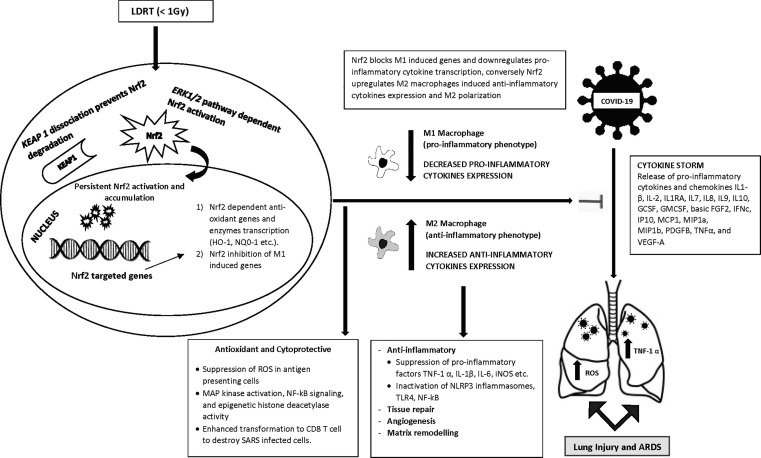
Novel mechanistic insights are discussed herein that link a single, nontoxic, low-dose radiotherapy (LDRT) treatment (0.5-1.0 Gy) to (1) beneficial subcellular effects mediated by the activation of nuclear factor erythroid 2-related transcription factor (Nrf2) and to (2) favorable clinical outcomes for COVID-19 pneumonia patients displaying symptoms of acute respiratory distress syndrome (ARDS). We posit that the favorable clinical outcomes following LDRT result from potent Nrf2-mediated antioxidant responses that rebalance the oxidatively skewed redox states of immunological cells, driving them toward anti-inflammatory phenotypes. Activation of Nrf2 by ionizing radiation is highly dose dependent and conforms to the features of a biphasic (hormetic) dose-response. At the cellular and subcellular levels, hormetic doses of <1.0 Gy induce polarization shifts in the predominant population of lung macrophages, from an M1 pro-inflammatory to an M2 anti-inflammatory phenotype. Together, the Nrf2-mediated antioxidant responses and the subsequent shifts to anti-inflammatory phenotypes have the capacity to suppress cytokine storms, resolve inflammation, promote tissue repair, and prevent COVID-19-related mortality. Given these mechanistic considerations-and the historical clinical success of LDRT early in the 20th century-we opine that LDRT should be regarded as safe and effective for use at almost any stage of COVID-19 infection. In theory, however, optimal life-saving potential is thought to occur when LDRT is applied prior to the cytokine storms and before the patients are placed on mechanical oxygen ventilators. The administration of LDRT either as an intervention of last resort or too early in the disease progression may be far less effective in saving the lives of ARDS patients.
本文讨论了一些新的机制见解,这些见解将单次无毒低剂量放疗(LDRT,0.5 - 1.0 Gy)与以下两点联系起来:(1)由核因子红细胞2相关转录因子(Nrf2)激活介导的有益亚细胞效应;(2)对表现出急性呼吸窘迫综合征(ARDS)症状的COVID - 19肺炎患者的良好临床结局。我们认为,LDRT后的良好临床结局源于强大的Nrf2介导的抗氧化反应,该反应可重新平衡免疫细胞氧化失衡的氧化还原状态,促使它们向抗炎表型转变。电离辐射对Nrf2的激活具有高度剂量依赖性,符合双相( hormetic)剂量反应的特征。在细胞和亚细胞水平上,小于1.0 Gy的hormetic剂量会诱导肺巨噬细胞主要群体的极化转变,从M1促炎表型转变为M2抗炎表型。总之,Nrf2介导的抗氧化反应以及随后向抗炎表型的转变有能力抑制细胞因子风暴、消除炎症、促进组织修复并预防COVID - 19相关的死亡。考虑到这些机制因素以及20世纪早期LDRT在临床上的历史成功,我们认为LDRT在COVID - 19感染的几乎任何阶段使用都应被视为安全有效的。然而,从理论上讲,当在细胞因子风暴之前且患者尚未使用机械氧气呼吸机之前应用LDRT时,其挽救生命的潜力被认为是最佳的。在疾病进展过程中,将LDRT作为最后手段进行干预或过早应用,在挽救ARDS患者生命方面可能效果要差得多。