Frankfurt Reference Centre for Rare Diseases, University Hospital Frankfurt, Goethe University Frankfurt, Theodor-Stern-Kai 7, 60590, Frankfurt am Main, Germany.
Medical Clinic II, University Hospital Gießen and Marburg, Klinikstraße 33, 35392, Gießen, Germany.
Orphanet J Rare Dis. 2021 May 1;16(1):198. doi: 10.1186/s13023-021-01831-3.
About 30 million people in the EU and USA, respectively, suffer from a rare disease. Driven by European legislative requirements, national strategies for the improvement of care in rare diseases are being developed. To improve timely and correct diagnosis for patients with rare diseases, the development of a registry for undiagnosed patients was recommended by the German National Action Plan. In this paper we focus on the question on how such a registry for undiagnosed patients can be built and which information it should contain.
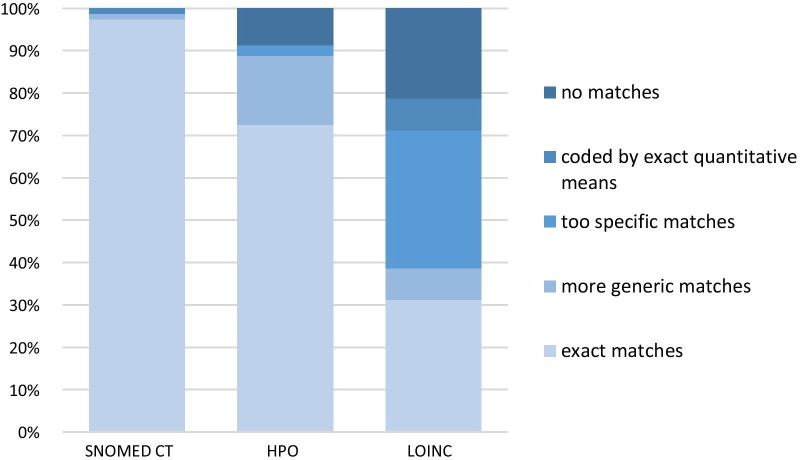
To develop a registry for undiagnosed patients, a software for data acquisition and storage, an appropriate data set and an applicable terminology/classification system for the data collected are needed. We have used the open-source software Open-Source Registry System for Rare Diseases (OSSE) to build the registry for undiagnosed patients. Our data set is based on the minimal data set for rare disease patient registries recommended by the European Rare Disease Registries Platform. We extended this Common Data Set to also include symptoms, clinical findings and other diagnoses. In order to ensure findability, comparability and statistical analysis, symptoms, clinical findings and diagnoses have to be encoded. We evaluated three medical ontologies (SNOMED CT, HPO and LOINC) for their usefulness. With exact matches of 98% of tested medical terms, a mean number of five deposited synonyms, SNOMED CT seemed to fit our needs best. HPO and LOINC provided 73% and 31% of exacts matches of clinical terms respectively. Allowing more generic codes for a defined symptom, with SNOMED CT 99%, with HPO 89% and with LOINC 39% of terms could be encoded.
With the use of the OSSE software and a data set, which, in addition to the Common Data Set, focuses on symptoms and clinical findings, a functioning and meaningful registry for undiagnosed patients can be implemented. The next step is the implementation of the registry in centres for rare diseases. With the help of medical informatics and big data analysis, case similarity analyses could be realized and aid as a decision-support tool enabling diagnosis of some undiagnosed patients.
欧盟和美国分别约有 3000 万人患有罕见病。在欧洲立法要求的推动下,各国正在制定改善罕见病护理的战略。为了改善罕见病患者的及时和正确诊断,德国国家行动计划建议为未确诊患者开发一个登记处。在本文中,我们专注于如何建立这样一个未确诊患者登记处,以及它应该包含哪些信息。
为了开发一个未确诊患者的登记处,需要一个用于数据采集和存储的软件、一个适当的数据集以及一个适用于收集数据的术语/分类系统。我们使用开源软件 Open-Source Registry System for Rare Diseases (OSSE) 来构建未确诊患者的登记处。我们的数据集中基于欧洲罕见病登记平台推荐的罕见病患者登记处最小数据集。我们扩展了这个通用数据集,还包括症状、临床发现和其他诊断。为了确保可查找性、可比性和统计分析,症状、临床发现和诊断必须进行编码。我们评估了三个医学本体(SNOMED CT、HPO 和 LOINC)在其有用性方面的表现。使用测试医学术语的 98%的精确匹配,平均有五个存储同义词,SNOMED CT 似乎最符合我们的需求。HPO 和 LOINC 分别提供了 73%和 31%的临床术语精确匹配。允许为定义的症状使用更通用的代码,SNOMED CT 为 99%,HPO 为 89%,LOINC 为 39%的术语可以进行编码。
使用 OSSE 软件和一个数据集,除了通用数据集外,还侧重于症状和临床发现,可以实现一个功能齐全且有意义的未确诊患者登记处。下一步是在罕见病中心实施该登记处。借助医学信息学和大数据分析,可以实现病例相似性分析,并作为决策支持工具,帮助诊断一些未确诊患者。