C2N Diagnostics, 20 S Sarah Street, St. Louis, MO, 63108, USA.
Department of Neurology, Hope Center for Neurological Disorders, Knight Alzheimer's Disease Research Center, Washington University School of Medicine, St. Louis, MO, 63110, USA.
Mol Neurodegener. 2021 May 1;16(1):30. doi: 10.1186/s13024-021-00451-6.
The development of blood-based biomarker tests that are accurate and robust for Alzheimer's disease (AD) pathology have the potential to aid clinical diagnosis and facilitate enrollment in AD drug trials. We developed a high-resolution mass spectrometry (MS)-based test that quantifies plasma Aβ42 and Aβ40 concentrations and identifies the ApoE proteotype. We evaluated robustness, clinical performance, and commercial viability of this MS biomarker assay for distinguishing brain amyloid status.
We used the novel MS assay to analyze 414 plasma samples that were collected, processed, and stored using site-specific protocols, from six independent US cohorts. We used receiver operating characteristic curve (ROC) analyses to assess assay performance and accuracy for predicting amyloid status (positive, negative, and standard uptake value ratio; SUVR). After plasma analysis, sites shared brain amyloid status, defined using diverse, site-specific methods and cutoff values; amyloid PET imaging using various tracers or CSF Aβ42/40 ratio.
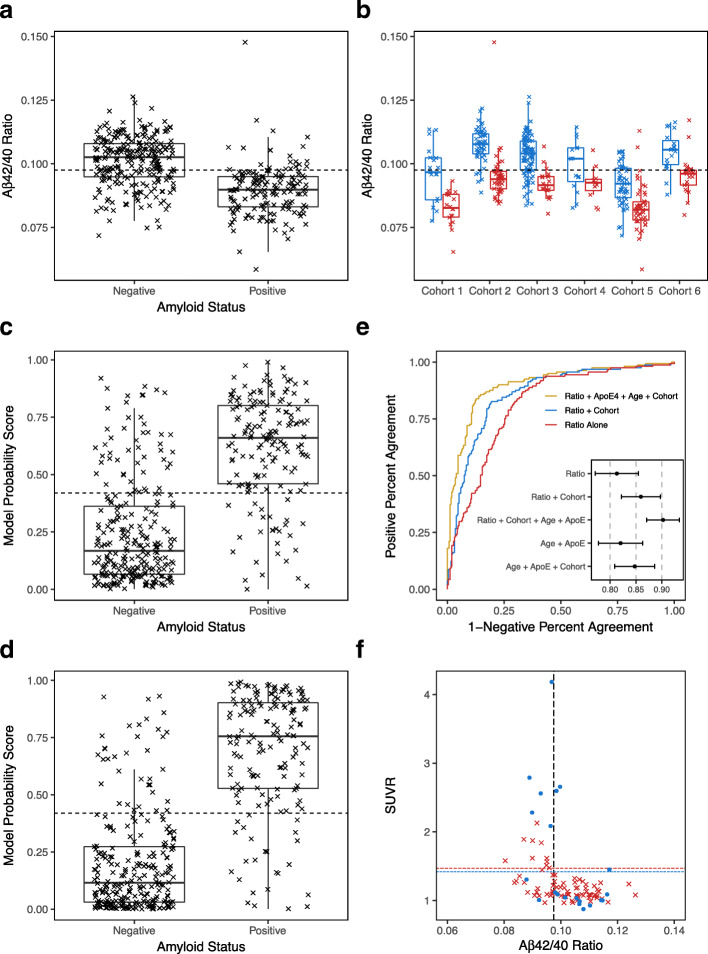
Plasma Aβ42/40 ratio was significantly (p < 0.001) lower in the amyloid positive vs. negative participants in each cohort. The area under the ROC curve (AUC-ROC) was 0.81 (95% CI = 0.77-0.85) and the percent agreement between plasma Aβ42/40 and amyloid positivity was 75% at the optimal (Youden index) cutoff value. The AUC-ROC (0.86; 95% CI = 0.82-0.90) and accuracy (81%) for the plasma Aβ42/40 ratio improved after controlling for cohort heterogeneity. The AUC-ROC (0.90; 95% CI = 0.87-0.93) and accuracy (86%) improved further when Aβ42/40, ApoE4 copy number and participant age were included in the model.
This mass spectrometry-based plasma biomarker test: has strong diagnostic performance; can accurately distinguish brain amyloid positive from amyloid negative individuals; may aid in the diagnostic evaluation process for Alzheimer's disease; and may enhance the efficiency of enrolling participants into Alzheimer's disease drug trials.
开发能够准确、稳健地检测阿尔茨海默病(AD)病理的基于血液的生物标志物测试,具有辅助临床诊断和促进 AD 药物试验入组的潜力。我们开发了一种基于高分辨率质谱(MS)的测试方法,该方法可定量测定血浆 Aβ42 和 Aβ40 浓度,并确定 ApoE 表型。我们评估了该 MS 生物标志物分析用于区分脑淀粉样蛋白状态的稳健性、临床性能和商业可行性。
我们使用新的 MS 分析方法分析了 414 个血浆样本,这些样本是使用特定地点的方案收集、处理和储存的,来自六个独立的美国队列。我们使用接受者操作特征曲线(ROC)分析来评估用于预测淀粉样蛋白状态(阳性、阴性和标准摄取比值;SUVR)的分析性能和准确性。在进行血浆分析后,各站点根据不同的、特定于站点的方法和截止值共享脑淀粉样蛋白状态;使用各种示踪剂或 CSF Aβ42/40 比值进行淀粉样 PET 成像。
与每个队列中的阴性参与者相比,淀粉样阳性参与者的血浆 Aβ42/40 比值显著(p<0.001)较低。ROC 曲线下面积(AUC-ROC)为 0.81(95%CI=0.77-0.85),在最佳(Youden 指数)截止值时,血浆 Aβ42/40 与淀粉样阳性之间的符合率为 75%。控制队列异质性后,血浆 Aβ42/40 比值的 AUC-ROC(0.86;95%CI=0.82-0.90)和准确性(81%)有所提高。当将 Aβ42/40、ApoE4 拷贝数和参与者年龄纳入模型时,AUC-ROC(0.90;95%CI=0.87-0.93)和准确性(86%)进一步提高。
这种基于质谱的血浆生物标志物测试具有以下特点:具有较强的诊断性能;能够准确区分脑淀粉样蛋白阳性与阴性个体;可能有助于阿尔茨海默病的诊断评估过程;并可能提高阿尔茨海默病药物试验的入组效率。