Novo Nordisk Foundation Center for Protein Research, Proteomics Program, Faculty of Health and Medical Sciences, University of Copenhagen, Copenhagen, Denmark.
Evosep Systems, Odense, Denmark.
Nat Commun. 2021 Dec 7;12(1):7113. doi: 10.1038/s41467-021-27398-y.
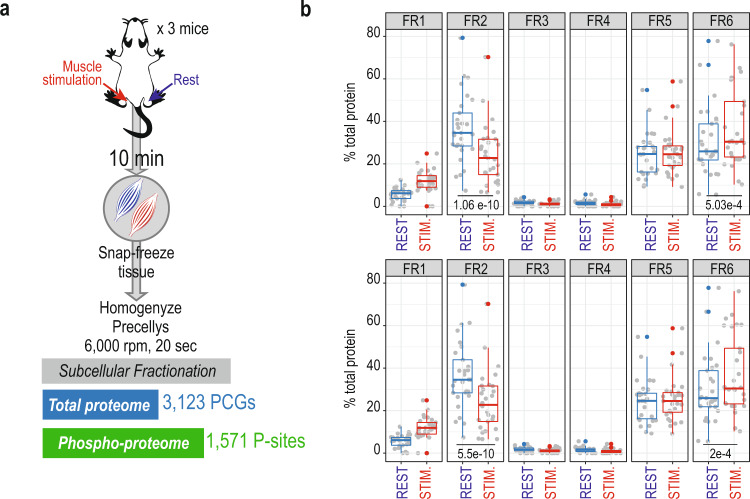
Dynamic change in subcellular localization of signaling proteins is a general concept that eukaryotic cells evolved for eliciting a coordinated response to stimuli. Mass spectrometry-based proteomics in combination with subcellular fractionation can provide comprehensive maps of spatio-temporal regulation of protein networks in cells, but involves laborious workflows that does not cover the phospho-proteome level. Here we present a high-throughput workflow based on sequential cell fractionation to profile the global proteome and phospho-proteome dynamics across six distinct subcellular fractions. We benchmark the workflow by studying spatio-temporal EGFR phospho-signaling dynamics in vitro in HeLa cells and in vivo in mouse tissues. Finally, we investigate the spatio-temporal stress signaling, revealing cellular relocation of ribosomal proteins in response to hypertonicity and muscle contraction. Proteomics data generated in this study can be explored through https://SpatialProteoDynamics.github.io .
信号蛋白亚细胞定位的动态变化是真核细胞进化出的一种普遍概念,用于对刺激做出协调反应。基于质谱的蛋白质组学与亚细胞分级分离相结合,可以提供细胞内蛋白质网络时空调节的综合图谱,但涉及到繁琐的工作流程,无法涵盖磷酸化蛋白质组水平。在这里,我们提出了一种基于顺序细胞分级分离的高通量工作流程,用于分析六个不同亚细胞部分的全局蛋白质组和磷酸化蛋白质组动态。我们通过在体外 HeLa 细胞和体内小鼠组织中研究时空 EGFR 磷酸化信号动力学来对该工作流程进行基准测试。最后,我们研究了时空应激信号,揭示了核糖体蛋白在应对高渗和肌肉收缩时的细胞重定位。通过 https://SpatialProteoDynamics.github.io 可以探索本研究中生成的蛋白质组学数据。