Shanghai Municipal Hospital of Traditional Chinese Medicine, Shanghai University of Traditional Chinese Medicine, Shanghai, China.
Shanghai Medical College, Fudan University, Shanghai, China.
J Alzheimers Dis. 2021;81(4):1391-1401. doi: 10.3233/JAD-201353.
Acupuncture has been used for treating vascular cognitive impairment, but evidence for its effectiveness remains limited.
This single-center, patient-accessor blinded, randomized controlled trial was designed to assess whether acupuncture could improve the cognitive function of patients with vascular cognitive impairment with no dementia (VCIND).
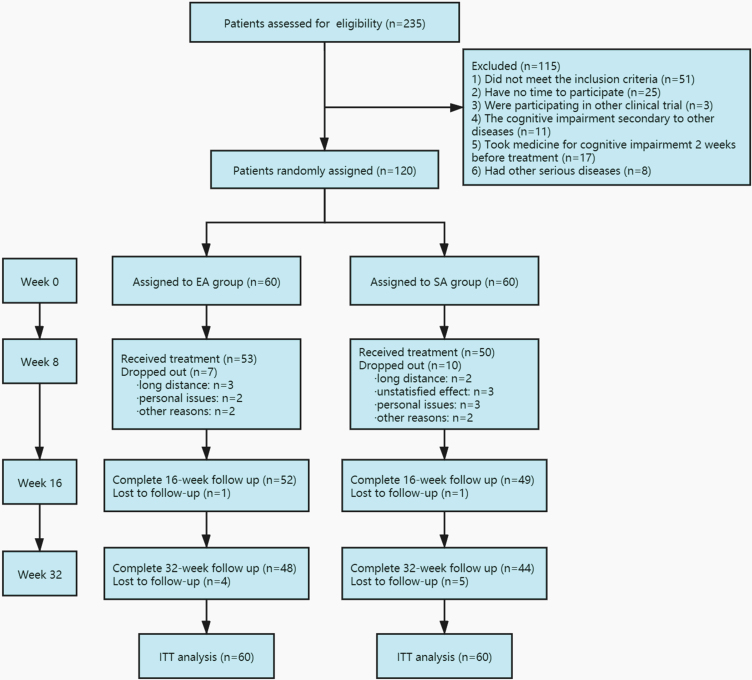
120 VCIND patients were randomly assigned to the electro-acupuncture (EA) or sham acupuncture (SA) group at a 1 : 1 ratio, with treatment conducted thrice weekly for 8 weeks. The primary outcome was the changes of cognitive function measured by the Montreal Cognitive Assessment (MoCA) from baseline to week 8. The secondary outcomes included the scores of the Mini-Mental State Examination (MMSE), the Modified Barthel Index (MBI) and the Self-rating Depression Scale (SDS). Follow-up assessments were performed with MoCA and MMSE at week 16 and 32. Linear mixed-effects models were used for analysis and all statistical tests were two-sided.
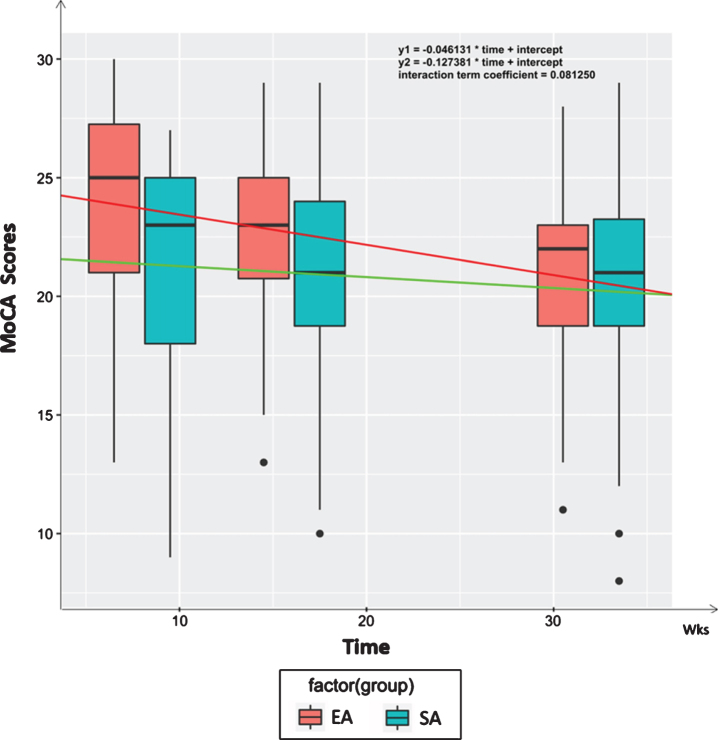
The results showed that patients in the EA group had a significantly greater improvement in MoCA score (23.85±4.18) than those in the SA group (21.48±4.44) at week 8 (95% CI = 0.80, 3.92, p = 0.04), as well as higher MoCA scores over time (p < 0.001 for interaction). Patients who received EA showed a greater increase in MMSE scores (26.41±3.47) than those who received SA (24.40±3.85) along 8 weeks (95% CI = 0.69, 3.34, p = 0.004). However, results diminished over time. No serious adverse events occurred during the trial.
EA is a safe and effective technique to improve cognition over the short term of 8 weeks in VCIND patients.
针灸已被用于治疗血管性认知障碍,但疗效证据仍然有限。
本单中心、患者设盲、随机对照试验旨在评估针刺是否能改善无痴呆的血管性认知障碍(VCIND)患者的认知功能。
将 120 例 VCIND 患者以 1∶1 的比例随机分为电针(EA)组或假针(SA)组,每周治疗 3 次,共 8 周。主要结局是从基线到第 8 周时认知功能的变化,采用蒙特利尔认知评估(MoCA)进行评估。次要结局包括简易精神状态检查(MMSE)、改良巴氏指数(MBI)和自评抑郁量表(SDS)评分。在第 16 周和第 32 周进行 MoCA 和 MMSE 的随访评估。采用线性混合效应模型进行分析,所有统计检验均为双侧。
结果显示,在第 8 周时,EA 组的 MoCA 评分(23.85±4.18)显著高于 SA 组(21.48±4.44)(95%CI:0.80,3.92,p=0.04),并且在整个研究期间 MoCA 评分更高(p 交互<0.001)。接受 EA 的患者的 MMSE 评分(26.41±3.47)在 8 周内的增加显著高于接受 SA 的患者(24.40±3.85)(95%CI:0.69,3.34,p=0.004)。然而,结果随时间而减弱。试验过程中未发生严重不良事件。
EA 是一种安全有效的技术,可在 8 周内短期改善 VCIND 患者的认知功能。