Kim Jung Eun, Kim Hye Ran, Kang Seok Young, Jung Min Je, Heo Nam Hun, Lee Hyun Ju, Ryu Aeli, Kim Hye One, Park Chun Wook, Chung Bo Young
Department of Dermatology, Soonchunhyang University Cheonan Hospital, Soonchunhyang University College of Medicine, Cheonan, Korea.
Department of Dermatology, Kangnam Sacred Heart Hospital, College of Medicine, Hallym University, Seoul, Korea.
Ann Dermatol. 2021 Apr;33(2):138-146. doi: 10.5021/ad.2021.33.2.138. Epub 2021 Mar 8.
The aryl hydrocarbon receptor (AHR) and autophagy are both important to maintain skin homeostasis. However, they are also involved in skin disorders. So far, their roles in psoriasis pathogenesis are unknown.
We studied the immunohistochemical and gene expression of AHR, CYP1A1, and microtubule-associated protein light chain 3 (LC3) in lesional skin of psoriasis patients to determine correlations among them.
We included 24 psoriasis patients and ten healthy volunteers. Skin biopsies were collected. AHR, CYP1A1, and LC3 protein expression was examined by immunohistochemistry, immunofluorescence, and western blotting. , , , , and mRNA levels were measured by quantitative polymerase chain reaction.
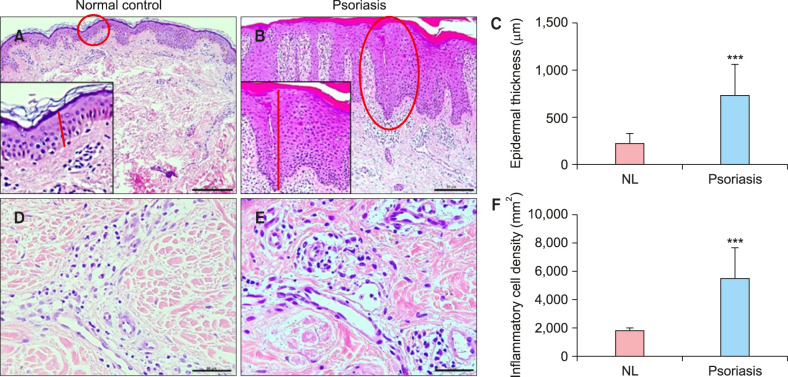
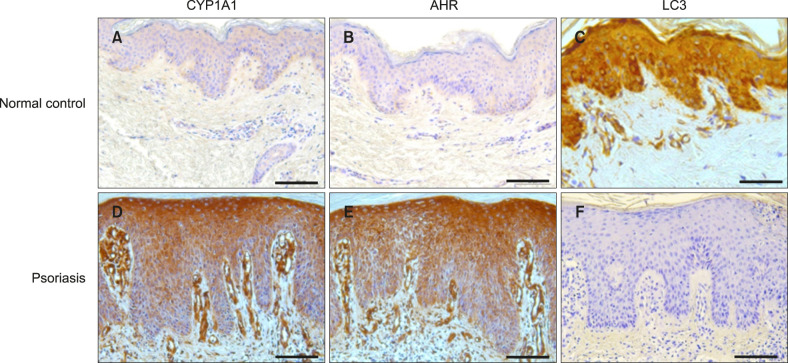
AHR and CYP1A1 protein expression were higher in psoriasis lesional skin than in normal skin. LC3 protein expression was lower in psoriasis lesions than in normal controls. AHR and CYP1A1 protein expression in psoriasis lesions showed significant positive correlations with mean epidermal thickness and inflammatory cell density. Significant negative correlations were noted between LC3 protein expression in psoriasis lesions and the mean epidermal thickness or inflammatory cell density. A significant negative correlation was found between AHR and LC3 expression in psoriatic skin. AHR, CYP1A1 and Nrf2 mRNA expression were upregulated while LC3, ATG5, and BECN1 mRNA were down-regulated, in psoriatic lesional skin compared with normal controls.
AHR and autophagy could play a role in psoriasis pathogenesis by modifying epidermal hyperproliferation and inflammation. AHR and autophagy regulation are potential therapeutic targets in chronic inflammatory skin diseases.
芳烃受体(AHR)和自噬对于维持皮肤稳态均很重要。然而,它们也与皮肤疾病有关。迄今为止,它们在银屑病发病机制中的作用尚不清楚。
我们研究了银屑病患者皮损中AHR、CYP1A1和微管相关蛋白轻链3(LC3)的免疫组化及基因表达,以确定它们之间的相关性。
我们纳入了24例银屑病患者和10名健康志愿者。采集皮肤活检样本。通过免疫组化、免疫荧光和蛋白质印迹法检测AHR、CYP1A1和LC3蛋白表达。通过定量聚合酶链反应测量……、……、……、……、……和……的mRNA水平。
银屑病皮损中AHR和CYP1A1蛋白表达高于正常皮肤。银屑病皮损中LC3蛋白表达低于正常对照。银屑病皮损中AHR和CYP1A1蛋白表达与平均表皮厚度和炎症细胞密度呈显著正相关。银屑病皮损中LC3蛋白表达与平均表皮厚度或炎症细胞密度之间存在显著负相关。银屑病皮肤中AHR与LC3表达之间存在显著负相关。与正常对照相比,银屑病皮损中AHR、CYP1A1和Nrf2 mRNA表达上调,而LC3、ATG5和BECN1 mRNA下调。
AHR和自噬可能通过改变表皮过度增殖和炎症在银屑病发病机制中发挥作用。AHR和自噬调节是慢性炎症性皮肤病潜在的治疗靶点。