Viegas Filipe O, Neuhauss Stephan C F
Department of Molecular Life Sciences, University of Zurich, Zurich, Switzerland.
Life Science Zurich Graduate School, Ph.D. Program in Molecular Life Sciences, Zurich, Switzerland.
Front Mol Neurosci. 2021 Apr 15;14:656000. doi: 10.3389/fnmol.2021.656000. eCollection 2021.
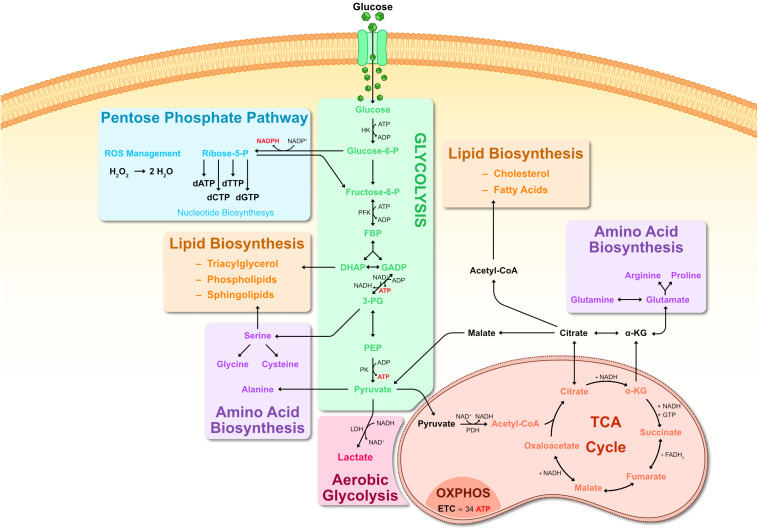
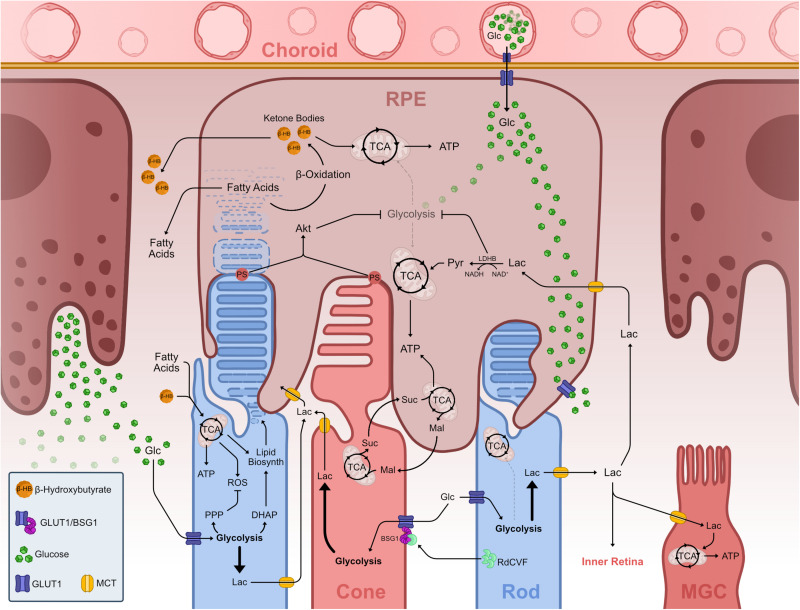
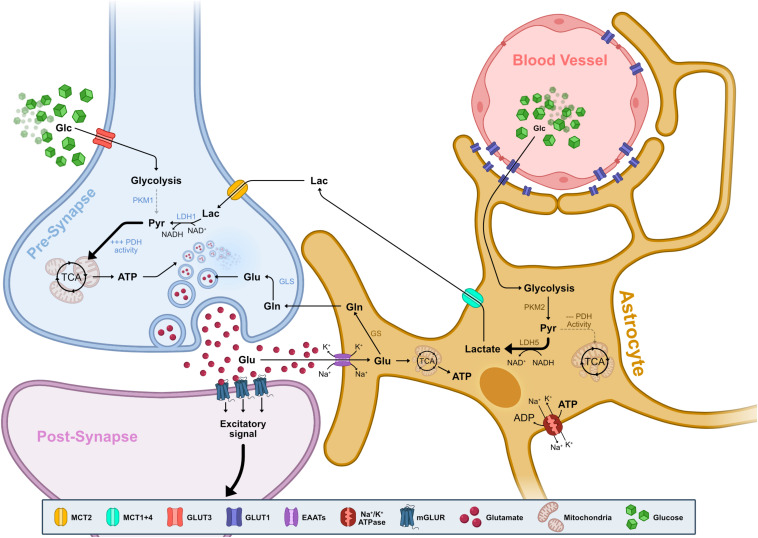
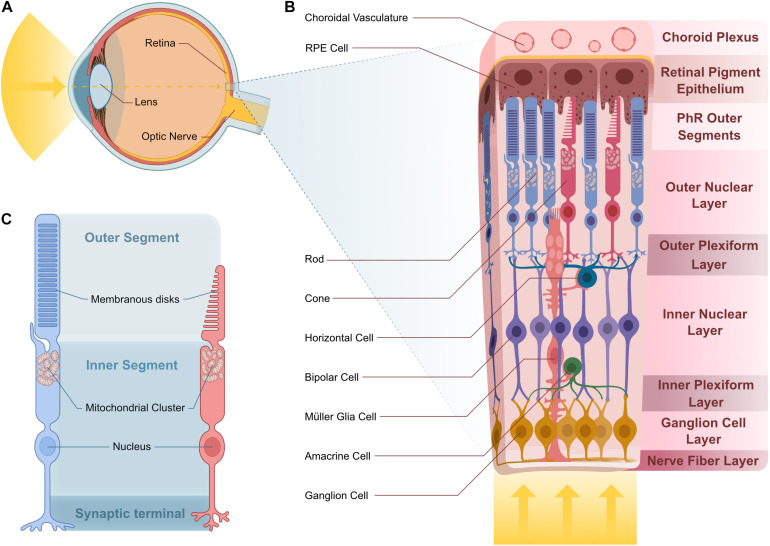
Neurons have high metabolic demands that are almost exclusively met by glucose supplied from the bloodstream. Glucose is utilized in complex metabolic interactions between neurons and glia cells, described by the astrocyte-neuron lactate shuttle (ANLS) hypothesis. The neural retina faces similar energy demands to the rest of the brain, with additional high anabolic needs to support continuous renewal of photoreceptor outer segments. This demand is met by a fascinating variation of the ANLS in which photoreceptors are the central part of a metabolic landscape, using glucose and supplying surrounding cells with metabolic intermediates. In this review we summarize recent evidence on how neurons, in particular photoreceptors, meet their energy and biosynthetic requirements by comprising a metabolic landscape of interdependent cells.
神经元具有很高的代谢需求,几乎完全由血液供应的葡萄糖来满足。葡萄糖在神经元和神经胶质细胞之间复杂的代谢相互作用中被利用,这一过程由星形胶质细胞-神经元乳酸穿梭(ANLS)假说描述。神经视网膜面临着与大脑其他部分相似的能量需求,同时还需要额外的高合成代谢需求来支持光感受器外段的持续更新。这种需求通过ANLS的一种有趣变体得到满足,在这种变体中,光感受器是代谢格局的核心部分,利用葡萄糖并向周围细胞提供代谢中间体。在这篇综述中,我们总结了最近的证据,这些证据表明神经元,特别是光感受器,如何通过形成相互依赖细胞的代谢格局来满足其能量和生物合成需求。