Busquets Albert, Ferrer-Uris Blai, Angulo-Barroso Rosa, Federolf Peter
Institut Nacional d'Educació Física de Catalunya (INEFC), Universitat de Barcelona (UB), Barcelona, Spain.
Department of Kinesiology, California State University, Northridge, CA, United States.
Front Psychol. 2021 Apr 15;12:661312. doi: 10.3389/fpsyg.2021.661312. eCollection 2021.
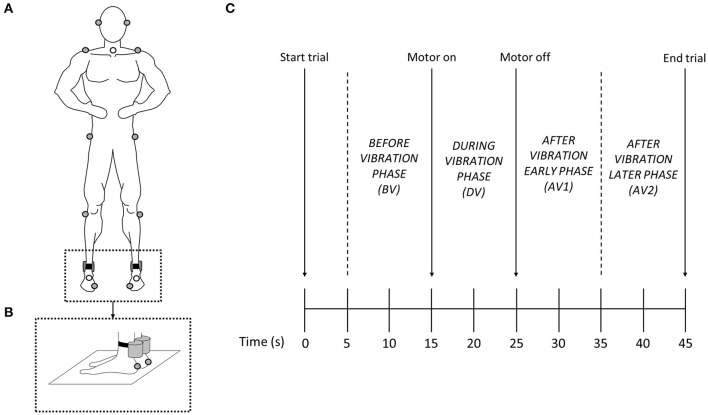
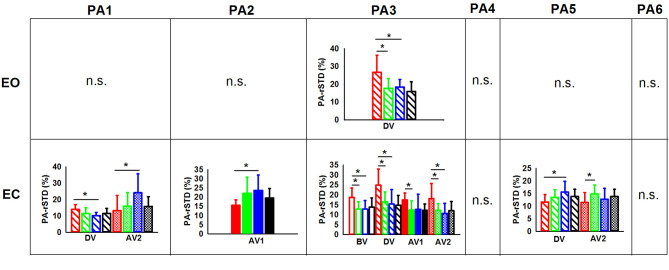
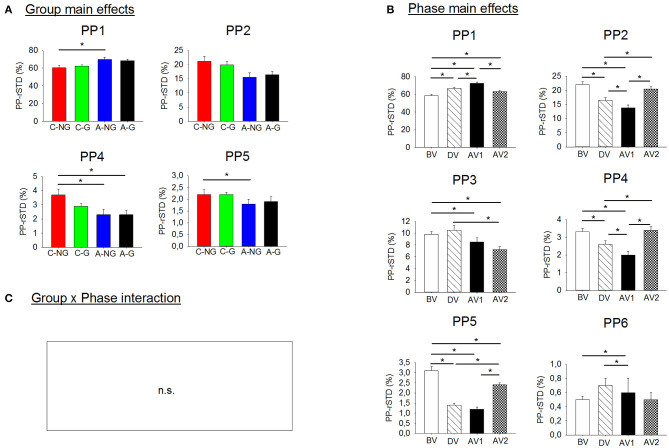
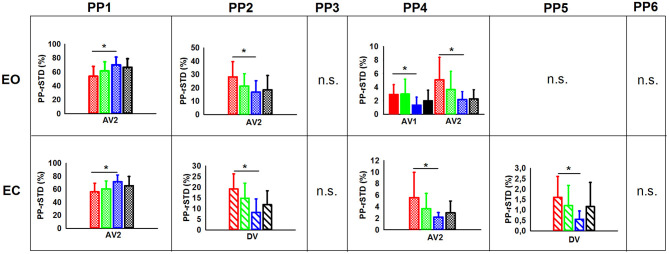
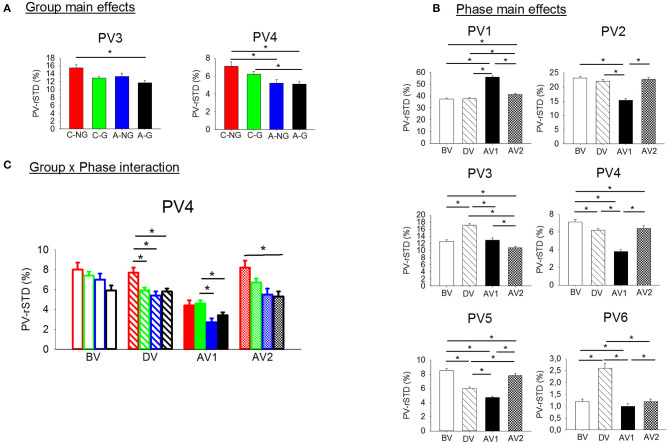
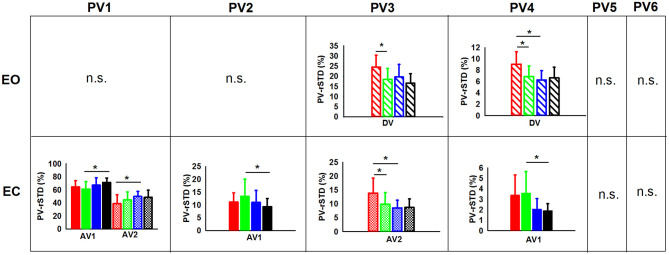
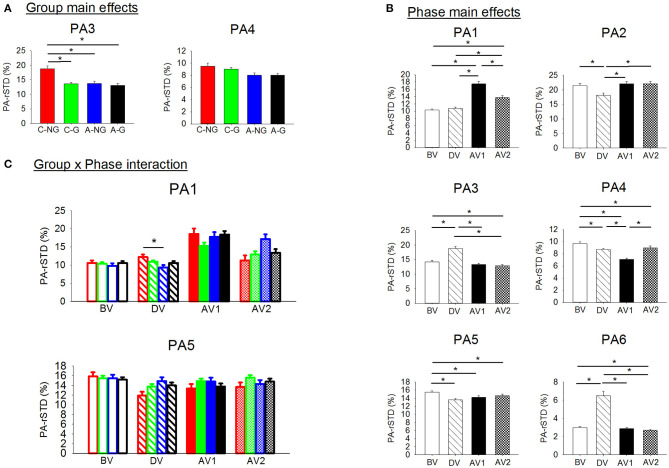
Performance and control of upright bipedal posture requires a constant and dynamic integration of relative contributions of different sensory inputs (i. e., sensory reweighting) to enable effective adaptations as individuals face environmental changes and perturbations. Children with gymnastic experience showed balance performance closer to that of adults during and after proprioceptive alteration than children without gymnastic experience when their center of pressure (COP) was analyzed. However, a particular COP sway can be achieved through performing and coordinating different postural movements. The aim of this study was to assess how children and adults of different gymnastic experience perform and control postural movements while they have to adjust balance during and after bilateral tendon vibration. All participants were equipped with spherical markers attached to their skin and two vibrators strapped over the Achilles tendons. Bipedal stance was performed in three 45-s trials in two visual conditions (eyes open, EO, and eyes closed, EC) ordered randomly in which vibration lasted 10 s. Posture movements were analyzed by a principal component analysis (PCA) calculated on normalized and weighted markers coordinates. The relative standard deviation of each principal movement component (principal position, PP-rSTD) quantified its contribution to the whole postural movements, i.e., quantified the coordinative structure. The first (principal velocities, PV-rSTD) and second (principal accelerations, PA-rSTD) time-derivatives characterized the rate-dependent sensory information associated with and the neuromuscular control of the postural movements, respectively. Children without gymnastic experience showed a different postural coordinative structure and different sensory-motor control characteristics. They used less ankle movements in the anterior-posterior direction but increased ankle movements in medio-lateral direction, presented larger hip and trunk velocities, and exhibited more hip actions. Gymnastic experience during childhood seemed to benefit the development of proprioceptive reweighting processes in children, leading to a more mature form of coordinating and controlling posture similarly to adults.
直立双足姿势的表现和控制需要不断动态整合不同感觉输入的相对贡献(即感觉重新加权),以便个体在面对环境变化和干扰时能够进行有效的适应。在分析压力中心(COP)时,有体操经验的儿童在本体感觉改变期间和之后的平衡表现比没有体操经验的儿童更接近成年人。然而,特定的COP摆动可以通过执行和协调不同的姿势运动来实现。本研究的目的是评估不同体操经验的儿童和成年人在双侧肌腱振动期间和之后调整平衡时如何执行和控制姿势运动。所有参与者都在皮肤上附着了球形标记,并在跟腱上绑了两个振动器。在两种视觉条件下(睁眼,EO,和闭眼,EC)进行三次45秒的双足站立试验,试验顺序随机,其中振动持续10秒。通过对标准化和加权的标记坐标进行主成分分析(PCA)来分析姿势运动。每个主要运动成分的相对标准偏差(主要位置,PP-rSTD)量化了其对整个姿势运动的贡献,即量化了协调结构。一阶(主要速度,PV-rSTD)和二阶(主要加速度,PA-rSTD)时间导数分别表征了与姿势运动相关的速率依赖性感觉信息和姿势运动的神经肌肉控制。没有体操经验的儿童表现出不同的姿势协调结构和不同的感觉运动控制特征。他们在前后方向上较少使用踝关节运动,但在内外侧方向上增加了踝关节运动,表现出更大的髋部和躯干速度,并表现出更多的髋部动作。儿童时期的体操经验似乎有利于儿童本体感觉重新加权过程的发展,从而导致与成年人相似的更成熟的姿势协调和控制形式。