Markopoulou Katerina, Chase Bruce A, Premkumar Ashvini P, Schoneburg Bernadette, Kartha Ninith, Wei Jun, Yu Hongjie, Epshteyn Alexander, Garduno Lisette, Pham Anna, Vazquez Rosa, Frigerio Roberta, Maraganore Demetrius
Department of Neurology, NorthShore University HealthSystem, Evanston, IL, United States.
Health Information Technology, NorthShore University HealthSystem, Evanston, IL, United States.
Front Neurol. 2021 Apr 14;12:662278. doi: 10.3389/fneur.2021.662278. eCollection 2021.
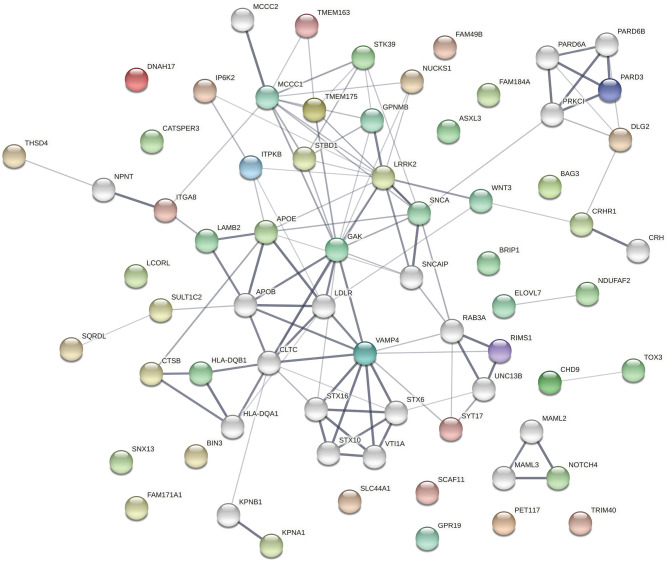
Genetic risk factors for Parkinson's disease (PD) risk and progression have been identified from genome-wide association studies (GWAS), as well as studies of familial forms of PD, implicating common variants at more than 90 loci and pathogenic or likely pathogenic variants at 16 loci. With the goal of understanding whether genetic variants at these PD-risk loci/genes differentially contribute to individual clinical phenotypic characteristics of PD, we used structured clinical documentation tools within the electronic medical record in an effort to provide a standardized and detailed clinical phenotypic characterization at the point of care in a cohort of 856 PD patients. We analyzed common SNPs identified in previous GWAS studies, as well as low-frequency and rare variants at parkinsonism-associated genes in the MDSgene database for their association with individual clinical characteristics and test scores at baseline assessment in our community-based PD patient cohort: age at onset, disease duration, Unified Parkinson's Disease Rating Scale I-VI, cognitive status, initial and baseline motor and non-motor symptoms, complications of levodopa therapy, comorbidities and family history of neurological disease with one or more than one affected family members. We find that in most cases an individual common PD-risk SNP identified in GWAS is associated with only a single clinical feature or test score, while gene-level tests assessing low-frequency and rare variants reveal genes associated in either a unique or partially overlapping manner with the different clinical features and test scores. Protein-protein interaction network analysis of the identified genes reveals that while some of these genes are members of already identified protein networks others are not. These findings indicate that genetic risk factors for PD differentially affect the phenotypic presentation and that genes associated with PD risk are also differentially associated with individual disease phenotypic characteristics at baseline. These findings raise the intriguing possibility that different SNPs/gene effects impact discrete phenotypic characteristics. Furthermore, they support the hypothesis that different gene and protein-protein interaction networks that underlie PD risk, the PD phenotype, and the neurodegenerative process leading to the disease phenotype, and point to the significance of the genetic background on disease phenotype.
帕金森病(PD)风险及进展的遗传风险因素已通过全基因组关联研究(GWAS)以及家族性PD研究得以确定,涉及90多个位点的常见变异以及16个位点的致病或可能致病变异。为了解这些PD风险位点/基因处的遗传变异是否对PD的个体临床表型特征有不同影响,我们在电子病历中使用结构化临床记录工具,力求在856例PD患者队列的医疗现场提供标准化且详细的临床表型特征描述。我们分析了先前GWAS研究中确定的常见单核苷酸多态性(SNP),以及MDSgene数据库中帕金森综合征相关基因的低频和罕见变异,以研究它们与我们基于社区的PD患者队列基线评估时的个体临床特征和测试分数之间的关联:发病年龄、病程、统一帕金森病评定量表I - VI、认知状态、初始和基线运动及非运动症状、左旋多巴治疗并发症、合并症以及有一个或多个患病家庭成员的神经疾病家族史。我们发现,在大多数情况下,GWAS中确定的单个常见PD风险SNP仅与单一临床特征或测试分数相关,而评估低频和罕见变异的基因水平测试显示,基因与不同临床特征和测试分数以独特或部分重叠的方式相关。对所鉴定基因的蛋白质 - 蛋白质相互作用网络分析表明,虽然其中一些基因是已确定蛋白质网络的成员,但其他基因并非如此。这些发现表明,PD的遗传风险因素对表型表现有不同影响,且与PD风险相关的基因在基线时也与个体疾病表型特征有不同关联。这些发现提出了一个有趣的可能性,即不同的SNP/基因效应会影响离散的表型特征。此外,它们支持这样一种假设,即不同的基因和蛋白质 - 蛋白质相互作用网络构成了PD风险、PD表型以及导致疾病表型的神经退行性过程的基础,并指出了遗传背景对疾病表型的重要性。