Manchester Collaborative Centre for Inflammation Research, Division of Infection, Immunity and Respiratory Medicine, School of Biological Science, Faculty of Biology, Medicine and Health, University of Manchester, Manchester Academic Health Science Centre, Manchester, United Kingdom.
Lydia Becker Institute of Immunology and Inflammation, Division of Infection, Immunity and Respiratory Medicine, School of Biological Science, Faculty of Biology, Medicine and Health, University of Manchester, Manchester Academic Health Science Centre, Manchester, United Kingdom.
Front Immunol. 2021 Apr 14;12:670471. doi: 10.3389/fimmu.2021.670471. eCollection 2021.
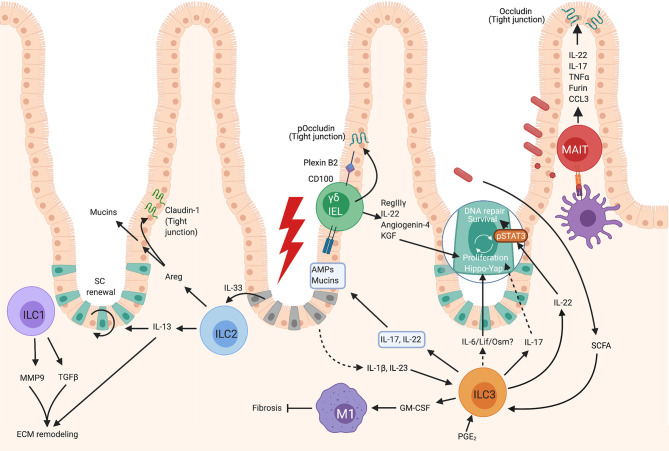
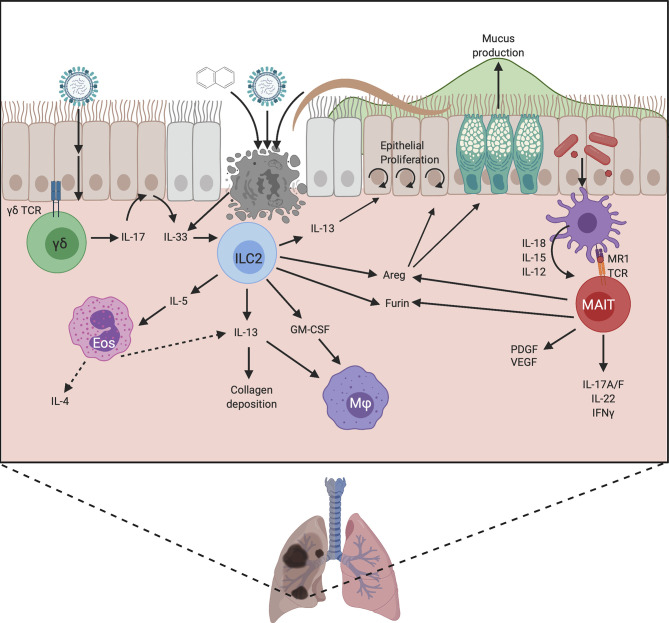
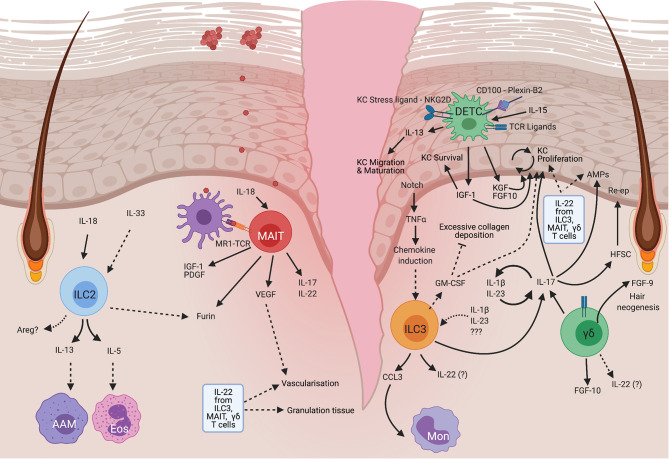
Mucosal surfaces, as a first barrier with the environment are especially susceptible to damage from both pathogens and physical trauma. Thus, these sites require tightly regulated repair programs to maintain barrier function in the face of such insults. Barrier sites are also enriched for unconventional lymphocytes, which lack rearranged antigen receptors or express only a limited range of such receptors, such as ILCs (Innate Lymphoid Cells), γδ T Cells and MAIT (Mucosal-Associated Invariant T Cells). Recent studies have uncovered critical roles for unconventional lymphocytes in regulating mucosal barrier function, and, in particular, have highlighted their important involvement in barrier repair. The production of growth factors such as amphiregulin by ILC2, and fibroblast growth factors by γδ T cells have been shown to promote tissue repair at multiple barrier sites. Additionally, MAIT cells have been shown to exhibit pro-repair phenotypes and demonstrate microbiota-dependent promotion of murine skin healing. In this review we will discuss how immune responses at mucosal sites are controlled by unconventional lymphocytes and the ways in which these cells promote tissue repair to maintain barrier integrity in the skin, gut and lungs.
黏膜表面作为与环境的第一道屏障,特别容易受到病原体和物理创伤的损害。因此,这些部位需要严格调控的修复程序来维持屏障功能,以应对这些损伤。屏障部位还富含非常规淋巴细胞,这些细胞缺乏重排的抗原受体,或者只表达有限范围的此类受体,如 ILCs(固有淋巴细胞)、γδ T 细胞和 MAIT(黏膜相关不变 T 细胞)。最近的研究揭示了非常规淋巴细胞在调节黏膜屏障功能方面的关键作用,特别是它们在屏障修复中的重要作用。ILC2 产生的生长因子如 Amphiregulin 和 γδ T 细胞产生的成纤维细胞生长因子已被证明可促进多个屏障部位的组织修复。此外,MAIT 细胞已被证明表现出促修复表型,并表现出依赖于微生物群的促进小鼠皮肤愈合的作用。在这篇综述中,我们将讨论黏膜部位的免疫反应是如何被非常规淋巴细胞控制的,以及这些细胞是如何促进组织修复以维持皮肤、肠道和肺部的屏障完整性的。