Simske Natasha M, Breslin Mary A, Hendrickson Sarah B, York Kenneth P, Vallier Heather A
MetroHealth Medical Center, Cleveland, Ohio, affiliated with Case Western Reserve University, Cleveland, Ohio.
OTA Int. 2019 Nov 22;2(4):e045. doi: 10.1097/OI9.0000000000000045. eCollection 2019 Dec.
To identify resources that patients perceive as helpful to their recovery and to characterize the impact of the Trauma Survivor Network (TSN), a program committed to enhancing recovery through education and engagement.
Prospective cohort study.
Level 1 trauma center.
PATIENTS/PARTICIPANTS: Four hundred eighty-five patients with musculoskeletal injuries. Two hundred eleven were exposed to TSN resources (Group 1). One hundred thirty-five patients were treated during the same period with no exposure (Group 2, control). One hundred thirty-nine patients were treated 1 to 3 months prior to TSN implementation (Group 3, control).
TSN resources including educational materials, family classes, peer survivor visits, coaching, online services, and support groups.
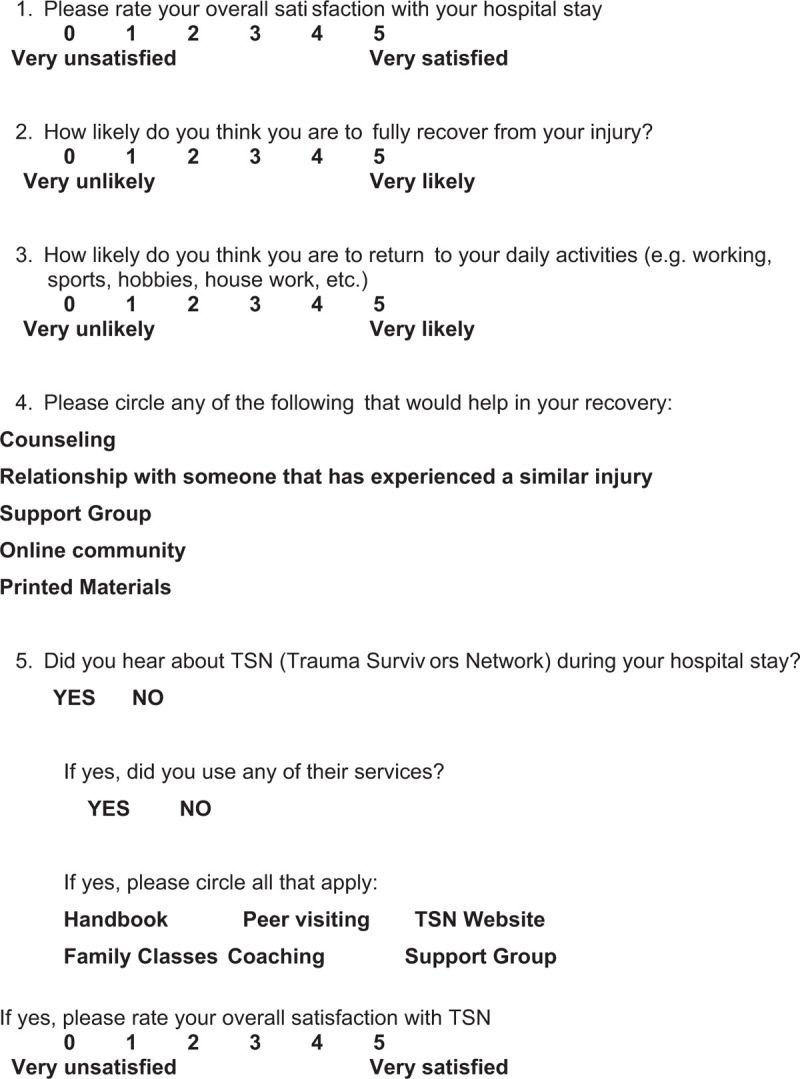
A survey to assess hospital experience and perceptions about recovery.
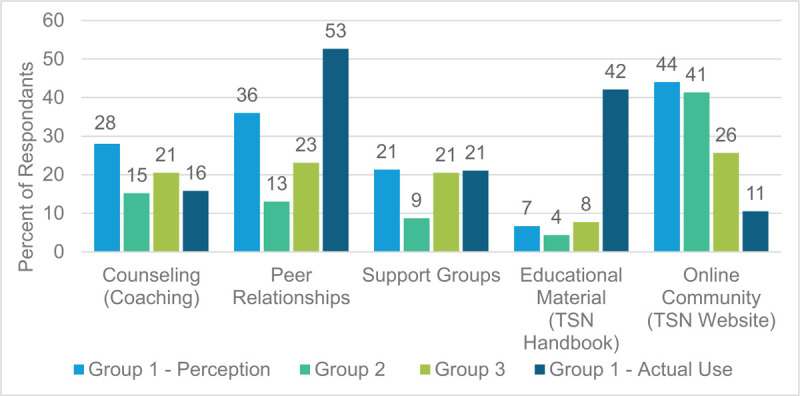
On a Likert scale from 0 to 5, patients were highly satisfied (mean 4.24), with no differences based on TSN exposure. Patients exposed to TSN programming reported greater perceived likelihood of recovery: mean 3.73 vs 3.41 vs 3.38, Group 1 vs Group 2 vs Group 3 ( = .05) and regarding return to daily activities: 3.69 vs 3.49 vs 3.10, = .003. Fifty-three percent of Group 1 patients exposed to TSN programming utilized peer relationships and 42% read the educational materials provided. Support groups were also popular, with 26% of patients attending at least 1 session. Patients who recalled utilization of TSN services were overall highly satisfied with these services, mean 4.42.
Patients were overall highly satisfied with their hospital stay, with those exposed to TSN services reporting greater perceived likelihood of recovery and return to daily activities. Development of nontraditional services, including peer visitation and support groups, appears to enhance expectations about recovery.
确定患者认为有助于其康复的资源,并描述创伤幸存者网络(TSN)的影响,该项目致力于通过教育和参与来促进康复。
前瞻性队列研究。
一级创伤中心。
患者/参与者:485名肌肉骨骼损伤患者。211名接触了TSN资源(第1组)。135名患者在同一时期接受治疗但未接触(第2组,对照组)。139名患者在TSN实施前1至3个月接受治疗(第3组,对照组)。
TSN资源,包括教育材料、家庭课程、同伴幸存者探访、辅导、在线服务和支持小组。
一项评估住院体验和对康复看法的调查。
在0至5的李克特量表上,患者总体满意度较高(平均4.24),且基于是否接触TSN没有差异。接触TSN项目的患者报告称康复的可能性更高:第1组、第2组和第3组的平均值分别为3.73、3.41和3.38(P = 0.05);关于恢复日常活动方面:分别为3.69、3.49和3.10(P = 0.003)。接触TSN项目的第1组患者中有53%利用了同伴关系,42%阅读了提供的教育材料。支持小组也很受欢迎,26%的患者至少参加了1次会议。回忆起使用过TSN服务的患者总体上对这些服务非常满意,平均分为4.42。
患者总体上对住院期间的体验非常满意,接触TSN服务的患者报告称康复和恢复日常活动的可能性更高。包括同伴探访和支持小组在内的非传统服务的开展似乎提高了对康复的期望。