• 文献检索
  • 文档翻译
  • 深度研究
  • 学术资讯
  • Suppr Zotero 插件Zotero 插件
  • 邀请有礼
  • 套餐&价格
  • 历史记录
应用&插件
Suppr Zotero 插件Zotero 插件浏览器插件Mac 客户端Windows 客户端微信小程序
定价
高级版会员购买积分包购买API积分包
服务
文献检索文档翻译深度研究API 文档MCP 服务
关于我们
关于 Suppr公司介绍联系我们用户协议隐私条款
关注我们

Suppr 超能文献

核心技术专利:CN118964589B侵权必究
粤ICP备2023148730 号-1Suppr @ 2026

文献检索

告别复杂PubMed语法,用中文像聊天一样搜索,搜遍4000万医学文献。AI智能推荐,让科研检索更轻松。

立即免费搜索

文件翻译

保留排版,准确专业,支持PDF/Word/PPT等文件格式,支持 12+语言互译。

免费翻译文档

深度研究

AI帮你快速写综述,25分钟生成高质量综述,智能提取关键信息,辅助科研写作。

立即免费体验

没有证据表明更新世人类到达后,岛屿出现了广泛的灭绝现象。

No evidence for widespread island extinctions after Pleistocene hominin arrival.

机构信息

Australian Research Centre for Human Evolution, Griffith University, Brisbane, QLD 4111, Australia;

Archaeology and Natural History, College of Asia and the Pacific, The Australian National University, Canberra, ACT 2601, Australia.

出版信息

Proc Natl Acad Sci U S A. 2021 May 18;118(20). doi: 10.1073/pnas.2023005118.

DOI:
10.1073/pnas.2023005118
PMID:33941645
原文链接:https://pmc.ncbi.nlm.nih.gov/articles/PMC8157961/
Abstract

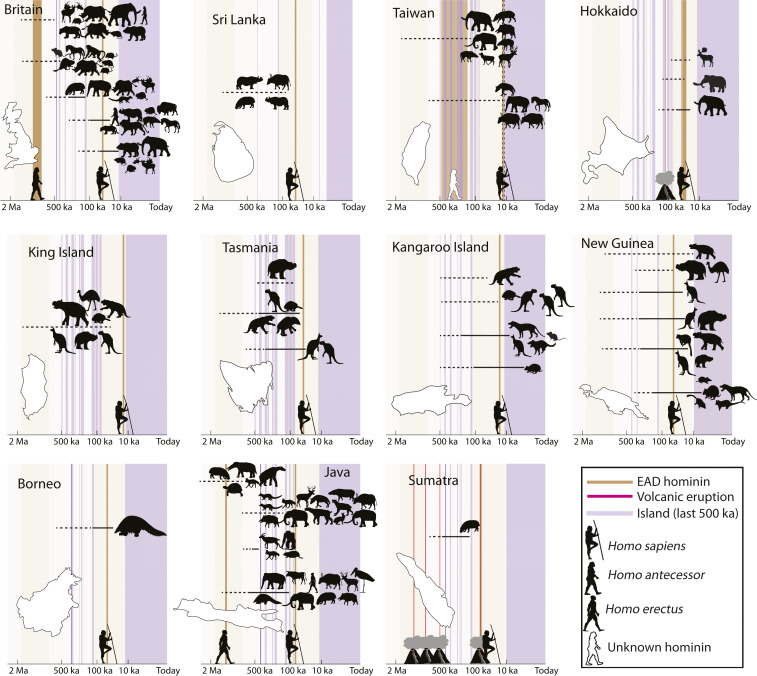
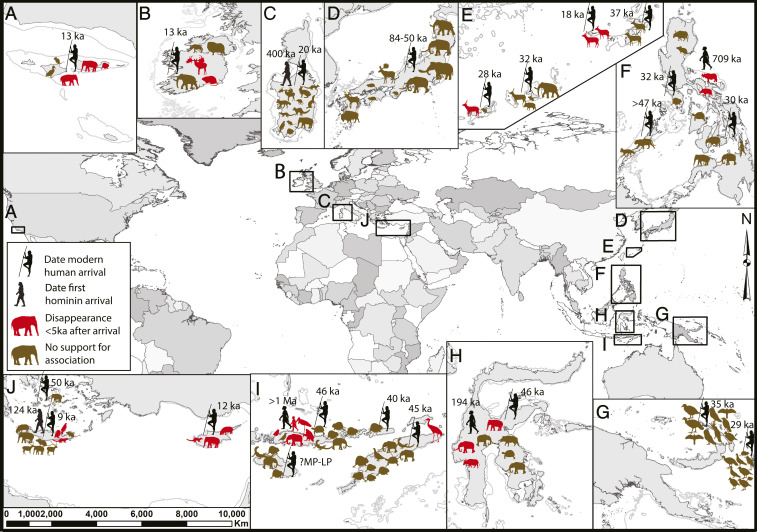
The arrival of modern humans into previously unoccupied island ecosystems is closely linked to widespread extinction, and a key reason cited for Pleistocene megafauna extinction is anthropogenic overhunting. A common assumption based on late Holocene records is that humans always negatively impact insular biotas, which requires an extrapolation of recent human behavior and technology into the archaeological past. Hominins have been on islands since at least the early Pleistocene and for at least 50 thousand y (ka). Over such lengthy intervals it is scarcely surprising that significant evolutionary, behavioral, and cultural changes occurred. However, the deep-time link between human arrival and island extinctions has never been explored globally. Here, we examine archaeological and paleontological records of all Pleistocene islands with a documented hominin presence to examine whether humans have always been destructive agents. We show that extinctions at a global level cannot be associated with Pleistocene hominin arrival based on current data and are difficult to disentangle from records of environmental change. It is not until the Holocene that large-scale changes in technology, dispersal, demography, and human behavior visibly affect island ecosystems. The extinction acceleration we are currently experiencing is thus not inherent but rather part of a more recent cultural complex.

摘要

现代人进入以前无人居住的岛屿生态系统与广泛的灭绝密切相关,而被引用为更新世巨型动物灭绝的一个关键原因是人类过度狩猎。根据全新世晚期的记录,一个常见的假设是人类总是对岛屿生物群产生负面影响,这需要将最近的人类行为和技术推断到考古学的过去。人类至少从更新世早期开始就在岛屿上,至少有 5 万年(ka)。在如此长的时间间隔内,发生重大的进化、行为和文化变化并不奇怪。然而,人类到达和岛屿灭绝之间的深层时间联系从未在全球范围内得到探索。在这里,我们检查了所有有记录的人类存在的更新世岛屿的考古学和古生物学记录,以研究人类是否一直是破坏性因素。我们表明,根据目前的数据,全球灭绝与更新世人类的到来之间无法联系,而且很难将其与环境变化的记录区分开来。直到全新世,技术、扩散、人口和人类行为的大规模变化才明显影响到岛屿生态系统。因此,我们目前正在经历的灭绝加速并不是内在的,而是最近文化复合体的一部分。
https://cdn.ncbi.nlm.nih.gov/pmc/blobs/b25d/8157961/a904f545a098/pnas.2023005118fig04.jpg
https://cdn.ncbi.nlm.nih.gov/pmc/blobs/b25d/8157961/6dc4e59b25c9/pnas.2023005118fig01.jpg
https://cdn.ncbi.nlm.nih.gov/pmc/blobs/b25d/8157961/e5f72465093f/pnas.2023005118fig02.jpg
https://cdn.ncbi.nlm.nih.gov/pmc/blobs/b25d/8157961/c8a692c340cf/pnas.2023005118fig03.jpg
https://cdn.ncbi.nlm.nih.gov/pmc/blobs/b25d/8157961/a904f545a098/pnas.2023005118fig04.jpg
https://cdn.ncbi.nlm.nih.gov/pmc/blobs/b25d/8157961/6dc4e59b25c9/pnas.2023005118fig01.jpg
https://cdn.ncbi.nlm.nih.gov/pmc/blobs/b25d/8157961/e5f72465093f/pnas.2023005118fig02.jpg
https://cdn.ncbi.nlm.nih.gov/pmc/blobs/b25d/8157961/c8a692c340cf/pnas.2023005118fig03.jpg
https://cdn.ncbi.nlm.nih.gov/pmc/blobs/b25d/8157961/a904f545a098/pnas.2023005118fig04.jpg

相似文献

1
No evidence for widespread island extinctions after Pleistocene hominin arrival.没有证据表明更新世人类到达后,岛屿出现了广泛的灭绝现象。
Proc Natl Acad Sci U S A. 2021 May 18;118(20). doi: 10.1073/pnas.2023005118.
2
Environmental drivers of megafauna and hominin extinction in Southeast Asia.东南亚巨型动物和人类灭绝的环境驱动因素。
Nature. 2020 Oct;586(7829):402-406. doi: 10.1038/s41586-020-2810-y. Epub 2020 Oct 7.
3
A reassessment of the early archaeological record at Leang Burung 2, a Late Pleistocene rock-shelter site on the Indonesian island of Sulawesi.重新评估印度尼西亚苏拉威西岛晚更新世岩棚遗址 Leang Burung 2 的早期考古记录。
PLoS One. 2018 Apr 11;13(4):e0193025. doi: 10.1371/journal.pone.0193025. eCollection 2018.
4
Early hominin biogeography in Island Southeast Asia.东南亚岛屿早期人类生物地理学。
Evol Anthropol. 2015 Sep-Oct;24(5):185-213. doi: 10.1002/evan.21460.
5
PALEOECOLOGY. Abrupt warming events drove Late Pleistocene Holarctic megafaunal turnover.古生态学。剧烈的变暖事件导致了更新世晚期泛北极巨型动物群的更替。
Science. 2015 Aug 7;349(6248):602-6. doi: 10.1126/science.aac4315. Epub 2015 Jul 23.
6
New geochronological, paleoclimatological, and archaeological data from the Narmada Valley hominin locality, central India.来自印度中部讷尔默达河谷古人类遗址的新地质年代学、古气候学和考古学数据。
J Hum Evol. 2009 Feb;56(2):114-33. doi: 10.1016/j.jhevol.2008.08.023. Epub 2008 Dec 31.
7
Human influence on distribution and extinctions of the late Pleistocene Eurasian megafauna.人类对晚更新世欧亚大陆巨型动物群分布及灭绝的影响。
J Hum Evol. 2008 Jun;54(6):769-82. doi: 10.1016/j.jhevol.2007.09.024. Epub 2008 Jan 15.
8
Late-surviving megafauna in Tasmania, Australia, implicate human involvement in their extinction.澳大利亚塔斯马尼亚晚期幸存的大型动物表明人类活动导致了它们的灭绝。
Proc Natl Acad Sci U S A. 2008 Aug 26;105(34):12150-3. doi: 10.1073/pnas.0801360105. Epub 2008 Aug 21.
9
Small populations of Palaeolithic humans in Cyprus hunted endemic megafauna to extinction.塞浦路斯的旧石器时代人类的小种群狩猎当地特有的大型动物,导致其灭绝。
Proc Biol Sci. 2024 Sep;291(2031):20240967. doi: 10.1098/rspb.2024.0967. Epub 2024 Sep 18.
10
The expansion of later Acheulean hominins into the Arabian Peninsula.晚期阿舍利人类向阿拉伯半岛的扩张。
Sci Rep. 2018 Nov 29;8(1):17165. doi: 10.1038/s41598-018-35242-5.

引用本文的文献

1
Patterns of late Holocene and historical extinctions on Madagascar.马达加斯加晚全新世及历史时期的灭绝模式。
Camb Prism Extinct. 2025 May 5;3:e9. doi: 10.1017/ext.2024.19. eCollection 2025.
2
Demographic models predict end-Pleistocene arrival and rapid expansion of pre-agropastoralist humans in Cyprus.人口统计学模型预测,在末次冰期结束时,前农业和畜牧业的人类已经抵达塞浦路斯,并迅速扩张。
Proc Natl Acad Sci U S A. 2024 May 21;121(21):e2318293121. doi: 10.1073/pnas.2318293121. Epub 2024 May 16.
3
Undiscovered bird extinctions obscure the true magnitude of human-driven extinction waves.

本文引用的文献

1
Environmental drivers of megafauna and hominin extinction in Southeast Asia.东南亚巨型动物和人类灭绝的环境驱动因素。
Nature. 2020 Oct;586(7829):402-406. doi: 10.1038/s41586-020-2810-y. Epub 2020 Oct 7.
2
Age control of the first appearance datum for Javanese in the Sangiran area.在 Sangiran 地区,爪哇人首次出现数据的年龄控制。
Science. 2020 Jan 10;367(6474):210-214. doi: 10.1126/science.aau8556.
3
Earliest hunting scene in prehistoric art.史前艺术中最早的狩猎场景。
未被发现的鸟类灭绝使人类驱动的灭绝浪潮的真正规模变得模糊不清。
Nat Commun. 2023 Dec 19;14(1):8116. doi: 10.1038/s41467-023-43445-2.
4
Megafauna extinctions produce idiosyncratic Anthropocene assemblages.巨型动物灭绝产生了独特的人类世组合。
Sci Adv. 2022 Oct 21;8(42):eabq2307. doi: 10.1126/sciadv.abq2307.
5
Cryptic extinction risk in a western Pacific lizard radiation.西太平洋蜥蜴辐射中的隐秘灭绝风险。
Biodivers Conserv. 2022;31(8-9):2045-2062. doi: 10.1007/s10531-022-02412-x. Epub 2022 May 25.
6
Ancient proteins resolve controversy over the identity of eggshell.古蛋白解决了蛋壳身份的争议。
Proc Natl Acad Sci U S A. 2022 Oct 25;119(43):e2109326119. doi: 10.1073/pnas.2109326119. Epub 2022 May 24.
7
Scientists' warning - The outstanding biodiversity of islands is in peril.科学家警告——岛屿独特的生物多样性正面临危机。
Glob Ecol Conserv. 2021 Nov;31:e01847. doi: 10.1016/j.gecco.2021.e01847.
8
Modelling the Pleistocene colonisation of Eastern Mediterranean islandscapes.模拟更新世时期东地中海岛屿的殖民化过程。
PLoS One. 2021 Oct 27;16(10):e0258370. doi: 10.1371/journal.pone.0258370. eCollection 2021.
Nature. 2019 Dec;576(7787):442-445. doi: 10.1038/s41586-019-1806-y. Epub 2019 Dec 11.
4
Least-cost pathway models indicate northern human dispersal from Sunda to Sahul.最经济路径模型表明人类从巽他群岛到萨胡尔的北方扩散。
J Hum Evol. 2018 Dec;125:59-70. doi: 10.1016/j.jhevol.2018.10.003. Epub 2018 Oct 26.
5
Earliest known hominin activity in the Philippines by 709 thousand years ago.菲律宾发现距今 70.9 万年的最早古人类活动遗迹。
Nature. 2018 May;557(7704):233-237. doi: 10.1038/s41586-018-0072-8. Epub 2018 May 2.
6
An early modern human presence in Sumatra 73,000-63,000 years ago.距今 7.3 万至 6.3 万年前的苏门答腊存在早期现代人类。
Nature. 2017 Aug 17;548(7667):322-325. doi: 10.1038/nature23452. Epub 2017 Aug 9.
7
Biodiversity losses and conservation responses in the Anthropocene.生物多样性在人类世的丧失与保护对策。
Science. 2017 Apr 21;356(6335):270-275. doi: 10.1126/science.aam9317.
8
Excess of genomic defects in a woolly mammoth on Wrangel island.弗兰格尔岛上的一头猛犸象存在过多的基因组缺陷。
PLoS Genet. 2017 Mar 2;13(3):e1006601. doi: 10.1371/journal.pgen.1006601. eCollection 2017 Mar.
9
The changing role of mammal life histories in Late Quaternary extinction vulnerability on continents and islands.哺乳动物生活史在大陆和岛屿晚第四纪灭绝脆弱性方面不断变化的作用。
Biol Lett. 2016 Jun;12(6). doi: 10.1098/rsbl.2016.0342.
10
Megafauna and ecosystem function from the Pleistocene to the Anthropocene.从更新世到人类世的巨型动物群与生态系统功能
Proc Natl Acad Sci U S A. 2016 Jan 26;113(4):838-46. doi: 10.1073/pnas.1502540113.