Wieland Mark L, Asiedu Gladys B, Lantz Kiley, Abbenyi Adeline, Njeru Jane W, Osman Ahmed, Goodson Miriam, Ahmed Yahye, Molina Luz E, Doubeni Chyke A, Sia Irene G
Division of Community Internal Medicine, Mayo Clinic, Rochester, MN, USA.
Kern Center for the Science of Healthcare Delivery, Mayo Clinic, Rochester, MN, USA.
J Clin Transl Sci. 2020 May 15;5(1):e6. doi: 10.1017/cts.2020.47.
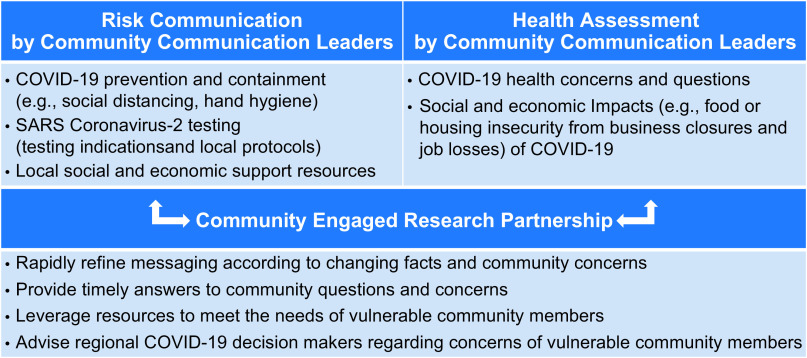
Community engagement is important for reaching vulnerable populations in the coronavirus disease 2019 (COVID-19) pandemic. A risk communication framework was implemented by a community-engaged research (CEnR) partnership in Southeast Minnesota to address COVID-19 prevention, testing, and socioeconomic impacts. Bidirectional communication between Communication Leaders and community members within their social networks was used by the partnership to refine messages, leverage resources, and advise policy makers. Over 14 days, messages were delivered by 24 Communication Leaders in 6 languages across 9 electronic platforms to 9882 individuals within their networks. CEnR partnerships may effectively implement crisis and emergency risk communication to vulnerable populations in a pandemic.
社区参与对于在2019冠状病毒病(COVID-19)大流行期间接触弱势群体至关重要。明尼苏达州东南部的一个社区参与研究(CEnR)伙伴关系实施了一个风险沟通框架,以应对COVID-19的预防、检测和社会经济影响。该伙伴关系利用沟通领导者与他们社交网络中的社区成员之间的双向沟通来完善信息、利用资源并为政策制定者提供建议。在14天的时间里,24名沟通领导者通过9个电子平台,用6种语言向其社交网络中的9882人传递了信息。CEnR伙伴关系可以有效地向大流行中的弱势群体实施危机和紧急风险沟通。