Hamburg Center for Health Economics, University of Hamburg, Hamburg, Germany.
Techniker Krankenkasse, Hamburg, Germany.
PLoS One. 2021 May 4;16(5):e0250993. doi: 10.1371/journal.pone.0250993. eCollection 2021.
Suboptimal patient adherence to pharmacological therapy of type 2 diabetes may be due in part to pill burden. One way to reduce pill burden in patients who need multiple medications is to use fixed-dose combinations. Our study aimed to compare the effects of fixed-dose combination versus loose-dose combination therapy on medication adherence and persistence, health care utilization, therapeutic safety, morbidities, and treatment modification in patients with type 2 diabetes over three years.
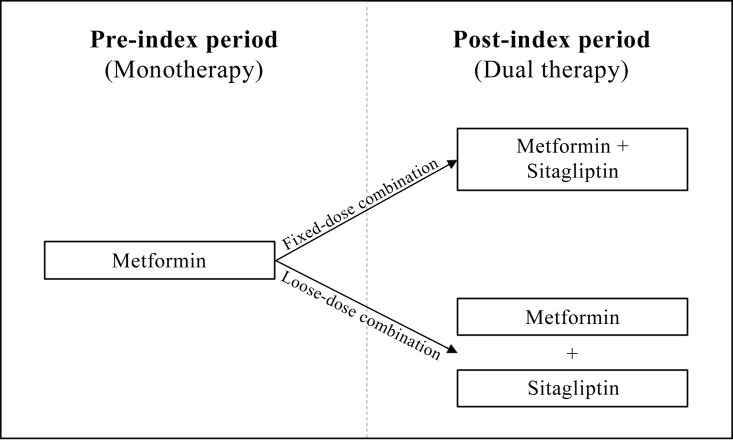
Using administrative data, we conducted a retrospective controlled cohort study comparing type 2 diabetes patients who switched from monotherapy to either a fixed-dose combination or a loose-dose combination. Adherence was assessed as the primary endpoint and calculated as the proportion of days covered with medication. After using entropy balancing to eliminate differences in observable baseline characteristics between the two groups, we applied difference-in-difference estimators for each outcome to account for time-invariant unobservable heterogeneity.
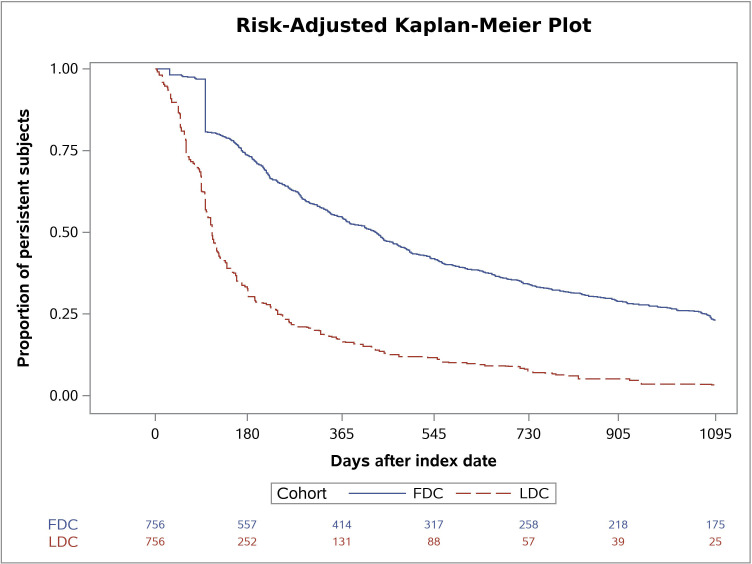
Of the 990 type 2 diabetes patients included in our analysis, 756 were taking a fixed-dose combination and 234 were taking a loose-dose combination. We observed a statistically significantly higher change in adherence (year one: 0.22, p<0.001, year two: 0.25, p<0.001, and year three: 0.29, p<0.001) as well as higher persistence and a smaller change in the number of drug prescriptions in each of the three years in the fixed-dose combination group compared to the loose-dose combination group. The differences were most pronounced in patients who were poorly adherent, had a high pill burden, or did not have a severe concomitant disease.
Our results indicate that taking a fixed-dose combination can lead to a significant improvement in adherence to pharmacological therapy of type 2 diabetes compared to a loose-dose combination. In particular, these findings suggest that reducing pill burden may improve disease management among patients with more complex medication demand and patients who have demonstrated poor medication adherence.
2 型糖尿病患者药物治疗依从性不理想的部分原因可能是药物负担过重。对于需要服用多种药物的患者,减少药物负担的一种方法是使用固定剂量复方制剂。我们的研究旨在比较固定剂量复方制剂与松散剂量复方制剂治疗对 2 型糖尿病患者在三年内药物依从性和持续性、医疗保健利用、治疗安全性、发病率和治疗调整的影响。
使用行政数据,我们进行了一项回顾性对照队列研究,比较了从单一疗法转为固定剂量复方制剂或松散剂量复方制剂的 2 型糖尿病患者。依从性作为主要终点进行评估,计算方法为用药天数比例。在使用熵平衡消除两组间可观察到的基线特征差异后,我们对每个结果应用差分差异估计器,以考虑时间不变的不可观察异质性。
在我们的分析中,990 名 2 型糖尿病患者中,756 名患者服用固定剂量复方制剂,234 名患者服用松散剂量复方制剂。我们观察到固定剂量复方制剂组在依从性方面有显著更高的变化(第一年:0.22,p<0.001,第二年:0.25,p<0.001,第三年:0.29,p<0.001),以及更高的持久性和三年内每个药物处方数量的变化较小。在依从性差、药物负担重或没有严重合并症的患者中,差异最为明显。
我们的研究结果表明,与松散剂量复方制剂相比,使用固定剂量复方制剂可显著提高 2 型糖尿病药物治疗的依从性。特别是,这些发现表明,减少药物负担可能会改善药物依从性较差和药物需求复杂的患者的疾病管理。