Koureas Michalis, Kalompatsios Dimitrios, Amoutzias Grigoris D, Hadjichristodoulou Christos, Gourgoulianis Konstantinos, Tsakalof Andreas
Department of Hygiene and Epidemiology, University Hospital of Larissa, Faculty of Medicine, University of Thessaly, 22 Papakyriazi Street, 41222 Larissa, Greece.
Bioinformatics Laboratory, Department of Biochemistry and Biotechnology, University of Thessaly, 41500 Larissa, Greece.
Molecules. 2021 Apr 29;26(9):2609. doi: 10.3390/molecules26092609.
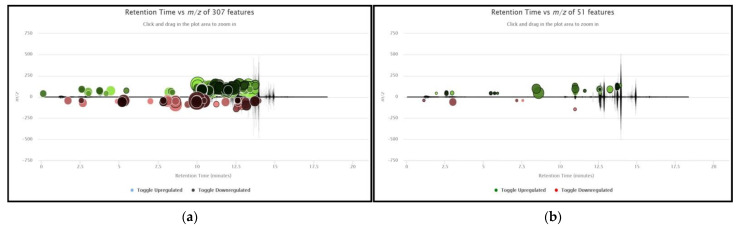
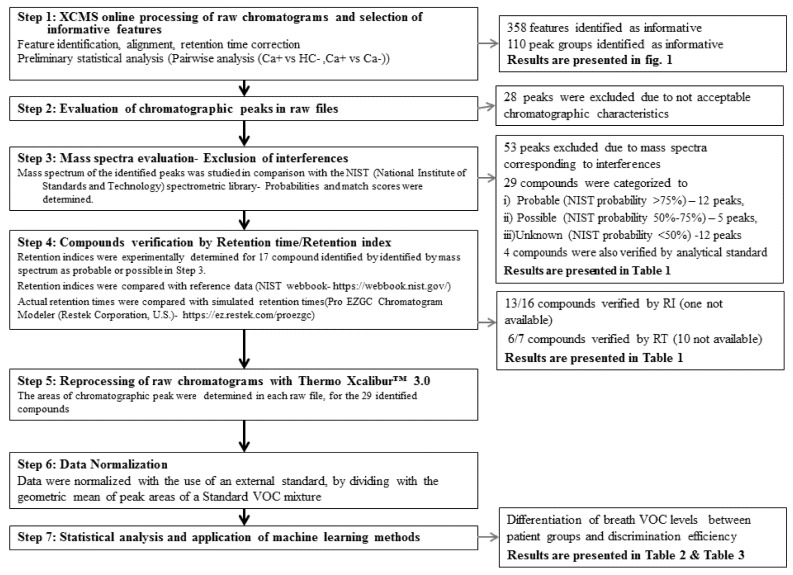
The aim of the present study was to compare the efficiency of targeted and untargeted breath analysis in the discrimination of lung cancer (Ca+) patients from healthy people (HC) and patients with benign pulmonary diseases (Ca-). Exhaled breath samples from 49 Ca+ patients, 36 Ca- patients and 52 healthy controls (HC) were analyzed by an SPME-GC-MS method. Untargeted treatment of the acquired data was performed with the use of the web-based platform XCMS Online combined with manual reprocessing of raw chromatographic data. Machine learning methods were applied to estimate the efficiency of breath analysis in the classification of the participants. Results: Untargeted analysis revealed 29 informative VOCs, from which 17 were identified by mass spectra and retention time/retention index evaluation. The untargeted analysis yielded slightly better results in discriminating Ca+ patients from HC (accuracy: 91.0%, AUC: 0.96 and accuracy 89.1%, AUC: 0.97 for untargeted and targeted analysis, respectively) but significantly improved the efficiency of discrimination between Ca+ and Ca- patients, increasing the accuracy of the classification from 52.9 to 75.3% and the AUC from 0.55 to 0.82. Conclusions: The untargeted breath analysis through the inclusion and utilization of newly identified compounds that were not considered in targeted analysis allowed the discrimination of the Ca+ from Ca- patients, which was not achieved by the targeted approach.
本研究的目的是比较靶向呼气分析和非靶向呼气分析在区分肺癌(Ca+)患者与健康人(HC)以及良性肺部疾病患者(Ca-)方面的效率。采用固相微萃取-气相色谱-质谱联用(SPME-GC-MS)方法分析了49例Ca+患者、36例Ca-患者和52例健康对照(HC)的呼出气体样本。利用基于网络的XCMS Online平台对采集的数据进行非靶向处理,并结合对原始色谱数据的人工再处理。应用机器学习方法评估呼气分析在参与者分类中的效率。结果:非靶向分析揭示了29种信息性挥发性有机化合物(VOC),其中17种通过质谱和保留时间/保留指数评估得以鉴定。在区分Ca+患者与HC方面,非靶向分析的结果略好(准确性:91.0%,曲线下面积[AUC]:0.96;靶向分析的准确性为89.1%,AUC为0.97),但显著提高了区分Ca+和Ca-患者的效率,将分类准确性从52.9%提高到75.3%,AUC从0.55提高到0.82。结论:通过纳入和利用靶向分析中未考虑的新鉴定化合物进行非靶向呼气分析,能够区分Ca+和Ca-患者,而靶向方法无法做到这一点。