Research Department of Pathology, University College London, UCL Cancer Institute, London, UK.
Medical Genomics Research Group, University College London, UCL Cancer Institute, London, UK.
J Pathol Clin Res. 2021 Jul;7(4):350-360. doi: 10.1002/cjp2.215. Epub 2021 May 5.
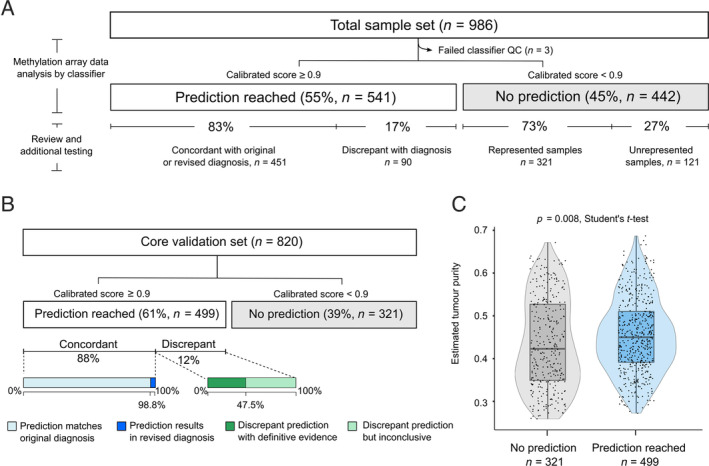
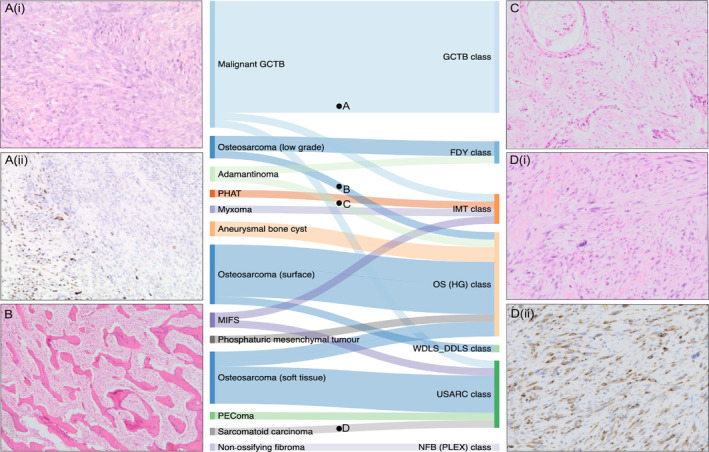
Diagnosing bone and soft tissue neoplasms remains challenging because of the large number of subtypes, many of which lack diagnostic biomarkers. DNA methylation profiles have proven to be a reliable basis for the classification of brain tumours and, following this success, a DNA methylation-based sarcoma classification tool from the Deutsches Krebsforschungszentrum (DKFZ) in Heidelberg has been developed. In this study, we assessed the performance of their classifier on DNA methylation profiles of an independent data set of 986 bone and soft tissue tumours and controls. We found that the 'DKFZ Sarcoma Classifier' was able to produce a diagnostic prediction for 55% of the 986 samples, with 83% of these predictions concordant with the histological diagnosis. On limiting the validation to the 820 cases with histological diagnoses for which the DKFZ Classifier was trained, 61% of cases received a prediction, and the histological diagnosis was concordant with the predicted methylation class in 88% of these cases, findings comparable to those reported in the DKFZ Classifier paper. The classifier performed best when diagnosing mesenchymal chondrosarcomas (CHSs, 88% sensitivity), chordomas (85% sensitivity), and fibrous dysplasia (83% sensitivity). Amongst the subtypes least often classified correctly were clear cell CHSs (14% sensitivity), malignant peripheral nerve sheath tumours (27% sensitivity), and pleomorphic liposarcomas (29% sensitivity). The classifier predictions resulted in revision of the histological diagnosis in six of our cases. We observed that, although a higher tumour purity resulted in a greater likelihood of a prediction being made, it did not correlate with classifier accuracy. Our results show that the DKFZ Classifier represents a powerful research tool for exploring the pathogenesis of sarcoma; with refinement, it has the potential to be a valuable diagnostic tool.
诊断骨和软组织肿瘤仍然具有挑战性,因为其亚型数量众多,其中许多缺乏诊断生物标志物。DNA 甲基化谱已被证明是脑肿瘤分类的可靠基础,在此成功之后,海德堡德国癌症研究中心(DKFZ)开发了一种基于 DNA 甲基化的肉瘤分类工具。在这项研究中,我们评估了他们的分类器在 986 个骨和软组织肿瘤及对照的独立数据集的 DNA 甲基化谱上的性能。我们发现,“DKFZ 肉瘤分类器”能够对 986 个样本中的 55%产生诊断预测,其中 83%的预测与组织学诊断一致。在将验证限制在为 DKFZ 分类器训练而具有组织学诊断的 820 个病例中,61%的病例得到了预测,并且在这些病例中,88%的预测与预测的甲基化类一致,这与 DKFZ 分类器论文中报道的结果相当。当诊断间叶性软骨肉瘤(CHS,88%的敏感性)、脊索瘤(85%的敏感性)和纤维发育不良(83%的敏感性)时,分类器的性能最佳。分类器错误分类的亚型中,透明细胞 CHS(14%的敏感性)、恶性周围神经鞘瘤(27%的敏感性)和多形性脂肪肉瘤(29%的敏感性)最少。分类器的预测结果导致我们的 6 个病例的组织学诊断发生了修订。我们观察到,虽然更高的肿瘤纯度增加了做出预测的可能性,但它与分类器的准确性没有相关性。我们的结果表明,DKFZ 分类器是探索肉瘤发病机制的有力研究工具;经过改进,它有可能成为一种有价值的诊断工具。