Dept. Materials Science and Engineering, Science for Life Laboratory, Uppsala University, Box 35, 751 03 Uppsala, Sweden.
Dept. Organismal Biology, Science for Life Laboratory, Uppsala University, Norbyvägen 18 A, 752 36 Uppsala, Sweden.
Lab Chip. 2021 May 4;21(9):1694-1705. doi: 10.1039/d0lc01288b.
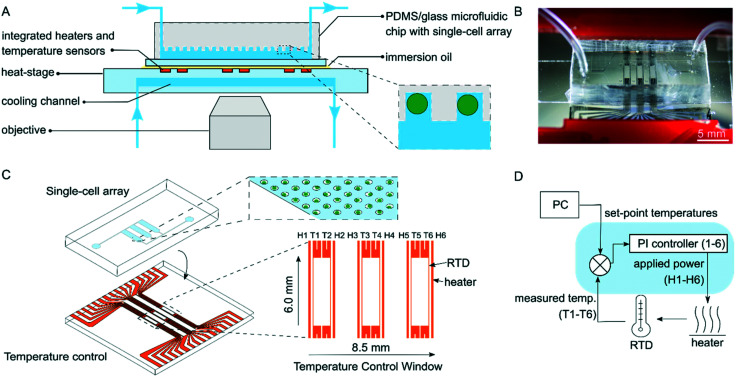
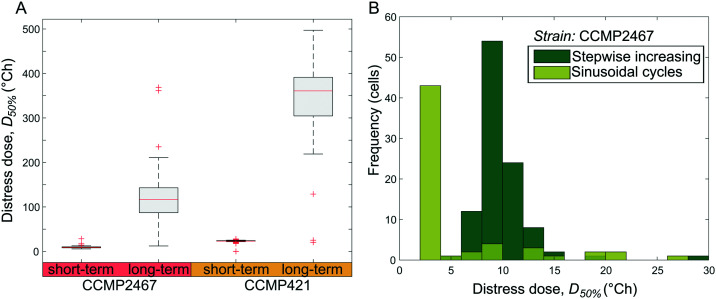
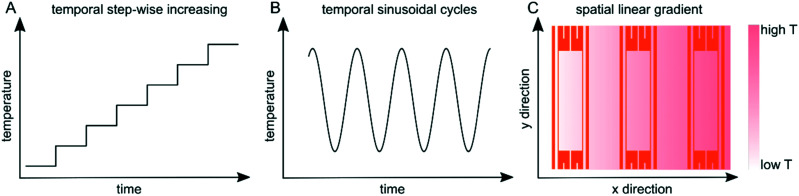
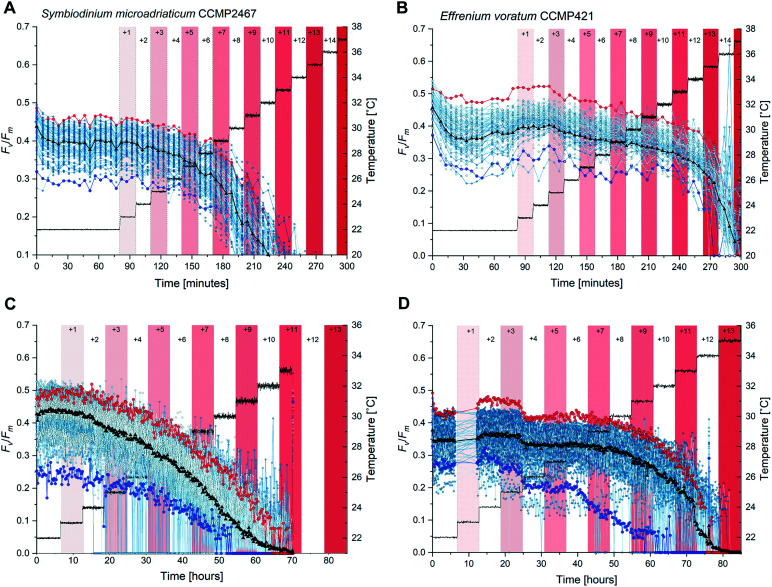
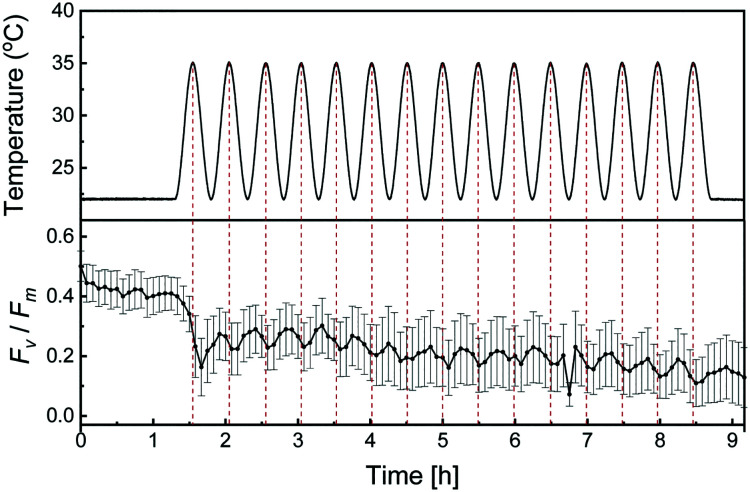
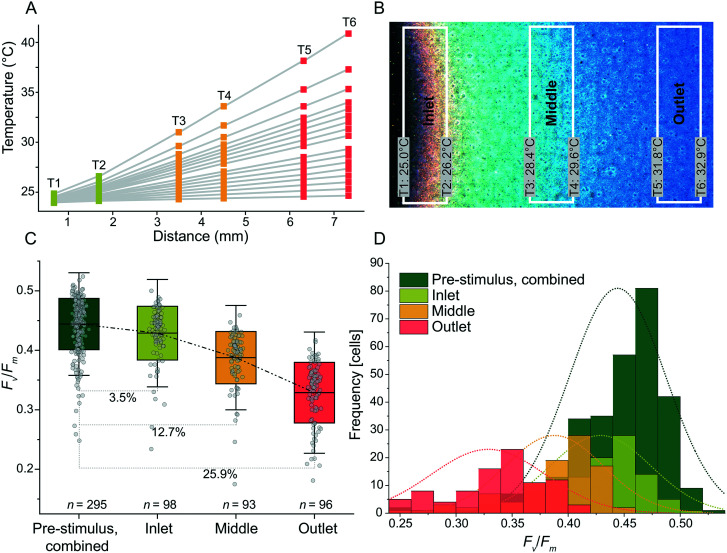
This work describes a programmable heat-stage compatible with in situ microscopy for the accurate provision of spatiotemporally defined temperatures to different microfluidic devices. The heat-stage comprises an array of integrated thin-film Joule heaters and resistance temperature detectors (RTDs). External programming of the heat-stage is provided by a custom software program connected to temperature controllers and heater-sensor pairs. Biologically relevant (20-40 °C) temperature profiles can be supplied to cells within microfluidic devices as spatial gradients (0.5-1.5 °C mm-1) or in a time-varying approach via e.g. step-wise or sinusoidally varying profiles with negligible temperature over-shoot. Demonstration of the device is achieved by exposing two strains of the coral symbiont Symbiodinium to different temperature profiles while monitoring their single-cell photophysiology via chlorophyll fluorometry. This revealed that photophysiological responses to temperature depended on the exposure duration, exposure magnitude and strain background. Moreover, thermal dose analysis suggested that cell acclimatisation occurs under longer temperature (6 h) exposures but not under shorter temperature exposures (15 min). As the thermal sensitivity of Symbiodinium mediates the thermal tolerance in corals, our versatile technology now provides unique possibilities to research this interdependency at single cell resolution. Our results also show the potential of this heat-stage for further applications in fields such as biotechnology and ecotoxicology.
这项工作描述了一种与原位显微镜兼容的可编程加热台,可精确提供不同微流控设备的时空定义温度。该加热台由集成的薄膜焦耳加热器和电阻温度探测器 (RTD) 阵列组成。通过连接到温度控制器和加热器-传感器对的定制软件程序,可以对加热台进行外部编程。可以将与生物学相关的(20-40°C)温度分布作为空间梯度(0.5-1.5°C mm-1)提供给微流控设备内的细胞,或者通过例如逐步或正弦变化的方式提供时变温度分布,而几乎没有温度过冲。通过暴露两种珊瑚共生藻 Symbiodinium 菌株到不同的温度分布,并通过叶绿素荧光法监测它们的单细胞光生理来实现该设备的演示。这表明,对温度的光生理反应取决于暴露持续时间、暴露幅度和菌株背景。此外,热剂量分析表明,在较长时间(6 小时)的温度暴露下会发生细胞适应,但在较短时间(15 分钟)的温度暴露下则不会。由于 Symbiodinium 的热敏感性调节珊瑚的热耐受性,我们的多功能技术现在为在单细胞分辨率下研究这种相互依存关系提供了独特的可能性。我们的结果还表明,该加热台在生物技术和生态毒理学等领域有进一步应用的潜力。