Nuffield Department of Primary Care Health Sciences, University of Oxford, Oxford.
THIS Institute, Department of Public Health and Primary Care, University of Cambridge, Cambridge.
Br J Gen Pract. 2021 Aug 26;71(710):e668-e676. doi: 10.3399/BJGP.2021.0030. Print 2021 Sep.
Endometriosis affects approximately 6-10% of women, with well documented delays between initial presentation with symptoms and diagnosis. In England, women typically seek help first in primary care, making this setting pivotal in women's pathways to diagnosis and treatment. English GP perspectives on managing possible endometriosis have not been previously reported.
To explore what GPs identify as important considerations when caring for women with symptoms that raise the possibility of endometriosis.
Qualitative study in English primary care.
Semi-structured scenario-based telephone interviews with 42 GPs from April 2019 to January 2020, based around a fictional scenario of a woman presenting to primary care with symptoms suggesting possible endometriosis. Interviews were thematically coded and analysed.
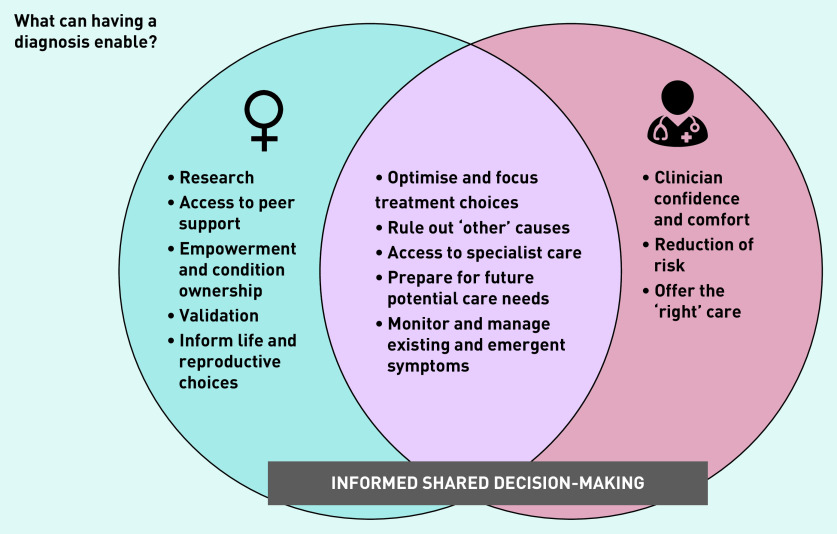
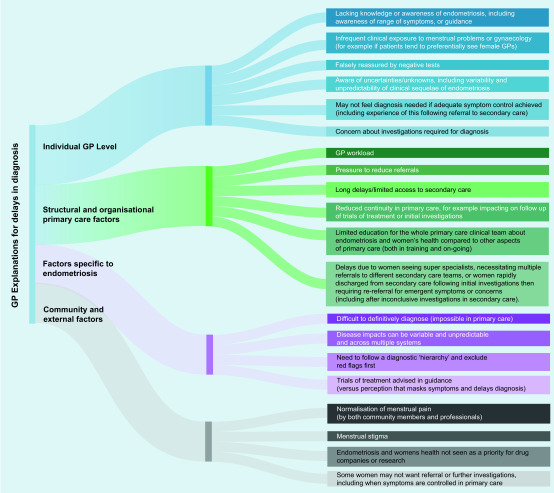
Managing possible endometriosis in primary care brings challenges. While knowledge and awareness were prerequisites for considering endometriosis, other important considerations were raised. Symptoms suggestive of endometriosis are non-specific, making endometriosis one possible consideration of many. GPs move through a diagnostic hierarchy to exclude sinister causes and utilise trials of treatment as both therapeutic interventions and diagnostic tools; processes which take time. An endometriosis label or diagnosis has advantages and risks. GPs reported sharing decisions about investigation and referral while holding women's priorities as pivotal. These conversations were underpinned by their knowledge of uncertainties and unknowns, including the wide spectrum and unpredictability of endometriosis.
GPs considerations are more complex than simply lacking awareness. The unknowns surrounding endometriosis matter to GPs. Further research and tailored resources for primary care, where women present with undifferentiated symptoms, are needed.
子宫内膜异位症影响大约 6-10%的女性,其从出现症状到确诊的时间存在明确的延迟。在英国,女性通常首先在初级保健机构寻求帮助,因此该环境在女性的诊断和治疗途径中至关重要。此前尚未报道过英国全科医生(GP)在管理疑似子宫内膜异位症时的看法。
探讨全科医生在照顾出现疑似子宫内膜异位症症状的女性时,认为哪些因素是重要的考虑因素。
在英国初级保健机构进行的定性研究。
2019 年 4 月至 2020 年 1 月,对 42 名全科医生进行了基于情景的半结构式电话访谈,访谈内容基于一名女性因疑似子宫内膜异位症症状就诊于初级保健机构的虚构情景。对访谈进行了主题编码和分析。
在初级保健中管理疑似子宫内膜异位症带来了挑战。尽管知识和意识是考虑子宫内膜异位症的前提条件,但也提出了其他重要的考虑因素。提示子宫内膜异位症的症状是非特异性的,这使得子宫内膜异位症只是众多可能原因之一。全科医生通过诊断层次结构来排除严重的病因,并利用治疗试验作为治疗干预和诊断工具;这个过程需要时间。贴上或诊断出子宫内膜异位症有其优势和风险。全科医生报告说,他们在共享调查和转诊决策的同时,将女性的优先事项视为关键。这些对话的基础是他们对不确定性和未知因素的了解,包括子宫内膜异位症的广泛谱和不可预测性。
全科医生的考虑因素比缺乏意识要复杂得多。围绕子宫内膜异位症的未知数对全科医生来说很重要。需要进一步研究和为初级保健机构提供有针对性的资源,因为女性出现的症状是未分化的。