Beck Katharina, Vincent Alessia, Becker Christoph, Keller Annalena, Cam Hasret, Schaefert Rainer, Reinhardt Thomas, Sutter Raoul, Tisljar Kai, Bassetti Stefano, Schuetz Philipp, Hunziker Sabina
Medical Communication and Psychosomatic Medicine, University Hospital Basel, Basel, Switzerland.
Division of Clinical Psychology and Psychotherapy, Faculty of Psychology, University of Basel, Basel, Switzerland.
PLoS One. 2021 May 5;16(5):e0250590. doi: 10.1371/journal.pone.0250590. eCollection 2021.
Due to the dramatic measures accompanying isolation and the general uncertainty and fear associated with COVID-19, patients and relatives may be at high risk for adverse psychological outcomes. Until now there has been limited research focusing on the prevalence of psychological distress and associated factors in COVID-19 patients and their relatives. The objective of our study was to assess psychological distress in COVID-19 patients and their relatives 30 days after hospital discharge.
In this prospective observational cohort study at two Swiss tertiary-care hospitals we included consecutive adult patients hospitalized between March and June 2020 for a proven COVID-19 and their relatives. Psychological distress was defined as symptoms of anxiety and/or depression measured with the Hospital Anxiety and Depression Scale (HADS), i.e., a score of ≥8 on the depression and/or anxiety subscale. We further evaluated symptoms of post-traumatic stress disorder (PTSD), defined as a score of ≥1.5 on the Impact of Event Scale-Revised (IES-R).
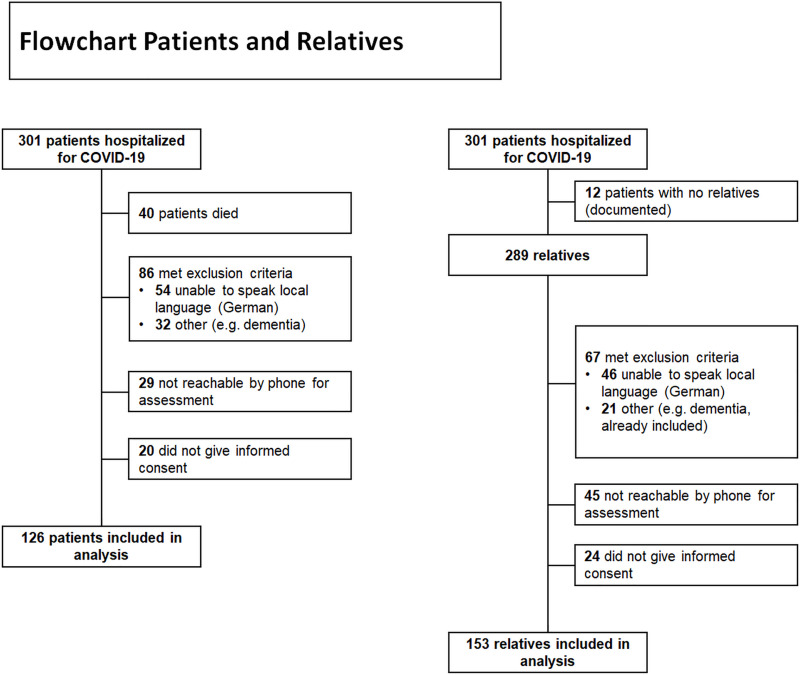
Among 126 included patients, 24 (19.1%) had psychological distress and 10 (8.7%) had symptoms of PTSD 30 days after hospital discharge. In multivariate logistic regression analyses three factors were independently associated with psychological distress in patients: resilience (OR 0.82; 95%CI 0.71 to 0.94; p = 0.005), high levels of perceived stress (OR 1.21; 95%CI 1.06 to 1.38; p = 0.006) and low frequency of contact with relatives (OR 7.67; 95%CI 1.42 to 41.58; p = 0.018). The model showed good discrimination, with an area under the receiver-operating characteristic curve (AUC) of 0.92. Among 153 relatives, 35 (22.9%) showed symptoms of psychological distress, and 3 (2%) of PTSD. For relatives, resilience was negatively associated (OR 0.85; 95%CI 0.75 to 0.96; p = 0.007), whereas perceived overall burden caused by COVID-19 was positively associated with psychological distress (OR 1.72; 95%CI 1.31 to 2.25; p<0.001). The overall model also had good discrimination, with an AUC of 0.87.
A relevant number of COVID-19 patients as well as their relatives exhibited psychological distress 30 days after hospital discharge. These results might aid in development of strategies to prevent psychological distress in COVID-19 patients and their relatives.
由于隔离措施严格,以及与2019冠状病毒病(COVID-19)相关的普遍不确定性和恐惧情绪,患者及其亲属可能面临不良心理后果的高风险。到目前为止,针对COVID-19患者及其亲属心理困扰的患病率及相关因素的研究有限。我们研究的目的是评估COVID-19患者及其亲属出院30天后的心理困扰情况。
在瑞士两家三级护理医院进行的这项前瞻性观察队列研究中,我们纳入了2020年3月至6月期间因确诊COVID-19而住院的成年患者及其亲属。心理困扰定义为用医院焦虑抑郁量表(HADS)测量的焦虑和/或抑郁症状,即抑郁和/或焦虑子量表得分≥8分。我们进一步评估创伤后应激障碍(PTSD)症状,定义为事件影响量表修订版(IES-R)得分≥1.5分。
在纳入的126例患者中,24例(19.1%)出院30天后存在心理困扰,10例(8.7%)有PTSD症状。在多因素逻辑回归分析中,有三个因素与患者的心理困扰独立相关:心理弹性(比值比[OR]0.82;95%置信区间[CI]0.71至0.94;p = 0.005)、高感知压力水平(OR 1.21;95%CI 1.06至1.38;p = 0.006)以及与亲属接触频率低(OR 7.67;95%CI 1.42至41.58;p = 0.018)。该模型显示出良好的辨别力,受试者工作特征曲线(ROC)下面积(AUC)为0.92。在153名亲属中,35例(22.9%)表现出心理困扰症状,3例(2%)有PTSD症状。对于亲属而言,心理弹性呈负相关(OR 0.85;95%CI 0.75至0.96;p = 0.007),而COVID-19导致的总体感知负担与心理困扰呈正相关(OR 1.72;95%CI 1.31至2.25;p<0.001)。总体模型也有良好的辨别力,AUC为0.87。
相当数量的COVID-19患者及其亲属在出院30天后出现心理困扰。这些结果可能有助于制定预防COVID-19患者及其亲属心理困扰的策略。