CooperVision Inc., Pleasanton, USA.
College of Optometry, University of Houston, Houston, USA.
Ophthalmic Physiol Opt. 2021 May;41(3):523-531. doi: 10.1111/opo.12812. Epub 2021 May 5.
Both emmetropic and myopic eyes elongate throughout childhood. The goals of this study were to compare axial elongation among untreated progressing myopes, progressing myopes treated with a myopia control contact lens and emmetropes, in order to place axial elongation in the context of normal eye growth in emmetropic children, and to consider whether normal physiological eye growth places limits on what might be achieved with myopia control.
Axial elongation data were taken from the 3-year randomised clinical trial of a myopia control dual-focus (MiSight® 1 day) contact lens. These were compared with data for myopic and emmetropic children in two large cohort studies: the Orinda Longitudinal Study of Myopia (OLSM) and the Singapore Cohort Study of the Risk Factors for Myopia (SCORM). Each study's published equations were used to calculate annual axial elongation. Four virtual cohorts-myopic and emmetropic for each model-were created, each with the same age distribution as the MiSight clinical trial subjects and the predicted cumulative elongation calculated at years 1, 2 and 3 for myopes and emmetropes using both the OLSM and SCORM models.
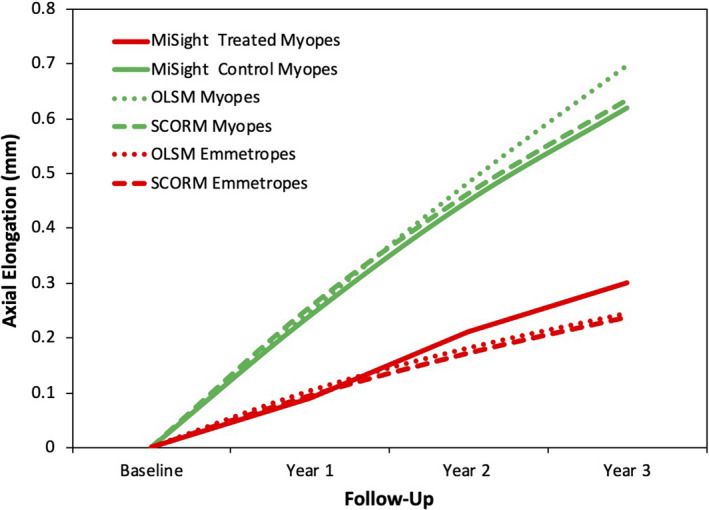
The untreated control myopes in the MiSight clinical trial showed mean axial elongation over 3 years (0.62 mm) similar to the virtual cohorts based on the OLSM (0.70 mm) and SCORM (0.65 mm) models. The predicted 3-year axial elongation for the virtual cohorts of emmetropes was 0.24 mm for both the OLSM and SCORM models-similar to the mean 3-year elongation in MiSight-treated myopes (0.30 mm).
The 3-year elongation in MiSight-treated myopes approached that of virtual cohorts of emmetropes with the same age distribution. It is hypothesised that myopic axial elongation is superimposed on an underlying physiological axial elongation observed in emmetropic eyes, which reflects increases in body stature. We speculate that optically based myopia control treatments may minimise the myopic axial elongation but retain the underlying physiological elongation observed in emmetropic eyes.
正视眼和近视眼中枢神经系统在整个儿童时期都在延长。本研究的目的是比较未经治疗的进展性近视、使用近视控制接触镜治疗的进展性近视和正视眼的轴向伸长,以便将轴向伸长置于正视儿童正常眼生长的背景下,并考虑正常生理眼生长是否限制了近视控制所能达到的效果。
轴向伸长数据来自近视控制双焦(MiSight®1 天)隐形眼镜的 3 年随机临床试验。将这些数据与两项大型队列研究(奥拉丁纵向近视研究[OLSM]和新加坡近视危险因素队列研究[SCORM])中的近视和正视儿童的数据进行比较。每个研究的已发表公式都用于计算每年的轴向伸长。创建了四个虚拟队列——每个模型的近视和正视,每个队列的年龄分布与 MiSight 临床试验受试者相同,使用 OLSM 和 SCORM 模型,分别为近视和正视计算了第 1、2 和 3 年的累积伸长。
MiSight 临床试验中未经治疗的对照组近视者在 3 年内的平均轴向伸长(0.62mm)与基于 OLSM(0.70mm)和 SCORM(0.65mm)模型的虚拟队列相似。OLSM 和 SCORM 模型的虚拟队列中,正视者的预测 3 年轴向伸长均为 0.24mm——与 MiSight 治疗的近视者的平均 3 年伸长(0.30mm)相似。
MiSight 治疗的近视者 3 年伸长接近具有相同年龄分布的虚拟正视者队列。据推测,近视的轴向伸长是在正视眼观察到的基础生理轴向伸长之上叠加的,这反映了身高的增加。我们推测,基于光学的近视控制治疗可能会最小化近视的轴向伸长,但保留正视眼中观察到的基础生理伸长。