Kearney Stephanie, Strang Niall C, Cagnolati Bastian, Gray Lyle S
Department of Vision Sciences, Glasgow Caledonian University, Glasgow, UK.
Department of Vision Sciences, Glasgow Caledonian University, Glasgow, UK.
J Optom. 2020 Apr-Jun;13(2):128-136. doi: 10.1016/j.optom.2019.12.008. Epub 2020 Jan 25.
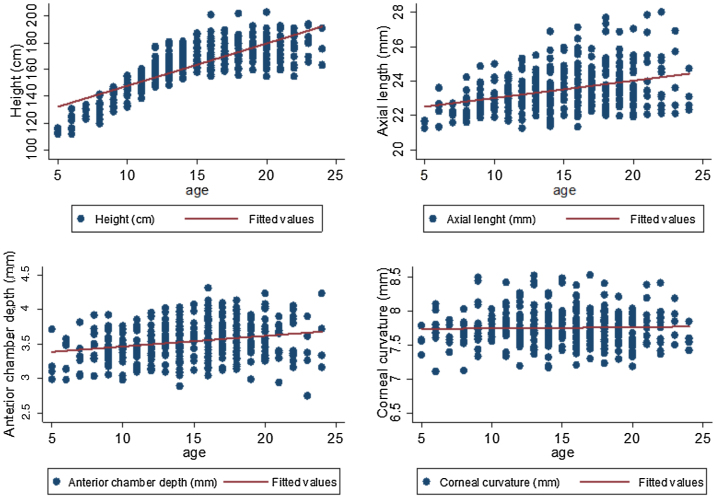
Body height and axial length (AL) increase during childhood with excessive axial elongation resulting in myopia. There is no consensus regarding the association between body growth and AL during refractive development. This study explored the association between change in body height, AL and refractive status over 4-years in children and young adults.
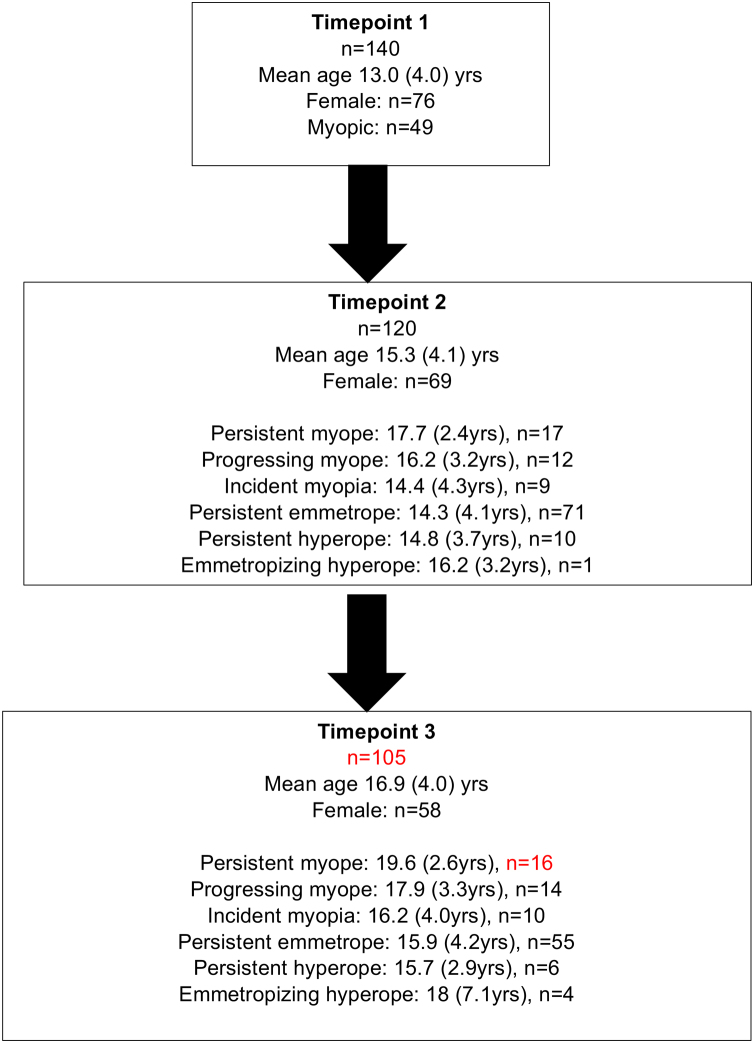
Measures were collected biennially (timepoints: t1, t2, t3) (t1 n = 140, aged 5-20years). Non-cycloplegic autorefraction was obtained using the Shin-Nippon openfield autorefractor. AL, corneal curvature (CC) and anterior chamber depth (ACD) were measured by IOL Master. Body height (cm) was measured using a wall mounted tape measure. Refractive status was classified using spherical equivalent refraction (SER): persistent emmetropes (PE) (-0.50D to +1.00D), persistent myopes (PM) (≤-0.50D), progressing myopes (PrM) (increase of ≤-0.50D between timepoints), incident myopes (IM) (subsequent SER≤-0.50D) and persistent hyperopes (PH) (>+1.00D).
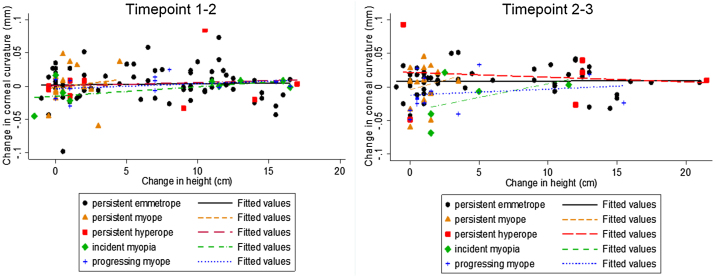
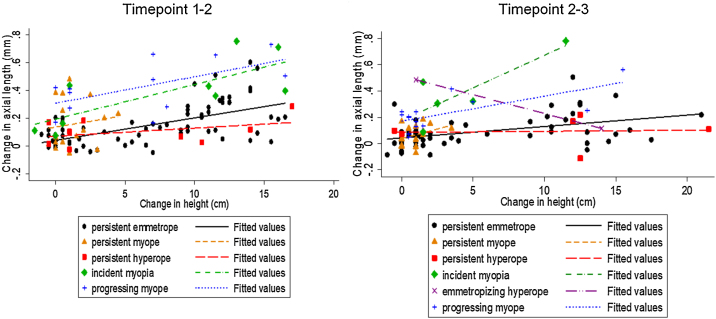
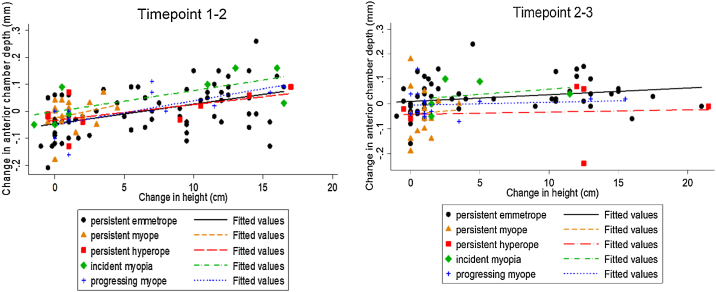
Change in AL and change in height were correlated in the PE (all t:p ≤ 0.003) and the IM (t1-t2 p = 0.04). For every increase in body height of 1 cm: t1-t2: AL increased by 0.03 mm in the PE, 0.15 in the PM, 0.11 mm in the IM, 0.14 mm in the PrM, -0.006 mm in the PH. T2-t3: AL increased by 0.02 mm in the PE, 0.06 in the PM, 0.16 mm in the PrM, 0.12 mm in the IM and -0.03 mm in the PH.
In emmetropia body growth and axial elongation are correlated. In participants with myopia, body growth appears to stabilise whilst axial elongation continues at a much faster rate indicating dysregulation of normal ocular growth.
儿童时期身高和眼轴长度(AL)会增加,过度的眼轴伸长会导致近视。在屈光发育过程中,身体生长与眼轴长度之间的关联尚无定论。本研究探讨了儿童和年轻人4年期间身高变化、眼轴长度和屈光状态之间的关联。
每两年收集一次测量数据(时间点:t1、t2、t3)(t1时n = 140,年龄5 - 20岁)。使用日本新光开放式自动验光仪进行非散瞳自动验光。使用IOL Master测量眼轴长度(AL)、角膜曲率(CC)和前房深度(ACD)。使用壁挂式卷尺测量身高(厘米)。屈光状态根据等效球镜度(SER)分类:持续性正视眼(PE)(-0.50D至+1.00D)、持续性近视眼(PM)(≤-0.50D)、进展性近视眼(PrM)(时间点之间增加≤-0.50D)、初发性近视眼(IM)(后续SER≤-0.50D)和持续性远视眼(PH)(>+1.00D)。
在持续性正视眼(所有t:p≤0.003)和初发性近视眼(t1 - t2,p = 0.04)中,眼轴长度变化与身高变化相关。身高每增加1厘米:t1 - t2:持续性正视眼中眼轴长度增加0.03毫米,持续性近视眼中增加0.15毫米,初发性近视眼中增加0.11毫米,进展性近视眼中增加0.14毫米,持续性远视眼中减少0.006毫米。t2 - t3:持续性正视眼中眼轴长度增加0.02毫米,持续性近视眼中增加0.06毫米,进展性近视眼中增加0.16毫米,初发性近视眼中增加0.12毫米,持续性远视眼中减少0.03毫米。
在正视眼中,身体生长与眼轴伸长相关。在近视参与者中,身体生长似乎稳定,而眼轴伸长继续以更快的速度进行,表明正常眼生长失调。