Seiverling Elizabeth V, Li Danielle, Stevens Kathryn, Cyr Peggy, Dorr Gregory, Ahrns Hadjh
Dermatology Division, Maine Medical Center, Portland, Maine, USA.
Tufts University School of Medicine, Boston, USA.
Dermatol Pract Concept. 2021 Apr 12;11(2):e2021030. doi: 10.5826/dpc.1102a30. eCollection 2021 Mar.
Dermoscopy aids in skin cancer identification. For family physicians who use dermoscopy, there is higher sensitivity for melanoma detection than naked-eye examination. There is a shortage of dermoscopy training for primary care providers. The triage amalgamated dermoscopic algorithm (TADA) is designed for novice dermoscopists. While TADA can be taught in a short dermoscopy workshop, spaced review and blended learning strategies improve knowledge retention.
This study determined the impact that the addition of a distance learning platform has on clinical dermoscopy use. Moreover, it evaluated dermoscopic image identification (knowledge retention) following the addition of distance learning via Extension for Community Health Outcomes (ECHO) to a traditional TADA dermoscopy workshop.
Primary care providers voluntarily attended a 120-minute TADA dermoscopy workshop. Participants completed pre-intervention, post-TADA, and post-ECHO tests of 30 dermoscopic images of benign and malignant skin lesions. A survey was also administered to analyze clinical dermoscopy use and prior dermoscopy training.
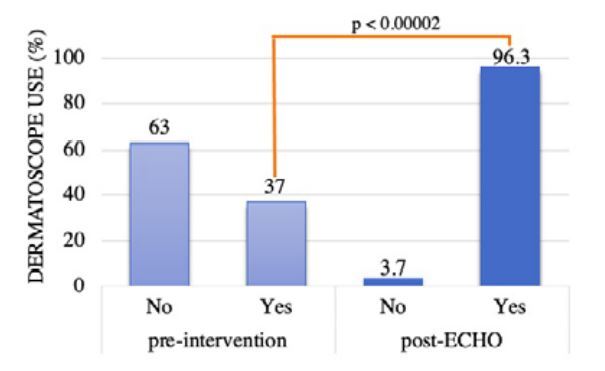
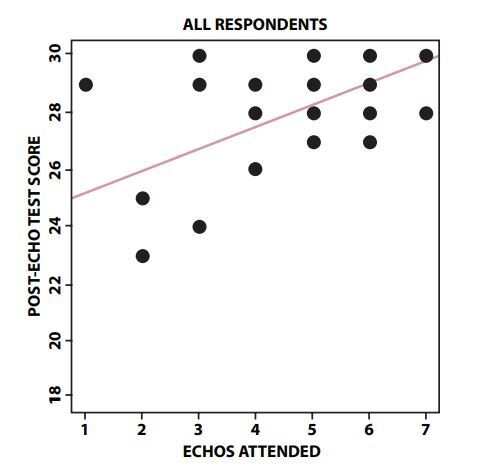
Twenty-seven residents, faculty, and advanced practice providers participated in this longitudinal observational cohort study. Mean test scores (out of 30) for images of benign and malignant lesions improved from 20.29 pre-intervention to 24.62 post-TADA and 27.63 post-ECHO (P < .001). On average, participants attended 4 ECHO sessions (out of 7 total) and there was a positive correlation ( = 0.77) between the number of ECHOs attended and post-ECHO scores. Dermoscope use increased from 37.0% to 96.3% (P < .001).
Distance learning and spaced review complement dermoscopy workshop training for primary care.
皮肤镜检查有助于皮肤癌的识别。对于使用皮肤镜的家庭医生来说,检测黑色素瘤的敏感性高于肉眼检查。初级保健提供者缺乏皮肤镜检查培训。分诊合并皮肤镜算法(TADA)是为新手皮肤镜检查者设计的。虽然TADA可以在一个简短的皮肤镜检查工作坊中教授,但间隔复习和混合学习策略可提高知识保留率。
本研究确定添加远程学习平台对临床皮肤镜检查使用的影响。此外,它还评估了通过社区健康结果扩展(ECHO)将远程学习添加到传统TADA皮肤镜检查工作坊后皮肤镜图像识别(知识保留)情况。
初级保健提供者自愿参加了一个120分钟的TADA皮肤镜检查工作坊。参与者完成了对30张良性和恶性皮肤病变皮肤镜图像的干预前、TADA后和ECHO后测试。还进行了一项调查,以分析临床皮肤镜检查的使用情况和先前的皮肤镜检查培训。
27名住院医师、教员和高级执业提供者参与了这项纵向观察性队列研究。良性和恶性病变图像的平均测试分数(满分30分)从干预前的20.29分提高到TADA后的24.62分和ECHO后的27.63分(P <.001)。参与者平均参加了4次ECHO课程(共7次),参加ECHO课程的次数与ECHO后分数之间存在正相关(r = 0.77)。皮肤镜的使用从37.0%增加到96.3%(P <.001)。
远程学习和间隔复习补充了初级保健的皮肤镜检查工作坊培训。