Bian Tianyuan, Meng Wen, Qiu Meihong, Zhong Zhigang, Lin Zhengrong, Zou Junjie, Wang Yibo, Huang Xiaowei, Xu Lisheng, Yuan Tifei, Huang Zhili, Niu Lili, Meng Long, Zheng Hairong
Institute of Biomedical and Health Engineering, Shenzhen Institutes of Advanced Technology, Chinese Academy of Sciences, 1068 Xueyuan Avenue, Shenzhen, China 518055.
Department of Pharmacology, School of Basic Medical Sciences, Fudan University, Shanghai, China 200032.
Research (Wash D C). 2021 Apr 12;2021:2674692. doi: 10.34133/2021/2674692. eCollection 2021.
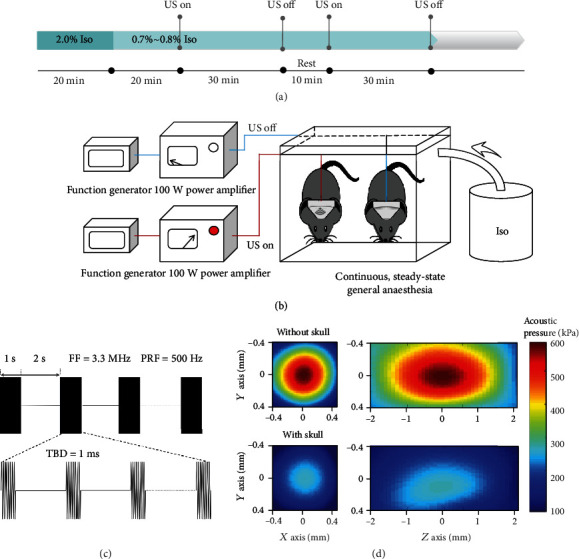
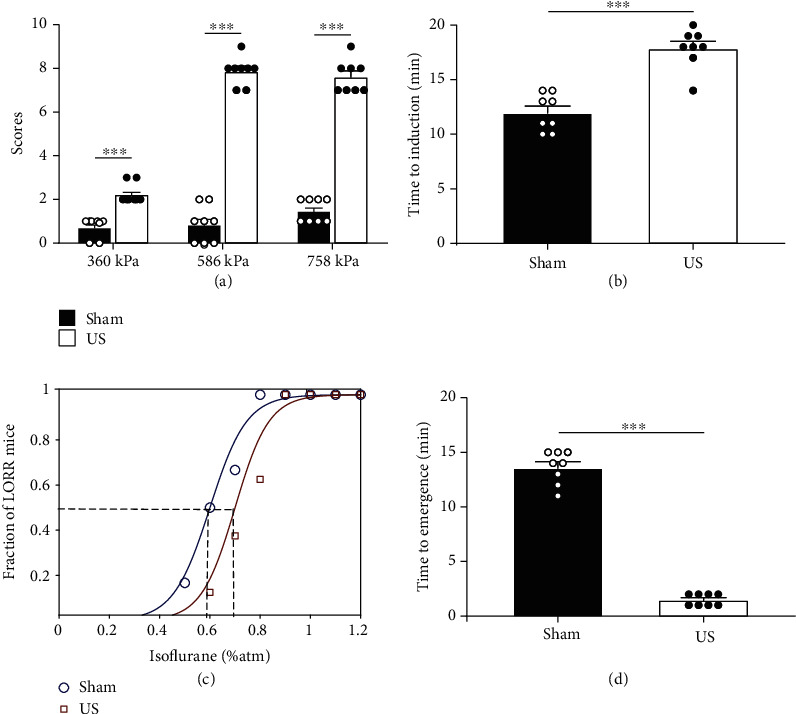
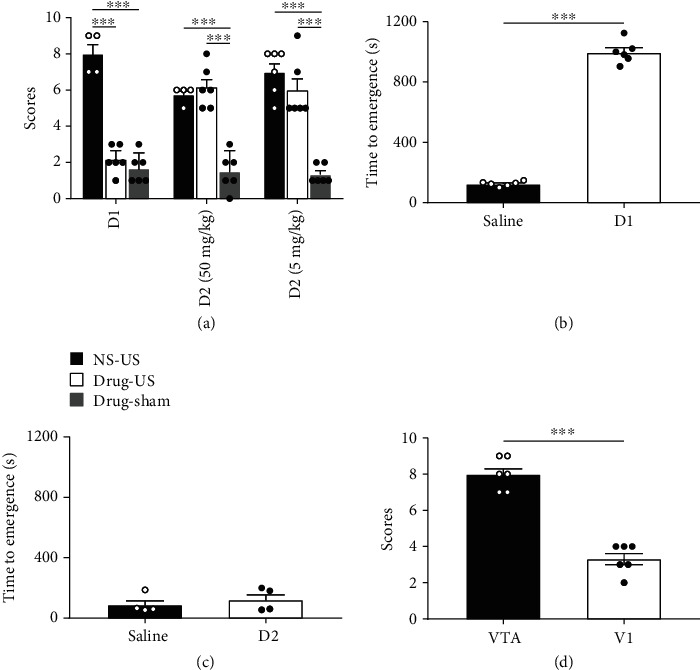
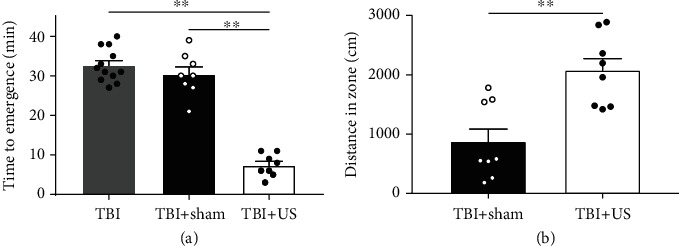
Evidence in animals suggests that deep brain stimulation or optogenetics can be used for recovery from disorders of consciousness (DOC). However, these treatments require invasive procedures. This report presents a noninvasive strategy to stimulate central nervous system neurons selectively for recovery from DOC in mice. Through the delivery of ultrasound energy to the ventral tegmental area, mice were aroused from an unconscious, anaesthetized state in this study, and this process was controlled by adjusting the ultrasound parameters. The mice in the sham group under isoflurane-induced, continuous, steady-state general anaesthesia did not regain their righting reflex. On insonation, the emergence time from inhaled isoflurane anaesthesia decreased (sham: 13.63 ± 0.53 min, ultrasound: 1.5 ± 0.19 min, < 0.001). Further, the induction time (sham: 12.0 ± 0.6 min, ultrasound: 17.88 ± 0.64 min, < 0.001) and the concentration for 50% of the maximal effect (EC50) of isoflurane (sham: 0.6%, ultrasound: 0.7%) increased. In addition, ultrasound stimulation reduced the recovery time in mice with traumatic brain injury (sham: 30.38 ± 1.9 min, ultrasound: 7.38 ± 1.02 min, < 0.01). This noninvasive strategy could be used on demand to promote emergence from DOC and may be a potential treatment for such disorders.
动物实验证据表明,深部脑刺激或光遗传学可用于意识障碍(DOC)的恢复。然而,这些治疗需要侵入性操作。本报告提出了一种非侵入性策略,用于选择性刺激中枢神经系统神经元,以促进小鼠从DOC中恢复。在本研究中,通过向腹侧被盖区传递超声能量,可使小鼠从无意识的麻醉状态中苏醒,并且该过程可通过调整超声参数进行控制。在异氟烷诱导的持续、稳态全身麻醉下,假手术组小鼠未恢复翻正反射。在超声照射时,从吸入异氟烷麻醉中苏醒的时间缩短(假手术组:13.63±0.53分钟,超声组:1.5±0.19分钟,<0.001)。此外,诱导时间(假手术组:12.0±0.6分钟,超声组:17.88±0.64分钟,<0.001)以及异氟烷最大效应的50%时的浓度(EC50)(假手术组:0.6%,超声组:0.7%)增加。此外,超声刺激缩短了创伤性脑损伤小鼠的恢复时间(假手术组:30.38±1.9分钟,超声组:7.38±1.02分钟,<0.01)。这种非侵入性策略可按需用于促进从DOC中苏醒,可能是治疗此类疾病的一种潜在方法。