The Zeeman Institute for Systems Biology & Infectious Disease Epidemiology Research, School of Life Sciences and Mathematics Institute, University of Warwick, Coventry, United Kingdom.
PLoS Comput Biol. 2021 May 6;17(5):e1008849. doi: 10.1371/journal.pcbi.1008849. eCollection 2021 May.
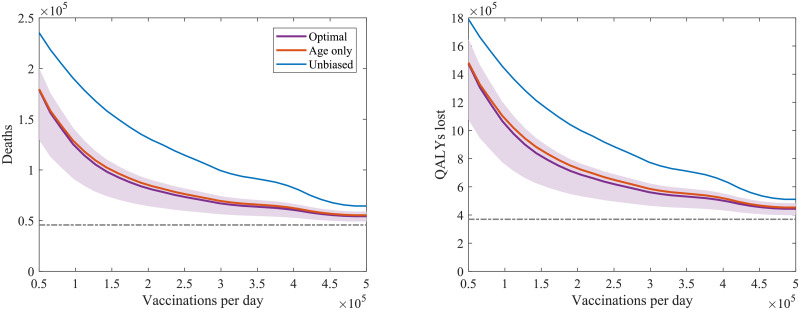
The COVID-19 outbreak has highlighted our vulnerability to novel infections. Faced with this threat and no effective treatment, in line with many other countries, the UK adopted enforced social distancing (lockdown) to reduce transmission-successfully reducing the reproductive number R below one. However, given the large pool of susceptible individuals that remain, complete relaxation of controls is likely to generate a substantial further outbreak. Vaccination remains the only foreseeable means of both containing the infection and returning to normal interactions and behaviour. Here, we consider the optimal targeting of vaccination within the UK, with the aim of minimising future deaths or quality adjusted life year (QALY) losses. We show that, for a range of assumptions on the action and efficacy of the vaccine, targeting older age groups first is optimal and may be sufficient to stem the epidemic if the vaccine prevents transmission as well as disease.
新冠疫情爆发凸显了我们对新型感染的脆弱性。面对这一威胁,又没有有效的治疗方法,英国与许多其他国家一样,采取了强制性的社会隔离(封锁)措施来减少传播,成功地将繁殖数 R 降低到 1 以下。然而,考虑到仍然存在大量易感人群,如果完全放松控制,很可能会引发大规模的进一步爆发。疫苗接种仍然是控制感染和恢复正常互动和行为的唯一可预见手段。在这里,我们考虑在英国境内进行疫苗接种的最佳目标,旨在将未来的死亡人数或质量调整生命年(QALY)损失降到最低。我们表明,对于疫苗的作用和功效的一系列假设,首先针对老年人群体是最优的,如果疫苗能够预防传播和疾病,那么可能足以阻止疫情。