Emara Aala'a, Shah Rishma
OMFS Department, Faculty of Dentistry, Cairo University, Cairo, Egypt.
Division of Craniofacial and Surgical Care, University of North Carolina (UNC) School of Dentistry, Chapel Hill, NC, USA.
J Tissue Eng. 2021 Apr 20;12:20417314211003735. doi: 10.1177/20417314211003735. eCollection 2021 Jan-Dec.
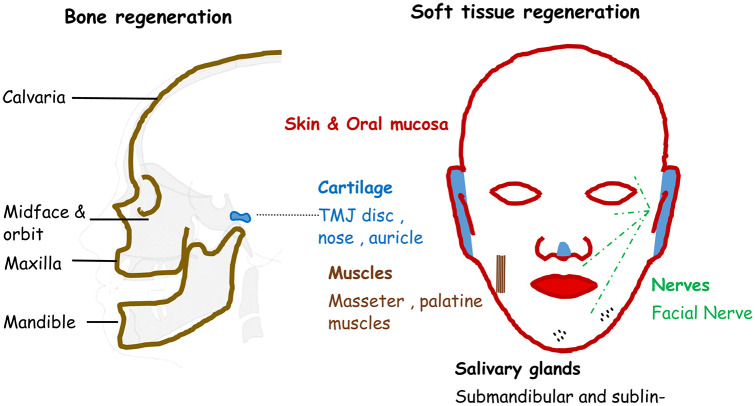
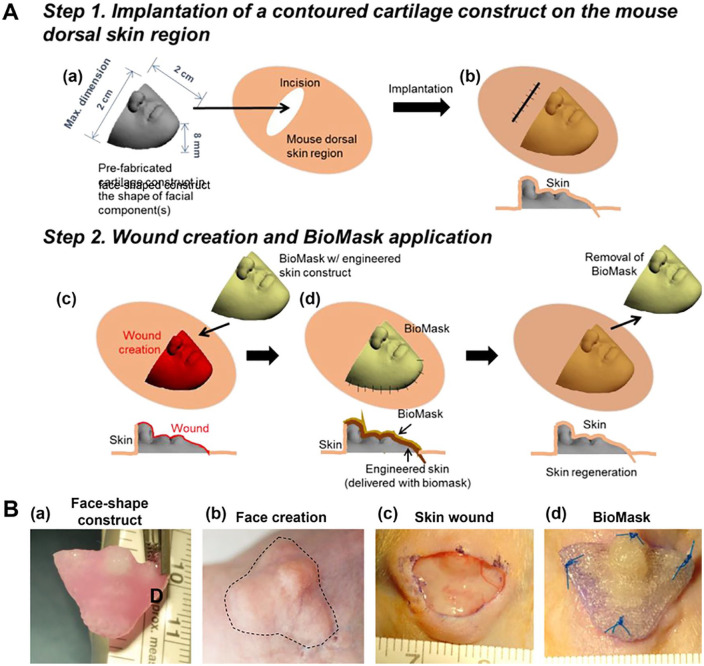
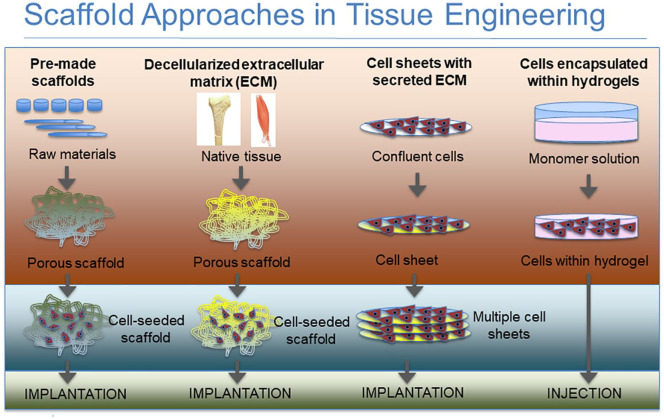
The craniofacial region consists of several different tissue types. These tissues are quite commonly affected by traumatic/pathologic tissue loss which has so far been traditionally treated by grafting procedures. With the complications and drawbacks of grafting procedures, the emerging field of regenerative medicine has proved potential. Tissue engineering advancements and the application in the craniofacial region is quickly gaining momentum although most research is still at early in vitro/in vivo stages. We aim to provide an overview on where research stands now in tissue engineering of craniofacial tissue; namely bone, cartilage muscle, skin, periodontal ligament, and mucosa. Abstracts and full-text English articles discussing techniques used for tissue engineering/regeneration of these tissue types were summarized in this article. The future perspectives and how current technological advancements and different material applications are enhancing tissue engineering procedures are also highlighted. Clinically, patients with craniofacial defects need hybrid reconstruction techniques to overcome the complexity of these defects. Cost-effectiveness and cost-efficiency are also required in such defects. The results of the studies covered in this review confirm the potential of craniofacial tissue engineering strategies as an alternative to avoid the problems of currently employed techniques. Furthermore, 3D printing advances may allow for fabrication of patient-specific tissue engineered constructs which should improve post-operative esthetic results of reconstruction. There are on the other hand still many challenges that clearly require further research in order to catch up with engineering of other parts of the human body.
颅面部区域由几种不同的组织类型组成。这些组织很常见地受到创伤性/病理性组织缺损的影响,到目前为止,传统上一直通过移植手术进行治疗。鉴于移植手术的并发症和缺点,再生医学这一新兴领域已展现出潜力。尽管大多数研究仍处于早期的体外/体内阶段,但组织工程学的进展及其在颅面部区域的应用正在迅速发展。我们旨在概述目前颅面部组织工程学的研究现状;即骨、软骨、肌肉、皮肤、牙周韧带和黏膜。本文总结了讨论这些组织类型的组织工程/再生所用技术的英文摘要和全文文章。还强调了未来的前景以及当前的技术进步和不同材料应用如何促进组织工程手术。临床上,颅面部缺损患者需要混合重建技术来克服这些缺损的复杂性。对于此类缺损,还需要考虑成本效益和成本效率。本综述涵盖的研究结果证实了颅面部组织工程策略作为一种替代方法的潜力,以避免当前所用技术存在的问题。此外,3D打印技术的进步可能允许制造针对患者的组织工程构建体,这应该会改善重建术后的美学效果。另一方面,仍然存在许多挑战,显然需要进一步研究,以便赶上人体其他部位的工程学发展。