Faculty of Brain Sciences, Division of Psychiatry, University College of London, London, United Kingdom.
Departments of Psychiatry and Neurology Services, Center for Neural Systems Investigation, Center for Morphometric Analysis, Athinoula A. Martinos Center for Biomedical Imaging, Massachusetts General Hospital, Boston, Massachusetts, USA.
Hum Brain Mapp. 2021 Aug 1;42(11):3561-3575. doi: 10.1002/hbm.25454. Epub 2021 May 7.
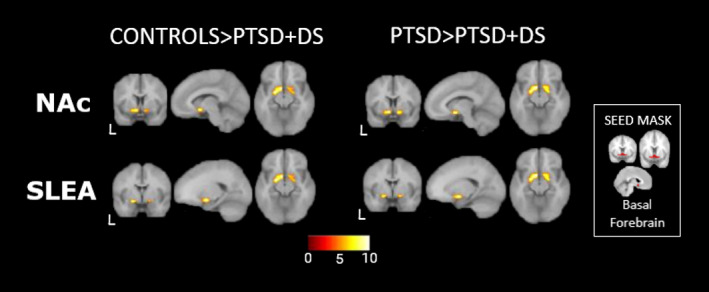
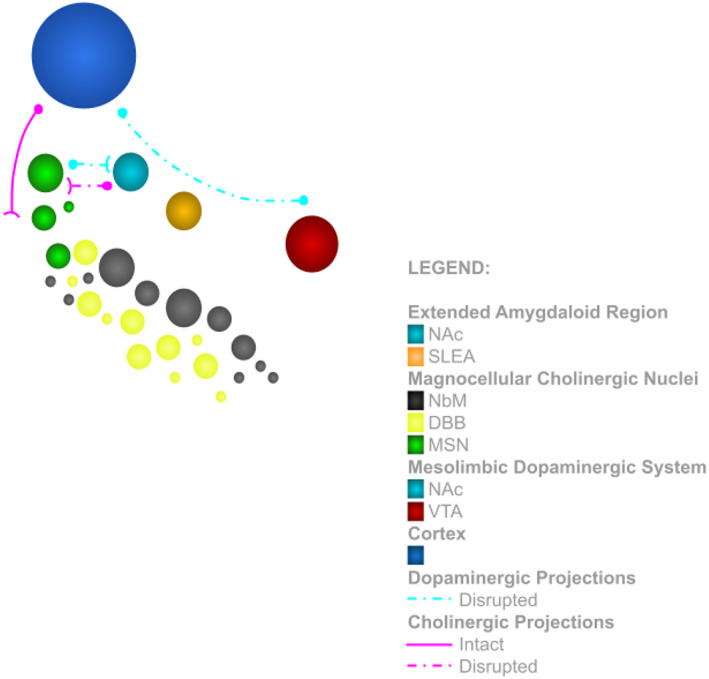
Individuals with posttraumatic stress disorder (PTSD) are at increased risk for the development of various forms of dementia. Nevertheless, the neuropathological link between PTSD and neurodegeneration remains unclear. Degeneration of the human basal forebrain constitutes a pathological hallmark of neurodegenerative diseases, such as Alzheimer's and Parkinson's disease. In this seed-based resting-state (rs-)fMRI study identifying as outcome measure the temporal BOLD signal fluctuation magnitude, a seed-to-voxel analyses assessed temporal correlations between the average BOLD signal within a bilateral whole basal forebrain region-of-interest and each whole-brain voxel among individuals with PTSD (n = 65), its dissociative subtype (PTSD+DS) (n = 38) and healthy controls (n = 46). We found that compared both with the PTSD and healthy controls groups, the PTSD+DS group exhibited increased BOLD signal variability within two nuclei of the seed region, specifically in its extended amygdaloid region: the nucleus accumbens and the sublenticular extended amygdala. This finding is provocative, because it mimics staging models of neurodegenerative diseases reporting allocation of neuropathology in early disease stages circumscribed to the basal forebrain. Here, underlying candidate etiopathogenetic mechanisms are neurovascular uncoupling, decreased connectivity in local- and large-scale neural networks, or disrupted mesolimbic dopaminergic circuitry, acting indirectly upon the basal forebrain cholinergic pathways. These abnormalities may underpin reward-related deficits representing a putative link between persistent traumatic memory in PTSD and anterograde memory deficits in neurodegeneration. Observed alterations of the basal forebrain in the dissociative subtype of PTSD point towards the urgent need for further exploration of this region as a potential candidate vulnerability mechanism for neurodegeneration in PTSD.
创伤后应激障碍(PTSD)患者发生各种形式痴呆的风险增加。然而,PTSD 与神经退行性变之间的神经病理学联系仍不清楚。人类基底前脑的退化是神经退行性疾病(如阿尔茨海默病和帕金森病)的病理标志之一。在这项基于种子的静息态(rs)功能磁共振成像研究中,以时间 BOLD 信号波动幅度作为结果测量指标,采用种子到体素分析评估了 PTSD 个体(n=65)、其分离型亚型(PTSD+DS)(n=38)和健康对照组(n=46)双侧全基底前脑感兴趣区(ROI)内平均 BOLD 信号与每个全脑体素之间的时间相关性。我们发现,与 PTSD 组和健康对照组相比,PTSD+DS 组在种子区域的两个核内表现出更大的 BOLD 信号变异性,特别是在其扩展杏仁核区域:伏隔核和亚侧杏仁核扩展区。这一发现很有启发性,因为它模仿了神经退行性疾病的分期模型,报告了在基底前脑局限的早期疾病阶段分配的神经病理学。在这里,潜在的候选发病机制是神经血管解耦、局部和大规模神经网络连接减少,或中边缘多巴胺能回路中断,这些机制间接作用于基底前脑胆碱能通路。这些异常可能是 PTSD 中持续创伤记忆和神经退行性变中顺行记忆缺陷的潜在联系的基础。PTSD 分离型亚型中基底前脑的观察到的改变表明,迫切需要进一步探索该区域作为 PTSD 中神经退行性变的潜在候选脆弱性机制。