National Environment Agency, Singapore.
Ministry of Health, Singapore.
Sci Total Environ. 2021 Sep 10;786:147419. doi: 10.1016/j.scitotenv.2021.147419. Epub 2021 Apr 29.
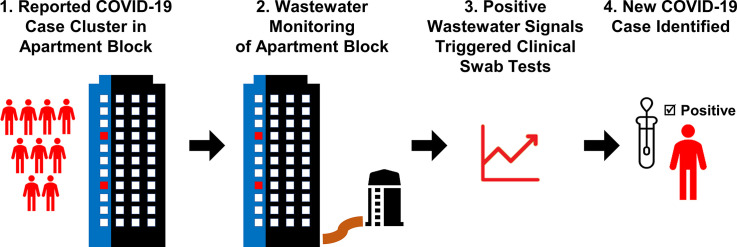
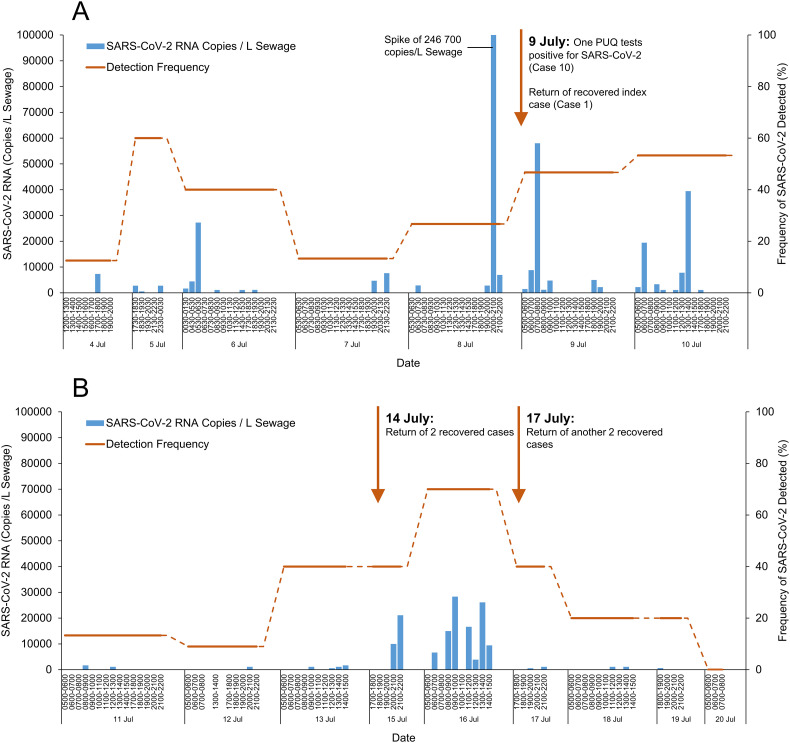
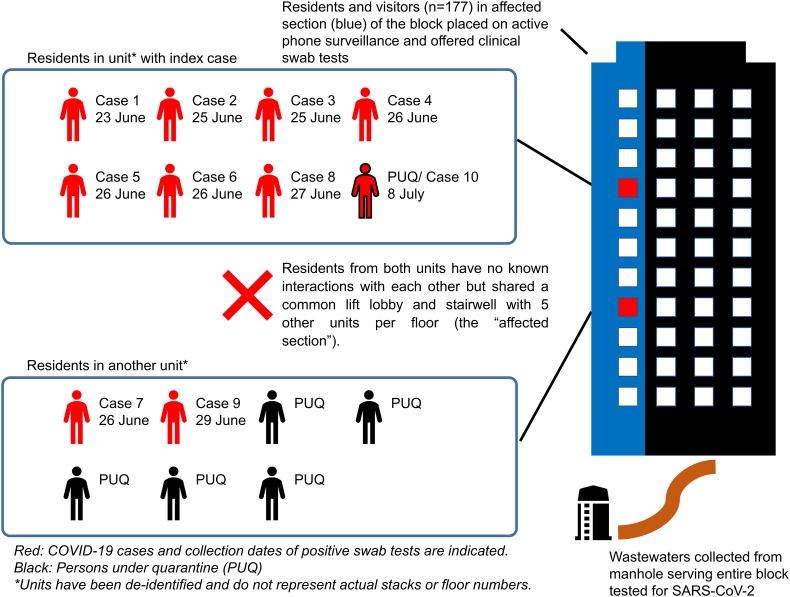
Wastewater-based surveillance for SARS-CoV-2 has been used for the early warning of transmission or objective trending of the population-level disease prevalence. Here, we describe a new use-case of conducting targeted wastewater surveillance to complement clinical testing for case identification in a small community at risk of COVID-19 transmission. On 2 July 2020, a cluster of COVID-19 cases in two unrelated households residing on different floors in the same stack of an apartment building was reported in Singapore. After cases were conveyed to healthcare facilities and six healthy household contacts were quarantined in their respective apartments, wastewater surveillance was implemented for the entire residential block. SARS-CoV-2 was subsequently detected in wastewaters in an increasing frequency and concentration, despite the absence of confirmed COVID-19 cases, suggesting the presence of fresh case/s in the building. Phone interviews of six residents in quarantine revealed that no one was symptomatic (fever/respiratory illness). However, when nasopharyngeal swabs from six quarantined residents were tested by PCR tests, one was positive for SARS-CoV-2. The positive case reported episodes of diarrhea and the case's stool sample was also positive for SARS-CoV-2, explaining the SARS-CoV-2 spikes observed in wastewaters. After the case was conveyed to a healthcare facility, wastewaters continued to yield positive signals for five days, though with a decreasing intensity. This was attributed to the return of recovered cases, who had continued to shed the virus. Our findings demonstrate the utility of wastewater surveillance as a non-intrusive tool to monitor high-risk COVID-19 premises, which is able to trigger individual tests for case detection, highlighting a new use-case for wastewater testing.
基于污水的 SARS-CoV-2 监测已被用于传播的早期预警或人群疾病流行的客观趋势。在这里,我们描述了一个新的应用案例,即在有 COVID-19 传播风险的小社区中,通过进行有针对性的污水监测来补充临床检测,以识别病例。2020 年 7 月 2 日,新加坡报告了两户无关联家庭的 COVID-19 病例聚集,这两户家庭分别居住在同一栋公寓楼同一层的不同单元。在病例被送往医疗机构后,六名健康的家庭接触者被隔离在各自的公寓中,对整个住宅街区实施了污水监测。尽管没有确诊的 COVID-19 病例,但随后在废水中越来越频繁地检测到 SARS-CoV-2,且浓度不断增加,这表明该建筑中存在新的病例。对六名被隔离居民的电话访谈显示,没有人出现症状(发烧/呼吸道疾病)。然而,当对六名被隔离的居民进行鼻咽拭子聚合酶链反应(PCR)检测时,有一人的 SARS-CoV-2 检测结果呈阳性。该阳性病例自述有腹泻症状,且其粪便样本也呈 SARS-CoV-2 阳性,这解释了在废水中观察到的 SARS-CoV-2 峰值。该病例被送往医疗机构后,污水在五天内继续呈阳性信号,尽管强度逐渐减弱。这归因于已康复的病例持续排出病毒,导致病毒重新出现。我们的研究结果表明,污水监测作为一种非侵入性工具,可用于监测高风险的 COVID-19 场所,能够触发对病例的个体检测,突显了污水检测的新用途。