Kang Weixi, Pineda Hernández Sònia, Mei Jie
Computational, Cognitive and Clinical Neuroimaging Laboratory, Division of Brain Sciences, Department of Medicine, Imperial College London, London, United Kingdom.
Euncet Business School, Polytechnic University of Catalonia, Barcelona, Spain.
Front Hum Neurosci. 2021 Apr 22;14:609312. doi: 10.3389/fnhum.2020.609312. eCollection 2020.
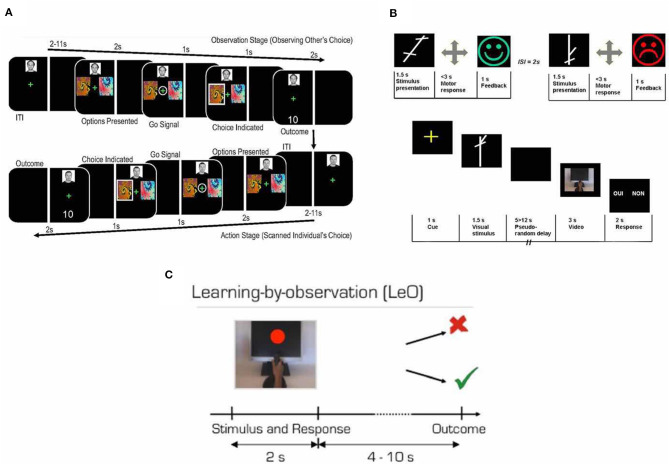
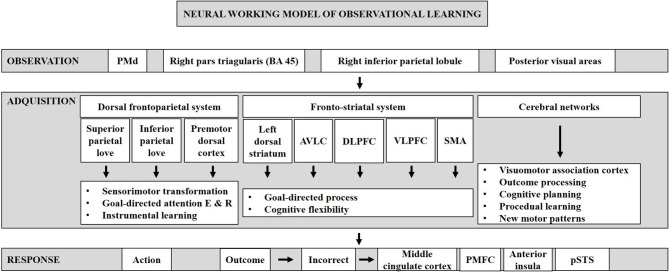
Humans and some animal species are able to learn stimulus-response (S-R) associations by observing others' behavior. It saves energy and time and avoids the danger of trying the wrong actions. Observational learning (OL) depends on the capability of mapping the actions of others into our own behaviors, processing outcomes, and combining this knowledge to serve our goals. Observational learning plays a central role in the learning of social skills, cultural knowledge, and tool use. Thus, it is one of the fundamental processes in which infants learn about and from adults (Byrne and Russon, 1998). In this paper, we review current methodological approaches employed in observational learning research. We highlight the important role of the prefrontal cortex and cognitive flexibility to support this learning process, develop a new neural working model of observational learning, illustrate how imitation relates to observational learning, and provide directions for future research.
人类和一些动物物种能够通过观察他人的行为来学习刺激-反应(S-R)关联。这节省了精力和时间,避免了尝试错误行为的危险。观察性学习(OL)依赖于将他人的行为映射到我们自己的行为、处理结果并结合这些知识以实现我们目标的能力。观察性学习在社交技能、文化知识和工具使用的学习中起着核心作用。因此,它是婴儿向成人学习以及从成人那里学习的基本过程之一(Byrne和Russon,1998)。在本文中,我们回顾了观察性学习研究中目前采用的方法。我们强调前额叶皮层和认知灵活性在支持这一学习过程中的重要作用,开发一种新的观察性学习神经工作模型,说明模仿与观察性学习的关系,并为未来的研究提供方向。