Clarke Gerard Janez Brett, Skandsen Toril, Zetterberg Henrik, Einarsen Cathrine Elisabeth, Feyling Casper, Follestad Turid, Vik Anne, Blennow Kaj, Håberg Asta Kristine
Department of Radiology and Nuclear Medicine, St. Olavs Hospital, Trondheim University Hospital, Trondheim, Norway.
Department of Neuromedicine and Movement Science, Faculty of Medicine and Health Sciences, Norwegian University of Science and Technology, NTNU, Trondheim, Norway.
Front Neurol. 2021 Apr 21;12:643743. doi: 10.3389/fneur.2021.643743. eCollection 2021.
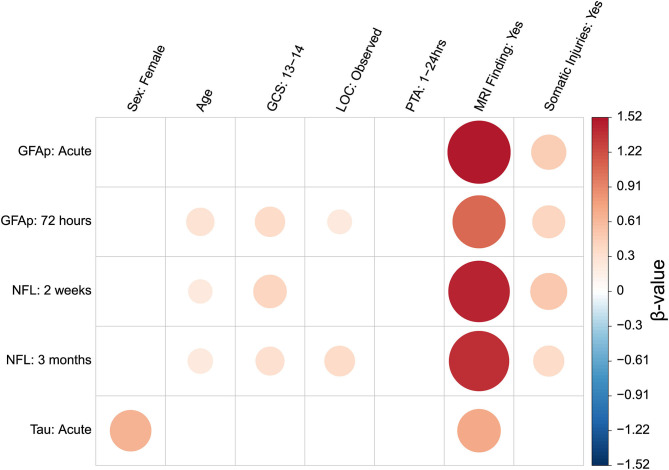
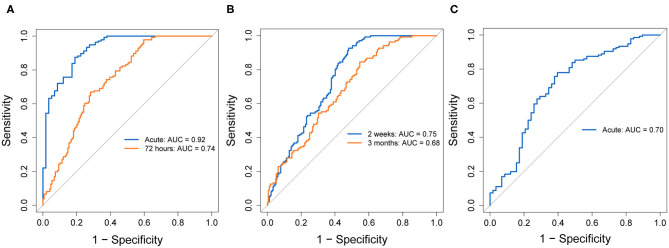
To investigate the longitudinal evolution of three blood biomarkers: neurofilament light (NFL), glial fibrillary acidic protein (GFAP) and tau, in out-patients and hospitalized patients with mild traumatic brain injury (mTBI) compared to controls, along with their associations-in patients-with clinical injury characteristics and demographic variables, and ability to discriminate patients with mTBI from controls. A longitudinal observation study including 207 patients with mTBI, 84 age and sex-matched community controls (CCs) and 52 trauma controls (TCs). Blood samples were collected at 5 timepoints: acute (<24 h), 72 h (24-72 h post-injury), 2 weeks, 3 and 12 months. Injury-related, clinical and demographic variables were obtained at inclusion and brain MRI within 72 h. Plasma GFAP and tau were most elevated acutely and NFL at 2 weeks and 3 months. The group of patients with mTBI and concurrent other somatic injuries (mTBI+) had the highest elevation in all biomarkers across time points, and were more likely to be victims of traffic accidents and violence. All biomarkers were positively associated with traumatic intracranial findings on MRI obtained within 72 h. Glial fibrillary acidic protein and NFL levels were associated with Glasgow Coma Scale (GCS) score and presence of other somatic injuries. Acute GFAP concentrations showed the highest discriminability between patients and controls with an Area Under the Curve (AUC) of 0.92. Acute tau and 2-week NFL concentrations showed moderate discriminability (AUC = 0.70 and AUC = 0.75, respectively). Tau showed high discriminability between mTBI+ and TCs (AUC = 0.80). The association of plasma NFL with traumatic intracranial MRI findings, together with its later peak, could reflect ongoing secondary injury or repair mechanisms, allowing for a protracted diagnostic time window. Patients experiencing both mTBI and other injuries appear to be a subgroup with greater neural injury, differing from both the mTBI without other injuries and from both control groups. Acute GFAP concentrations showed the highest discriminability between patients and controls, were highly associated with intracranial traumatic injury, and showed the largest elevations compared to controls at the acute timepoint, suggesting it to be the most clinically useful plasma biomarker of primary CNS injury in mTBI.
神经丝轻链(NFL)、胶质纤维酸性蛋白(GFAP)和tau,在轻度创伤性脑损伤(mTBI)门诊患者和住院患者中的纵向演变,并与对照组进行比较,以及它们在患者中与临床损伤特征和人口统计学变量的关联,以及区分mTBI患者和对照组的能力。一项纵向观察研究,纳入了207例mTBI患者、84例年龄和性别匹配的社区对照(CCs)以及52例创伤对照(TCs)。在5个时间点采集血样:急性期(<24小时)、72小时(伤后24 - 72小时)、2周、3个月和12个月。在纳入研究时获取损伤相关、临床和人口统计学变量,并在72小时内进行脑部MRI检查。血浆GFAP和tau在急性期升高最为明显,NFL在2周和3个月时升高。合并其他躯体损伤的mTBI患者组(mTBI+)在所有时间点的所有生物标志物升高幅度最大,且更有可能是交通事故和暴力的受害者。所有生物标志物均与72小时内获得的MRI上的创伤性颅内发现呈正相关。胶质纤维酸性蛋白和NFL水平与格拉斯哥昏迷量表(GCS)评分及其他躯体损伤的存在相关。急性期GFAP浓度在患者和对照组之间显示出最高的辨别能力,曲线下面积(AUC)为0.92。急性期tau和2周时的NFL浓度显示出中等辨别能力(AUC分别为0.70和0.75)。tau在mTBI+和TCs之间显示出高辨别能力(AUC = 0.80)。血浆NFL与创伤性颅内MRI发现的关联及其后期峰值,可能反映了持续的继发性损伤或修复机制,从而允许有一个延长的诊断时间窗。同时经历mTBI和其他损伤的患者似乎是一个神经损伤更严重的亚组,与未合并其他损伤的mTBI患者和两个对照组均不同。急性期GFAP浓度在患者和对照组之间显示出最高的辨别能力,与颅内创伤性损伤高度相关,并且在急性期与对照组相比升高幅度最大,表明它是mTBI中最具临床应用价值的原发性中枢神经系统损伤血浆生物标志物。