School of Public Policy and Department of Sociology and Criminology, Penn State University, University Park, PA, USA.
Department of Health Policy and Management, University of Maryland, College Park, MD, USA.
Demography. 2021 Aug 1;58(4):1171-1195. doi: 10.1215/00703370-9305166.
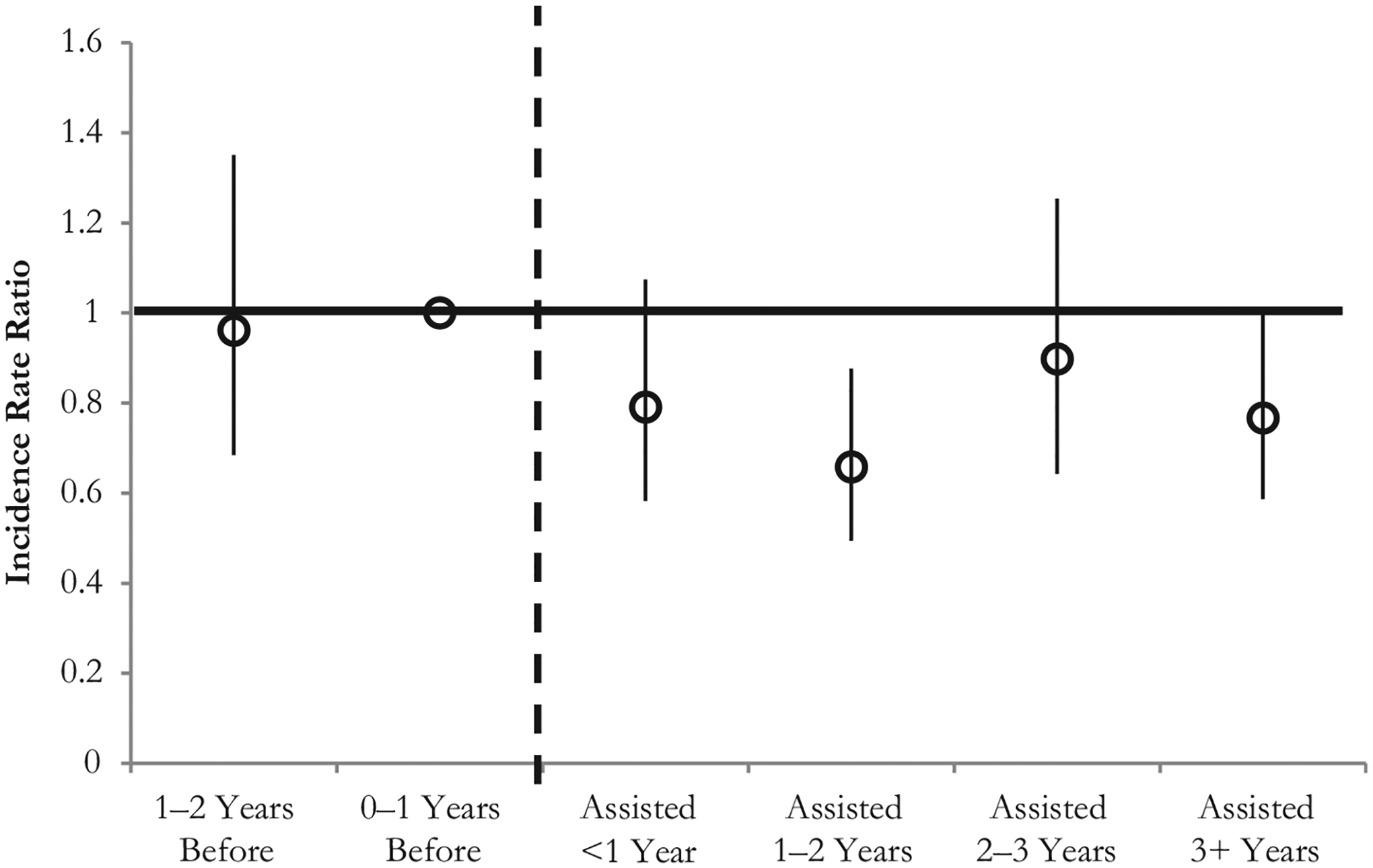
Programs that provide affordable and stable housing may contribute to better child health and thus to fewer missed days of school. Drawing on a unique linkage of survey and administrative data, we use a quasi-experimental approach to examine the impact of rental assistance programs on missed days of school due to illness. We compare missed school days due to illness among children receiving rental assistance with those who will enter assistance within two years of their interview, the average length of waitlists for federal rental assistance. Overall, we find that children who receive rental assistance miss fewer days of school due to illness relative to those in the pseudo-waitlist group. We demonstrate that rental assistance leads to a reduction in the number of health problems among children and thus to fewer days of school missed due to illness. We find that the effect of rental assistance on missed school days is stronger for adolescents than for younger children. Additionally, race-stratified analyses reveal that rental assistance leads to fewer missed days due to illness among non-Hispanic White and Hispanic/Latino children; this effect, however, is not evident for non-Hispanic Black children, the largest racial/ethnic group receiving assistance. These findings suggest that underinvestment in affordable housing may impede socioeconomic mobility among disadvantaged non-Hispanic White and Hispanic/Latino children. In contrast, increases in rental assistance may widen racial/ethnic disparities in health among disadvantaged children, and future research should examine why this benefit is not evident for Black children.
提供负担得起且稳定的住房的项目可能有助于改善儿童健康,从而减少缺课的天数。我们利用调查和行政数据的独特关联,采用准实验方法来研究租金援助计划对因疾病而缺课的影响。我们比较了接受租金援助的儿童和那些将在他们接受采访后两年内进入援助的儿童(联邦租金援助的平均候补名单长度)因疾病而缺课的天数。总体而言,我们发现接受租金援助的儿童因病缺课的天数相对较少,而在伪候补名单组的儿童则较多。我们证明租金援助导致儿童的健康问题减少,从而减少了因病缺课的天数。我们发现租金援助对青少年的缺课天数的影响比对年幼儿童的影响更大。此外,按种族分层的分析表明,租金援助可减少非西班牙裔白人和西班牙裔/拉丁裔儿童因病缺课的天数;然而,对于非西班牙裔黑人儿童,这种效果并不明显,因为他们是非裔美国人和西班牙裔/拉丁裔儿童中最大的种族/族裔群体,也是接受援助的最大群体。这些发现表明,对经济适用房的投资不足可能会阻碍处境不利的非西班牙裔白人和西班牙裔/拉丁裔儿童的社会经济流动性。相比之下,增加租金援助可能会扩大处境不利的儿童在健康方面的种族/族裔差距,未来的研究应该探讨为什么这种好处对黑人儿童不明显。