From the Department of Orthopaedic Surgery (Ms. Bhatt, Dr. Manning, Dr. Peabody), Northwestern University Feinberg School of Medicine; the Northwestern Memorial HealthCare (Ms. Davis, Dr. Barnard), Northwestern University Center for Healthcare Studies; the Department of Medical Social Sciences (Dr. Rothrock), Northwestern University Feinberg School of Medicine; and the Department of Surgery (Dr. Barnard), Feinberg School of Medicine, Northwestern University, Chicago, IL.
J Am Acad Orthop Surg Glob Res Rev. 2020 May;4(5):e2000034. doi: 10.5435/JAAOSGlobal-D-20-00034.
Despite widely appreciated barriers to successful clinical implementation, the literature regarding how to operationalize electronic health record-integrated patient-reported outcomes (PROs) remains sparse. We offer a detailed summary of the implementation of PROs into the standard of care at a major tertiary academic medical center.
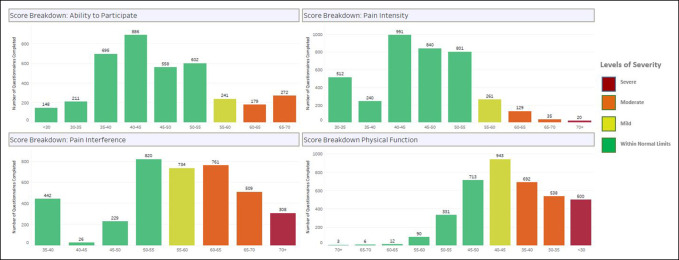
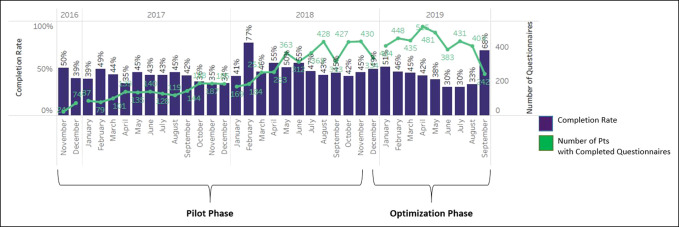
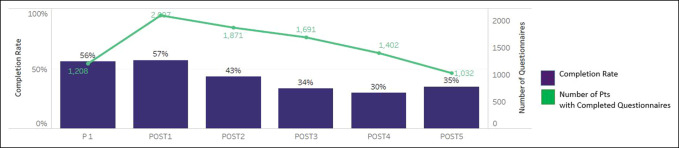
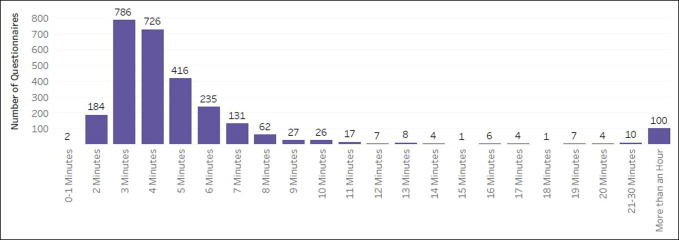
Collection of four Patient-Reported Outcomes Measurement Information System computer adaptive tests was piloted in a large academic orthopaedic surgery ambulatory clinic starting in October 2016. The Patient-Reported Outcomes Measurement Information System computer adaptive tests (Physical Function, Pain Intensity, Pain Interference, and Ability to Return to Social Roles and Activities) were initially implemented as manual order sets to be administered before surgery through 2 years after surgery. Completion rate over time, mean time to completion for all PRO domains, and the overall distribution of symptom severity were used to evaluate the success of the pilot. A subsequent optimization and redesign of the pilot was conducted using tablets, automation of questionnaire deployment, and improved results review to address obstacles encountered during the pilot phase.
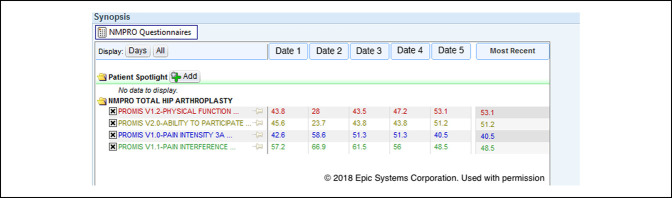
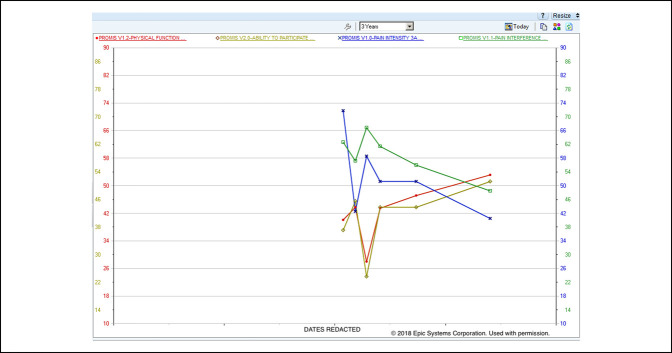
Two thousand nine distinct joint arthroplasty patients (mean age = 65) completed at least one set of PRO assessments, with overall completion rates reaching 68% and mean completion time of 3 minutes. Focal points during the implementation process included engagement and training of staff, selection of an appropriate patient population and outcome measures, and user friendly data displays for patients and providers.
Our pilot program successfully demonstrated that PROs can be administered, scored, and made immediately available within the electronic health record to patients and their providers with minimal disruption of clinical workflows. Although considerable operational and technological challenges remain, we found that the implementation of PROs in clinical care within an ambulatory practice at an academic medical center can be achieved through a constellation of several key factors.
尽管成功实施电子病历整合患者报告结局(PROs)存在广泛认可的障碍,但有关如何实现这一目标的文献仍然很少。我们详细总结了在一家主要的三级学术医疗中心将 PRO 纳入标准护理的实施情况。
从 2016 年 10 月开始,在一家大型学术骨科门诊诊所试点了四项患者报告结局测量信息系统计算机适应性测试。患者报告结局测量信息系统计算机适应性测试(身体功能、疼痛强度、疼痛干扰、以及重返社会角色和活动的能力)最初作为手动医嘱集实施,在手术前和手术后 2 年内进行管理。通过随时间推移的完成率、所有 PRO 领域的平均完成时间以及症状严重程度的总体分布,评估试点的成功情况。使用平板电脑、问卷部署自动化和改进的结果审查,对试点阶段遇到的障碍进行了后续的优化和重新设计。
2900 名不同的关节置换患者(平均年龄=65 岁)完成了至少一组 PRO 评估,总体完成率达到 68%,平均完成时间为 3 分钟。实施过程中的重点包括员工的参与和培训、选择适当的患者人群和结局测量指标,以及为患者和提供者提供用户友好的数据显示。
我们的试点项目成功地证明了 PROs 可以在电子病历中进行管理、评分,并在最小程度干扰临床工作流程的情况下立即提供给患者及其提供者。尽管仍存在相当大的运营和技术挑战,但我们发现,在学术医疗中心的门诊实践中,在临床护理中实施 PROs 可以通过一系列关键因素来实现。