Department of Cognitive, Linguistic & Psychological Sciences, Brown University, Providence, Rhode Island, United States of America.
Carney Institute for Brain Science, Brown University, Providence, Rhode Island, United States of America.
PLoS Comput Biol. 2021 May 10;17(5):e1008955. doi: 10.1371/journal.pcbi.1008955. eCollection 2021 May.
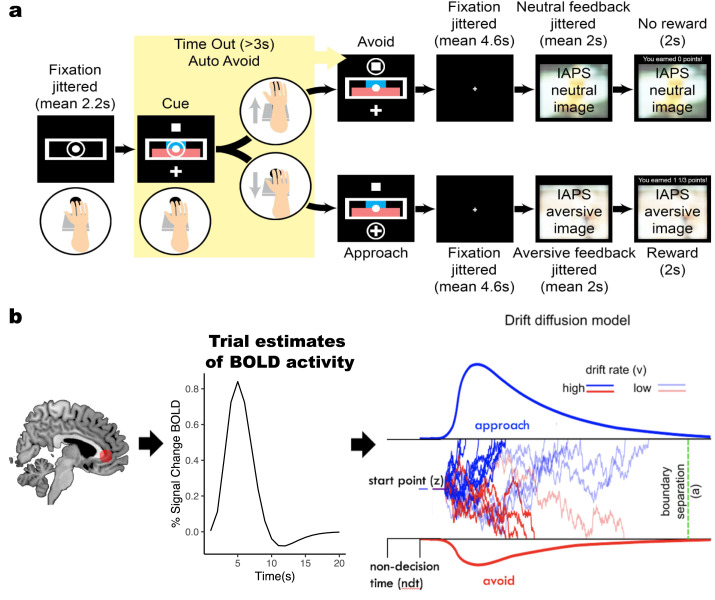
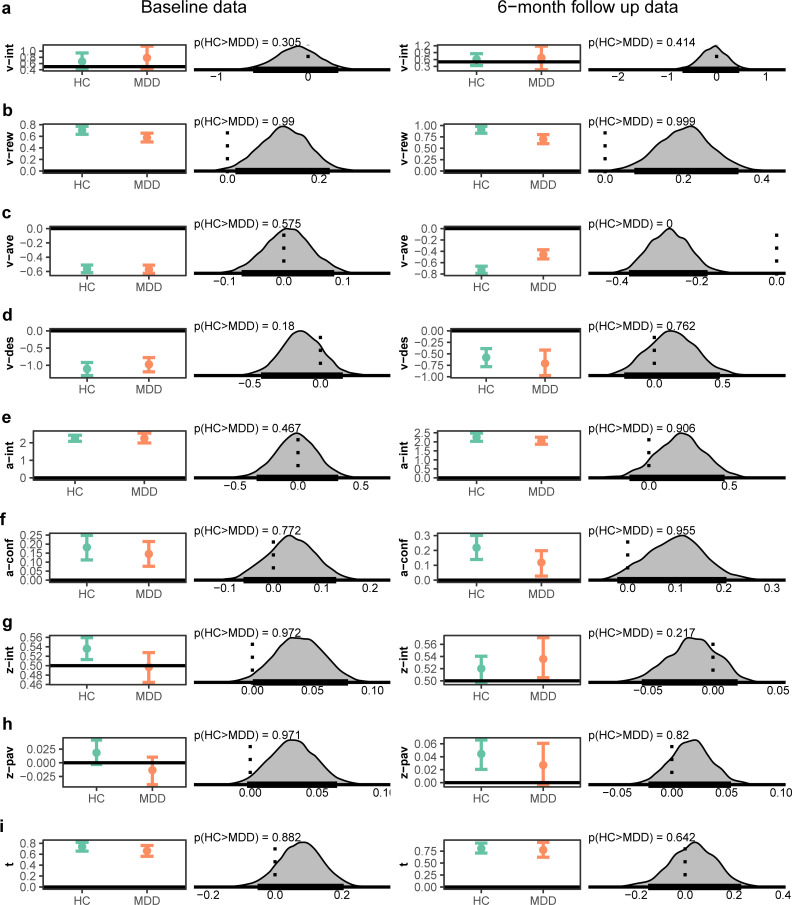
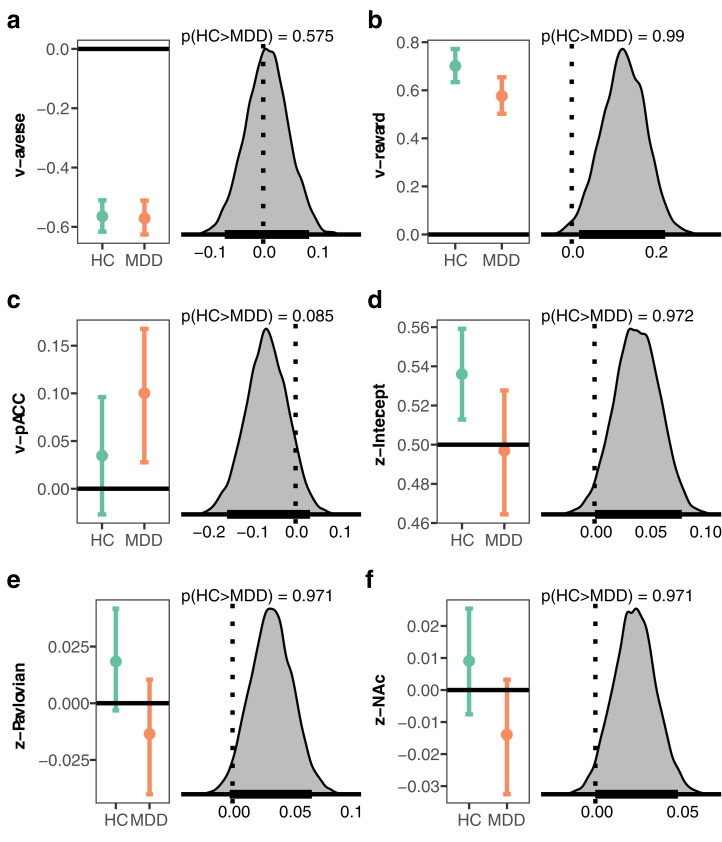
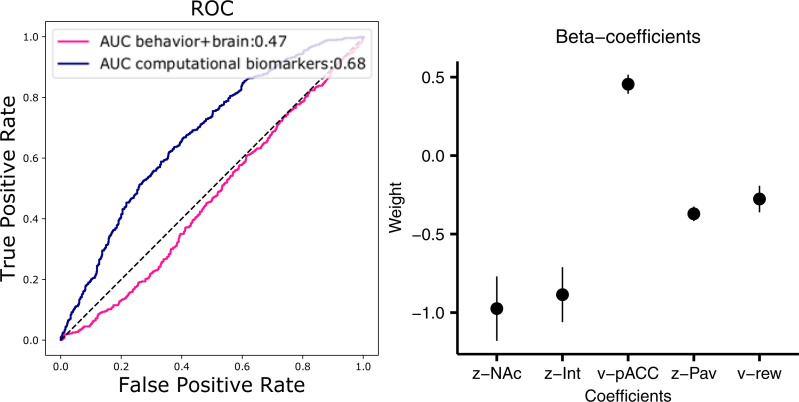
Adaptive behavior requires balancing approach and avoidance based on the rewarding and aversive consequences of actions. Imbalances in this evaluation are thought to characterize mood disorders such as major depressive disorder (MDD). We present a novel application of the drift diffusion model (DDM) suited to quantify how offers of reward and aversiveness, and neural correlates thereof, are dynamically integrated to form decisions, and how such processes are altered in MDD. Hierarchical parameter estimation from the DDM demonstrated that the MDD group differed in three distinct reward-related parameters driving approach-based decision making. First, MDD was associated with reduced reward sensitivity, measured as the impact of offered reward on evidence accumulation. Notably, this effect was replicated in a follow-up study. Second, the MDD group showed lower starting point bias towards approaching offers. Third, this starting point was influenced in opposite directions by Pavlovian effects and by nucleus accumbens activity across the groups: greater accumbens activity was related to approach bias in controls but avoid bias in MDD. Cross-validation revealed that the combination of these computational biomarkers were diagnostic of patient status, with accumbens influences being particularly diagnostic. Finally, within the MDD group, reward sensitivity and nucleus accumbens parameters were differentially related to symptoms of perceived stress and depression. Collectively, these findings establish the promise of computational psychiatry approaches to dissecting approach-avoidance decision dynamics relevant for affective disorders.
适应性行为需要根据行为的奖励和惩罚后果来平衡接近和回避。这种评估的不平衡被认为是情绪障碍(如重度抑郁症)的特征。我们提出了一种漂移扩散模型(DDM)的新应用,适用于量化奖励和厌恶的提供,以及与之相关的神经相关性,如何动态地整合形成决策,以及这些过程在 MDD 中是如何改变的。DDM 的分层参数估计表明,MDD 组在三个不同的与奖励相关的参数上有所不同,这些参数驱动着基于接近的决策。首先,MDD 与奖励敏感性降低有关,这表现为所提供的奖励对证据积累的影响。值得注意的是,这一效应在后续研究中得到了复制。其次,MDD 组表现出对接近奖励的起点偏见降低。第三,这种起点在群体之间受到巴甫洛夫效应和伏隔核活动的相反影响:伏隔核活动的增加与对照组的接近偏见有关,但与 MDD 的回避偏见有关。交叉验证表明,这些计算生物标志物的组合可以诊断患者的状态,而伏隔核的影响则特别具有诊断意义。最后,在 MDD 组中,奖励敏感性和伏隔核参数与感知压力和抑郁症状有不同的关系。总之,这些发现为计算精神病学方法在剖析与情感障碍相关的接近-回避决策动态方面提供了希望。