School of Health Sciences, University of East Anglia, Norwich, NR4 7TJ, UK.
University of Cape Town Lung Institute, Knowledge Translation Unit, University of Cape Town, Mowbray, 7700, South Africa.
Infect Dis Poverty. 2021 May 10;10(1):67. doi: 10.1186/s40249-021-00840-5.
Despite progress towards End TB Strategy targets for reducing tuberculosis (TB) incidence and deaths by 2035, South Africa remains among the top ten high-burden tuberculosis countries globally. A large challenge lies in how policies to improve detection, diagnosis and treatment completion interact with social and structural drivers of TB. Detailed understanding and theoretical development of the contextual determinants of problems in TB care is required for developing effective interventions. This article reports findings from the pre-implementation phase of a study of TB care in South Africa, contributing to HeAlth System StrEngThening in Sub-Saharan Africa (ASSET)-a five-year research programme developing and evaluating health system strengthening interventions in sub-Saharan Africa. The study aimed to develop hypothetical propositions regarding contextual determinants of problems in TB care to inform intervention development to reduce TB deaths and incidence whilst ensuring the delivery of quality integrated, person-centred care.
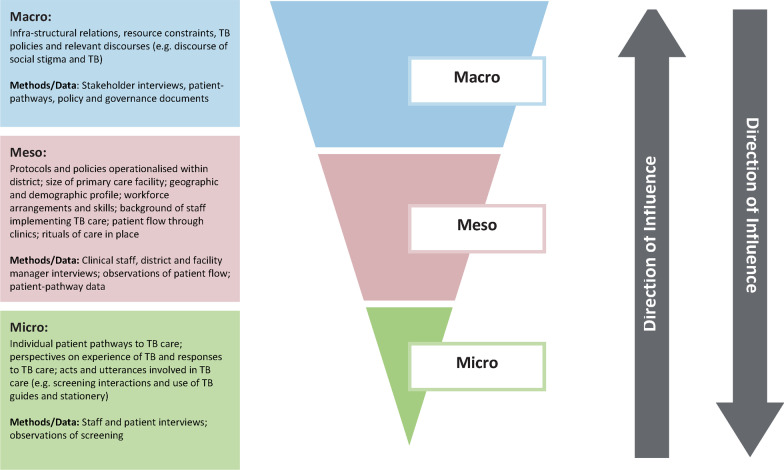
Theory-building case study design using the Context and Implementation of Complex Interventions (CICI) framework to identify contextual determinants of problems in TB care. Between February and November 2019, we used mixed methods in six public-sector primary healthcare facilities and one public-sector hospital serving impoverished urban and rural communities in the Amajuba District of KwaZulu-Natal Province, South Africa. Qualitative data included stakeholder interviews, observations and documentary analysis. Quantitative data included routine data on sputum testing and TB deaths. Data were inductively analysed and mapped onto the seven CICI contextual domains.
Delayed diagnosis was caused by interactions between fragmented healthcare provision; limited resources; verticalised care; poor TB screening, sputum collection and record-keeping. One nurse responsible for TB care, with limited integration of TB with other conditions, and policy focused on treatment adherence contributed to staff stress and limited consideration of patients' psychosocial needs. Patients were lost to follow up due to discontinuity of information, poverty, employment restrictions and limited support for treatment side-effects. Infection control measures appeared to be compromised by efforts to integrate care.
Delayed diagnosis, limited psychosocial support for patients and staff, patients lost to follow-up and inadequate infection control are caused by an interaction between multiple interacting contextual determinants. TB policy needs to resolve tensions between treating TB as epidemic and individually-experienced social problem, supporting interventions which strengthen case detection, infection control and treatment, and also promote person-centred support for healthcare professionals and patients.
尽管在实现 2035 年降低结核病(TB)发病率和死亡率的结核病防治战略目标方面取得了进展,但南非仍是全球结核病负担最重的十大国家之一。一个巨大的挑战在于,提高发现、诊断和治疗完成率的政策如何与结核病的社会和结构性驱动因素相互作用。为了制定有效的干预措施,需要深入了解和理论发展结核病护理问题的背景决定因素。本文报告了南非结核病护理研究的实施前阶段的研究结果,该研究是加强撒哈拉以南非洲卫生系统(ASSET)的五年研究方案的一部分,该方案正在开发和评估撒哈拉以南非洲的卫生系统加强干预措施。该研究旨在针对结核病护理问题的背景决定因素提出假设性命题,为减少结核病死亡和发病率的同时确保提供优质的综合以患者为中心的护理提供信息干预措施的制定。
使用复杂干预措施的背景和实施(CICI)框架进行理论构建案例研究设计,以确定结核病护理问题的背景决定因素。在 2019 年 2 月至 11 月期间,我们在南非夸祖鲁-纳塔尔省阿玛祖巴区的六家公立初级保健机构和一家公立医院使用混合方法,为贫困的城市和农村社区服务。定性数据包括利益攸关方访谈、观察和文件分析。定量数据包括痰检和结核病死亡的常规数据。数据采用归纳法进行分析,并映射到 CICI 的七个背景领域。
由于医疗服务碎片化;资源有限;垂直化护理;结核病筛查、痰标本采集和记录不佳,导致诊断延迟。一名负责结核病护理的护士,结核病与其他疾病的整合有限,以及注重治疗依从性的政策,导致工作人员压力大,对患者的心理社会需求考虑不足。由于信息不连续、贫困、就业限制和对治疗副作用的支持有限,患者失去随访。控制感染的措施似乎因整合护理的努力而受到影响。
诊断延迟、患者和工作人员的心理社会支持有限、患者失访以及感染控制不足,是由多种相互作用的背景决定因素相互作用引起的。结核病政策需要解决将结核病作为传染病和个体经历的社会问题来治疗之间的紧张关系,支持加强病例发现、感染控制和治疗的干预措施,并促进医护人员和患者的以患者为中心的支持。