• 文献检索
  • 文档翻译
  • 深度研究
  • 学术资讯
  • Suppr Zotero 插件Zotero 插件
  • 邀请有礼
  • 套餐&价格
  • 历史记录
应用&插件
Suppr Zotero 插件Zotero 插件浏览器插件Mac 客户端Windows 客户端微信小程序
定价
高级版会员购买积分包购买API积分包
服务
文献检索文档翻译深度研究API 文档MCP 服务
关于我们
关于 Suppr公司介绍联系我们用户协议隐私条款
关注我们

Suppr 超能文献

核心技术专利:CN118964589B侵权必究
粤ICP备2023148730 号-1Suppr @ 2026

文献检索

告别复杂PubMed语法,用中文像聊天一样搜索,搜遍4000万医学文献。AI智能推荐,让科研检索更轻松。

立即免费搜索

文件翻译

保留排版,准确专业,支持PDF/Word/PPT等文件格式,支持 12+语言互译。

免费翻译文档

深度研究

AI帮你快速写综述,25分钟生成高质量综述,智能提取关键信息,辅助科研写作。

立即免费体验

社交媒体与 COVID-19 大流行早期阶段的研究出版活动:纵向趋势分析。

Social Media and Research Publication Activity During Early Stages of the COVID-19 Pandemic: Longitudinal Trend Analysis.

机构信息

National Institutes of Diabetes and Digestive and Kidney Diseases, Digestive Disease Branch, Bethesda, MD, United States.

Urologic Oncology Branch, National Cancer Institute, National Institutes of Health, Bethesda, MD, United States.

出版信息

J Med Internet Res. 2021 Jun 17;23(6):e26956. doi: 10.2196/26956.

DOI:10.2196/26956
PMID:33974550
原文链接:https://pmc.ncbi.nlm.nih.gov/articles/PMC8212965/
Abstract

BACKGROUND

The COVID-19 pandemic has highlighted the importance of rapid dissemination of scientific and medical discoveries. Current platforms available for the distribution of scientific and clinical research data and information include preprint repositories and traditional peer-reviewed journals. In recent times, social media has emerged as a helpful platform to share scientific and medical discoveries.

OBJECTIVE

This study aimed to comparatively analyze activity on social media (specifically, Twitter) and that related to publications in the form of preprint and peer-reviewed journal articles in the context of COVID-19 and gastroenterology during the early stages of the COVID-19 pandemic.

METHODS

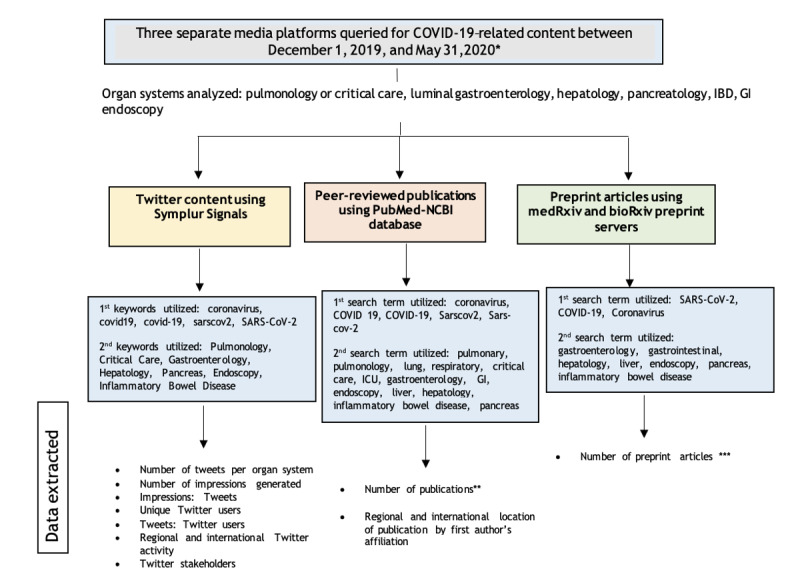
COVID-19-related data from Twitter (tweets and user data) and articles published in preprint servers (bioRxiv and medRxiv) as well as in the PubMed database were collected and analyzed during the first 6 months of the pandemic, from December 2019 through May 2020. Global and regional geographic and gastrointestinal organ-specific social media trends were compared to preprint and publication activity. Any relationship between Twitter activity and preprint articles published and that between Twitter activity and PubMed articles published overall, by organ system, and by geographic location were identified using Spearman's rank-order correlation.

RESULTS

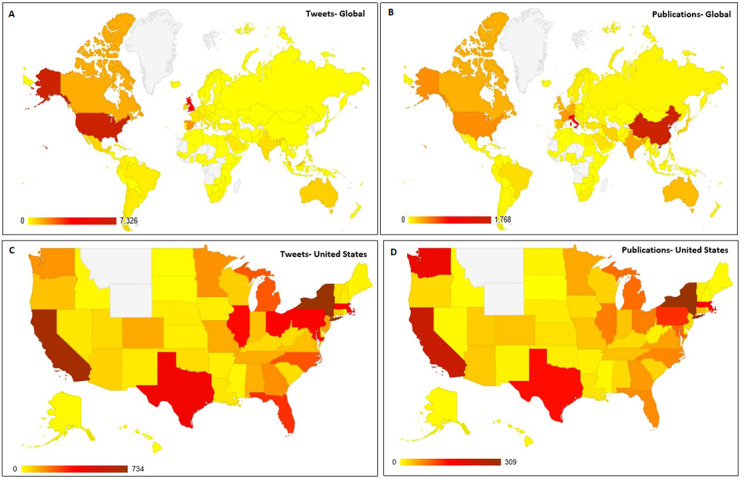
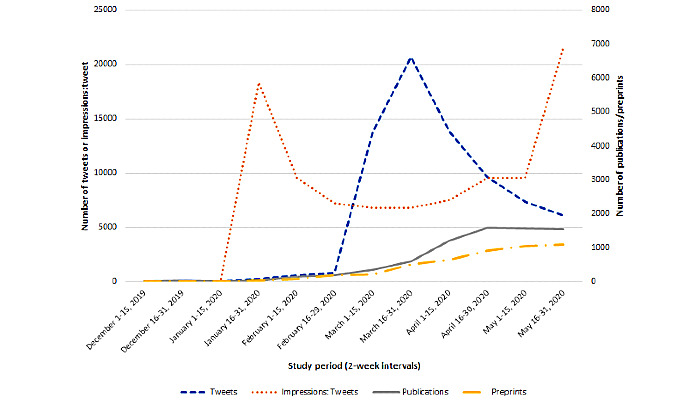
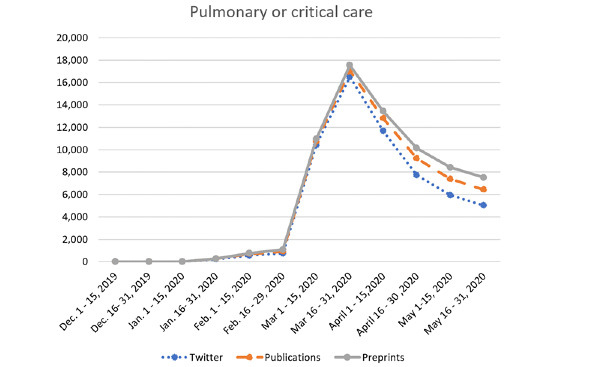
Over the 6-month period, 73,079 tweets from 44,609 users, 7164 journal publications, and 4702 preprint publications were retrieved. Twitter activity (ie, number of tweets) peaked in March 2020, whereas preprint and publication activity (ie, number of articles published) peaked in April 2020. Overall, strong correlations were identified between trends in Twitter activity and preprint and publication activity (P<.001 for both). COVID-19 data across the three platforms mainly concentrated on pulmonology or critical care, but when analyzing the field of gastroenterology specifically, most tweets pertained to pancreatology, most publications focused on hepatology, and most preprints covered hepatology and luminal gastroenterology. Furthermore, there were significant positive associations between trends in Twitter and publication activity for all gastroenterology topics (luminal gastroenterology: P=.009; hepatology and inflammatory bowel disease: P=.006; gastrointestinal endoscopy: P=.007), except pancreatology (P=.20), suggesting that Twitter activity did not correlate with publication activity for this topic. Finally, Twitter activity was the highest in the United States (7331 tweets), whereas PubMed activity was the highest in China (1768 publications).

CONCLUSIONS

The COVID-19 pandemic has highlighted the potential of social media as a vehicle for disseminating scientific information during a public health crisis. Sharing and spreading information on COVID-19 in a timely manner during the pandemic has been paramount; this was achieved at a much faster pace on social media, particularly on Twitter. Future investigation could demonstrate how social media can be used to augment and promote scholarly activity, especially as the world begins to increasingly rely on digital or virtual platforms. Scientists and clinicians should consider the use of social media in augmenting public awareness regarding their scholarly pursuits.

摘要

背景

新冠疫情凸显了快速传播科学和医学发现的重要性。目前可用于分发科学和临床研究数据和信息的平台包括预印本存储库和传统同行评议期刊。最近,社交媒体已成为分享科学和医学发现的有用平台。

目的

本研究旨在比较分析新冠疫情期间社交媒体(特别是 Twitter)上的活动与预印本和同行评议期刊文章形式的发表活动,以及新冠疫情早期的胃肠病学相关活动。

方法

从 2019 年 12 月至 2020 年 5 月,即新冠疫情的前 6 个月,收集并分析了来自 Twitter(推文和用户数据)、预印本服务器(bioRxiv 和 medRxiv)以及 PubMed 数据库的与新冠病毒相关的数据。比较了全球和区域地理以及胃肠道特定器官的社交媒体趋势与预印本和出版活动。使用 Spearman 秩相关分析确定了 Twitter 活动与预印本文章发表之间以及 Twitter 活动与 PubMed 文章发表之间的任何关系,包括按器官系统和地理位置进行的总体、按器官系统和地理位置进行的分析。

结果

在 6 个月期间,共检索到来自 44609 名用户的 73079 条推文、7164 篇期刊出版物和 4702 篇预印本出版物。Twitter 活动(即推文数量)在 2020 年 3 月达到峰值,而预印本和出版活动(即发表的文章数量)在 2020 年 4 月达到峰值。总体而言,Twitter 活动趋势与预印本和出版活动之间存在很强的相关性(两者均 P<.001)。这三个平台上的新冠病毒数据主要集中在肺病学或重症监护领域,但在专门分析胃肠病学领域时,大多数推文与胰腺炎有关,大多数出版物侧重于肝病学,大多数预印本涵盖肝病学和腔肠胃肠病学。此外,Twitter 趋势与所有胃肠病学主题的出版活动之间存在显著的正相关关系(腔肠胃肠病学:P=.009;肝病学和炎症性肠病:P=.006;胃肠内镜:P=.007),除了胰腺炎(P=.20),这表明 Twitter 活动与该主题的出版活动没有相关性。最后,Twitter 在美国的活动量最高(7331 条推文),而 PubMed 的活动量在中国最高(1768 篇出版物)。

结论

新冠疫情凸显了社交媒体作为在公共卫生危机期间传播科学信息的工具的潜力。在大流行期间及时分享和传播新冠病毒相关信息至关重要;这在社交媒体上,尤其是在 Twitter 上,实现的速度要快得多。未来的研究可以证明社交媒体如何用于增强和促进学术活动,尤其是随着世界开始越来越依赖数字或虚拟平台。科学家和临床医生应该考虑在增强公众对其学术追求的认识方面使用社交媒体。
https://cdn.ncbi.nlm.nih.gov/pmc/blobs/f320/8212965/833a8895be44/jmir_v23i6e26956_fig6.jpg
https://cdn.ncbi.nlm.nih.gov/pmc/blobs/f320/8212965/f473e48b619a/jmir_v23i6e26956_fig1.jpg
https://cdn.ncbi.nlm.nih.gov/pmc/blobs/f320/8212965/b4a5d24a8153/jmir_v23i6e26956_fig2.jpg
https://cdn.ncbi.nlm.nih.gov/pmc/blobs/f320/8212965/6e3b317a7a52/jmir_v23i6e26956_fig3.jpg
https://cdn.ncbi.nlm.nih.gov/pmc/blobs/f320/8212965/72d67c6b9dd7/jmir_v23i6e26956_fig4.jpg
https://cdn.ncbi.nlm.nih.gov/pmc/blobs/f320/8212965/c21119d31e26/jmir_v23i6e26956_fig5.jpg
https://cdn.ncbi.nlm.nih.gov/pmc/blobs/f320/8212965/833a8895be44/jmir_v23i6e26956_fig6.jpg
https://cdn.ncbi.nlm.nih.gov/pmc/blobs/f320/8212965/f473e48b619a/jmir_v23i6e26956_fig1.jpg
https://cdn.ncbi.nlm.nih.gov/pmc/blobs/f320/8212965/b4a5d24a8153/jmir_v23i6e26956_fig2.jpg
https://cdn.ncbi.nlm.nih.gov/pmc/blobs/f320/8212965/6e3b317a7a52/jmir_v23i6e26956_fig3.jpg
https://cdn.ncbi.nlm.nih.gov/pmc/blobs/f320/8212965/72d67c6b9dd7/jmir_v23i6e26956_fig4.jpg
https://cdn.ncbi.nlm.nih.gov/pmc/blobs/f320/8212965/c21119d31e26/jmir_v23i6e26956_fig5.jpg
https://cdn.ncbi.nlm.nih.gov/pmc/blobs/f320/8212965/833a8895be44/jmir_v23i6e26956_fig6.jpg

相似文献

1
Social Media and Research Publication Activity During Early Stages of the COVID-19 Pandemic: Longitudinal Trend Analysis.社交媒体与 COVID-19 大流行早期阶段的研究出版活动:纵向趋势分析。
J Med Internet Res. 2021 Jun 17;23(6):e26956. doi: 10.2196/26956.
2
COVID-19: An analysis of social media and research publication activity during the early stages of the pandemic.COVID-19:大流行早期阶段社交媒体与研究发表活动分析
medRxiv. 2020 Dec 22:2020.12.20.20248517. doi: 10.1101/2020.12.20.20248517.
3
Characterization and Reach of Orthopaedic Research Posted to Preprint Servers: Are We "Undercooking" Our Science?骨科研究论文发布到预印本服务器的特征和影响:我们的研究是否“火候不足”?
Clin Orthop Relat Res. 2023 Aug 1;481(8):1491-1500. doi: 10.1097/CORR.0000000000002621. Epub 2023 Mar 10.
4
Conversations and Medical News Frames on Twitter: Infodemiological Study on COVID-19 in South Korea.推特上的对话与医学新闻框架:韩国新冠肺炎信息流行病学研究
J Med Internet Res. 2020 May 5;22(5):e18897. doi: 10.2196/18897.
5
Temporal and Location Variations, and Link Categories for the Dissemination of COVID-19-Related Information on Twitter During the SARS-CoV-2 Outbreak in Europe: Infoveillance Study.欧洲SARS-CoV-2疫情期间推特上新冠疫情相关信息传播的时间和地点变化以及链接类别:信息监测研究
J Med Internet Res. 2020 Aug 28;22(8):e19629. doi: 10.2196/19629.
6
Using Tweets to Understand How COVID-19-Related Health Beliefs Are Affected in the Age of Social Media: Twitter Data Analysis Study.利用推文了解社交媒体时代 COVID-19 相关健康信念如何受到影响:推特数据分析研究。
J Med Internet Res. 2021 Feb 22;23(2):e26302. doi: 10.2196/26302.
7
Dissemination of Anesthesia Information During the Coronavirus Disease 2019 Pandemic Through Twitter: An Infodemiology Study.新型冠状病毒肺炎大流行期间通过 Twitter 传播的麻醉信息:一项信息流行病学研究。
Anesth Analg. 2021 Aug 1;133(2):515-525. doi: 10.1213/ANE.0000000000005602.
8
Social Media Insights Into US Mental Health During the COVID-19 Pandemic: Longitudinal Analysis of Twitter Data.社交媒体洞察美国在 COVID-19 大流行期间的心理健康状况:对 Twitter 数据的纵向分析。
J Med Internet Res. 2020 Dec 14;22(12):e21418. doi: 10.2196/21418.
9
Using Social Media for Rapid Information Dissemination in a Pandemic: #PedsICU and Coronavirus Disease 2019.利用社交媒体在大流行期间快速传播信息:#儿科 ICU 和 2019 年冠状病毒病。
Pediatr Crit Care Med. 2020 Aug;21(8):e538-e546. doi: 10.1097/PCC.0000000000002474.
10
The Asymmetric Influence of Emotion in the Sharing of COVID-19 Science on Social Media: Observational Study.情绪在社交媒体上新冠科学分享中的不对称影响:观察性研究
JMIR Infodemiology. 2022 Dec 8;2(2):e37331. doi: 10.2196/37331. eCollection 2022 Jul-Dec.

引用本文的文献

1
Research on New Methods of Topic Mining and Topic Prediction for Medical Preprints on Emerging Infectious Diseases.新发传染病医学预印本主题挖掘与主题预测新方法研究
Cureus. 2025 Jun 11;17(6):e85773. doi: 10.7759/cureus.85773. eCollection 2025 Jun.
2
Infoveillance and bibliometric analysis of COVID-19 in Nigeria.尼日利亚新冠疫情的信息监测与文献计量分析。
Public Health Chall. 2023 Mar 21;2(1):e77. doi: 10.1002/puh2.77. eCollection 2023 Mar.
3
Unveiling Topics and Emotions in Arabic Tweets Surrounding the COVID-19 Pandemic: Topic Modeling and Sentiment Analysis Approach.

本文引用的文献

1
Publishing volumes in major databases related to Covid-19.在与新冠病毒相关的主要数据库中发表论文。
Scientometrics. 2021;126(1):831-842. doi: 10.1007/s11192-020-03675-3. Epub 2020 Aug 28.
2
The Use of Social Media to Increase the Impact of Health Research: Systematic Review.利用社交媒体提高健康研究的影响力:系统评价
J Med Internet Res. 2020 Jul 6;22(7):e15607. doi: 10.2196/15607.
3
Redesign of a GI endoscopy unit during the COVID-19 emergency: A practical model.在 COVID-19 紧急情况下对 GI 内镜室进行重新设计:一种实用模型。
揭示围绕新冠疫情的阿拉伯语推文的主题与情感:主题建模与情感分析方法
JMIR Infodemiology. 2025 Feb 10;5:e53434. doi: 10.2196/53434.
4
Public Awareness of the Fencing Response as an Indicator of Traumatic Brain Injury: Quantitative Study of Twitter and Wikipedia Data.公众对作为创伤性脑损伤指标的防御反应的认知:对推特和维基百科数据的定量研究
JMIR Form Res. 2023 Mar 17;7:e39061. doi: 10.2196/39061.
5
LDA-based topic modeling for COVID-19-related sports research trends.基于潜在狄利克雷分配的新冠肺炎相关体育研究趋势主题建模
Front Psychol. 2022 Nov 14;13:1033872. doi: 10.3389/fpsyg.2022.1033872. eCollection 2022.
6
Messing with Merton: The intersection between open science practices and Mertonian values.扰乱默顿:开放科学实践与默顿价值观的交叉点。
Account Res. 2024 Jul;31(5):428-455. doi: 10.1080/08989621.2022.2141625. Epub 2022 Nov 6.
7
Impact of COVID-19 Pandemic on Biomedical Publications and Their Citation Frequency.COVID-19 大流行对生物医学出版物及其引文频次的影响。
J Korean Med Sci. 2022 Oct 17;37(40):e296. doi: 10.3346/jkms.2022.37.e296.
8
Trend clustering from COVID-19 tweets using graphical lasso-guided iterative principal component analysis.基于图型套索引导迭代主成分分析的 COVID-19 推文趋势聚类。
Sci Rep. 2022 Apr 5;12(1):5709. doi: 10.1038/s41598-022-09651-6.
9
Release and Demand of Public Health Information in Social Media During the Outbreak of COVID-19 in China.社交媒体在 2019 年中国新冠疫情爆发期间公共卫生信息的发布与需求。
Front Public Health. 2022 Feb 10;9:829589. doi: 10.3389/fpubh.2021.829589. eCollection 2021.
10
Social Media Tools for the Development of Pre-Service Health Sciences Researchers during COVID-19 in Pakistan.社交媒体工具在巴基斯坦 COVID-19 期间对卫生科学研究人员职前教育的影响
Int J Environ Res Public Health. 2022 Jan 5;19(1):581. doi: 10.3390/ijerph19010581.
Dig Liver Dis. 2020 Oct;52(10):1178-1187. doi: 10.1016/j.dld.2020.05.007. Epub 2020 May 16.
4
Is SARS-CoV-2 Also an Enteric Pathogen With Potential Fecal-Oral Transmission? A COVID-19 Virological and Clinical Review.严重急性呼吸综合征冠状病毒2(SARS-CoV-2)也是一种具有潜在粪口传播途径的肠道病原体吗?一项关于2019冠状病毒病(COVID-19)的病毒学与临床综述。
Gastroenterology. 2020 Jul;159(1):53-61. doi: 10.1053/j.gastro.2020.04.052. Epub 2020 Apr 27.
5
Health Status of Patients Who Underwent Liver Transplantation During the Coronavirus Outbreak at a Large Center in Milan, Italy.意大利米兰一家大型中心在新冠疫情期间接受肝移植患者的健康状况
Clin Gastroenterol Hepatol. 2020 Aug;18(9):2131-2133.e1. doi: 10.1016/j.cgh.2020.04.041. Epub 2020 Apr 22.
6
Characteristics and Prognosis of Patients With Inflammatory Bowel Disease During the SARS-CoV-2 Pandemic in the Basque Country (Spain).西班牙巴斯克地区新冠疫情期间炎症性肠病患者的特征与预后
Gastroenterology. 2020 Aug;159(2):781-783. doi: 10.1053/j.gastro.2020.04.043. Epub 2020 Apr 21.
7
Inflammatory Bowel Diseases and COVID-19: The Invisible Enemy.炎症性肠病与2019冠状病毒病:无形的敌人
Gastroenterology. 2020 Jun;158(8):2302-2304. doi: 10.1053/j.gastro.2020.04.032. Epub 2020 Apr 16.
8
Clinical Features of COVID-19-Related Liver Functional Abnormality.新型冠状病毒病相关肝功能异常的临床特征。
Clin Gastroenterol Hepatol. 2020 Jun;18(7):1561-1566. doi: 10.1016/j.cgh.2020.04.002. Epub 2020 Apr 10.
9
Management of Patients With Crohn's Disease and Ulcerative Colitis During the Coronavirus Disease-2019 Pandemic: Results of an International Meeting.2019冠状病毒病大流行期间克罗恩病和溃疡性结肠炎患者的管理:一次国际会议的结果
Gastroenterology. 2020 Jul;159(1):6-13.e6. doi: 10.1053/j.gastro.2020.04.002. Epub 2020 Apr 6.
10
Social Media and Emergency Preparedness in Response to Novel Coronavirus.社交媒体与应对新型冠状病毒的应急准备
JAMA. 2020 May 26;323(20):2011-2012. doi: 10.1001/jama.2020.4469.