State Key Laboratory of Pollution Control & Resource Reuse, School of the Environment, Nanjing University, Nanjing, PR China.
Lamont-Doherty Earth Observatory, Columbia University, Palisades, NY, United States of America.
PLoS One. 2021 May 11;16(5):e0250885. doi: 10.1371/journal.pone.0250885. eCollection 2021.
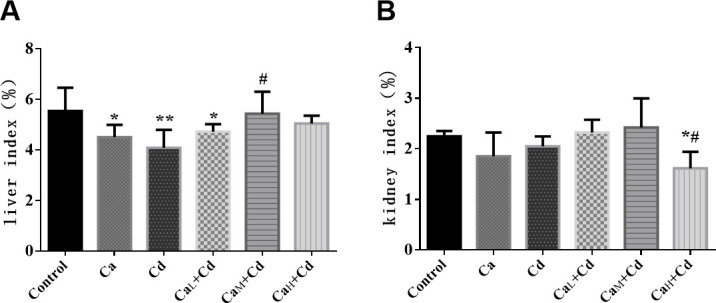
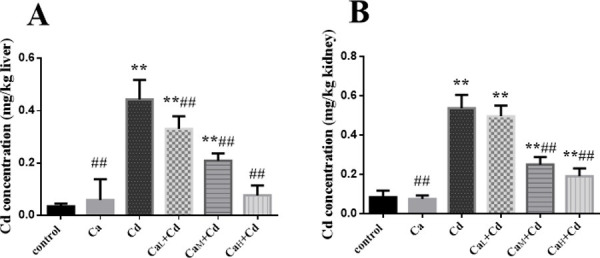
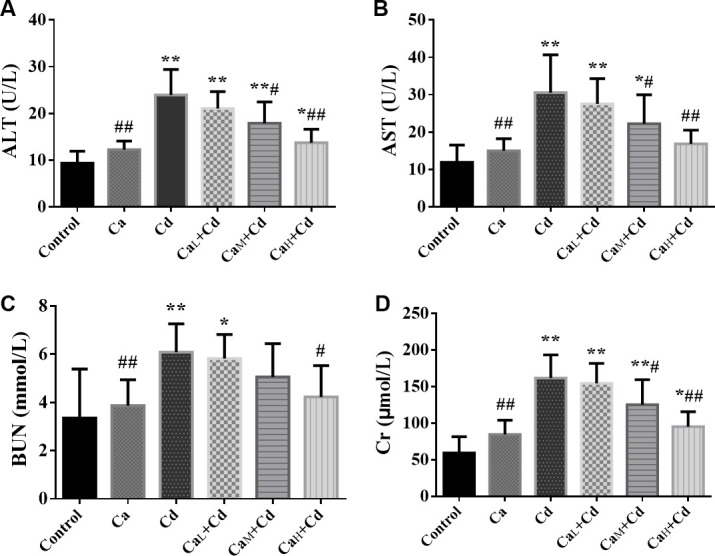
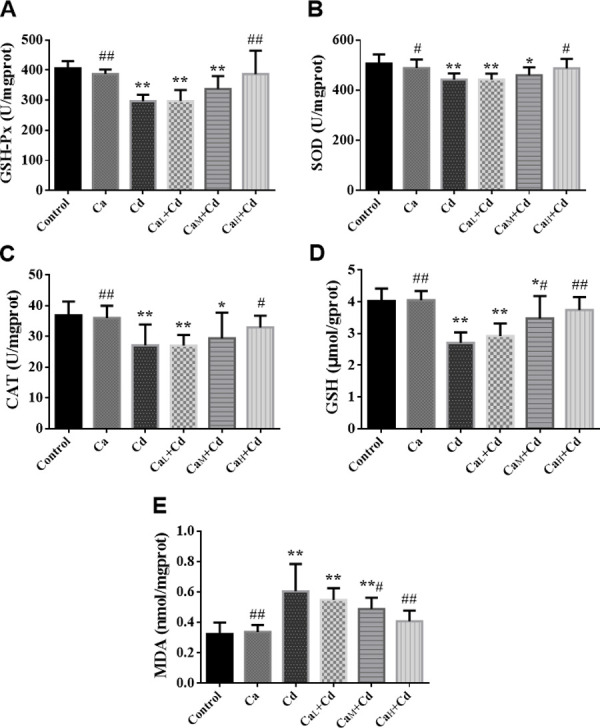
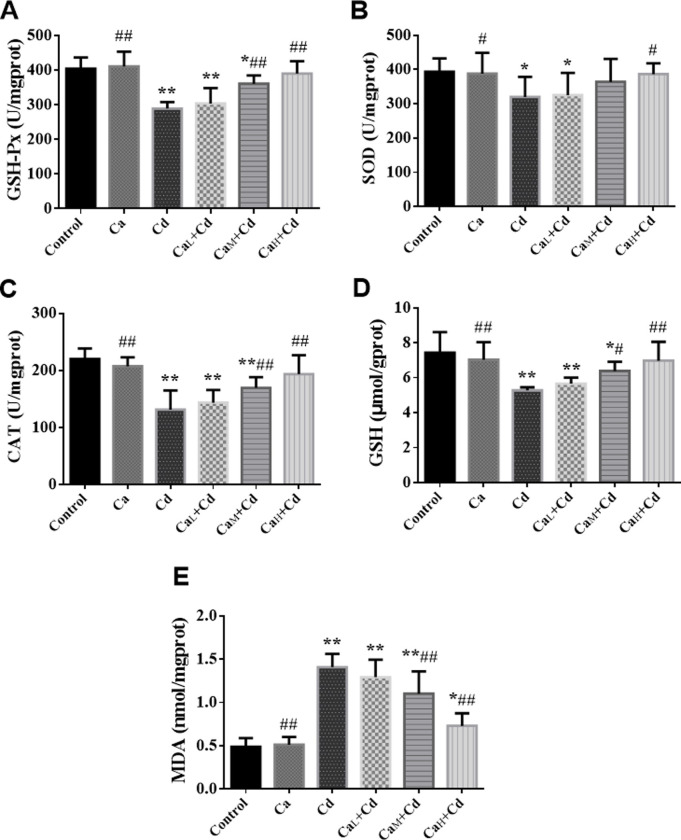
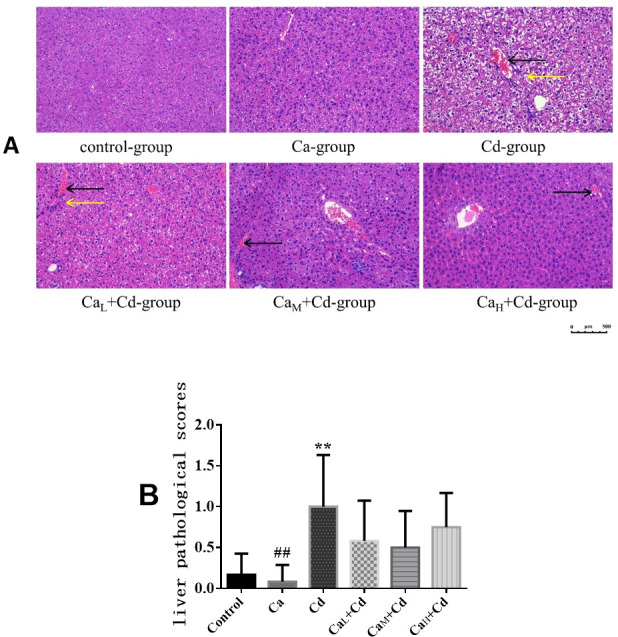
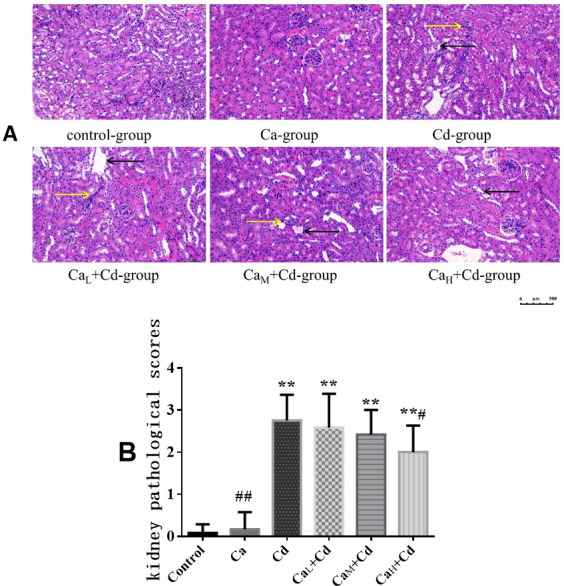
Cadmium (Cd) is a toxic non-essential element, while calcium (Ca) is an essential element with high chemical similarity to Cd. Dietary intake is the major Cd exposure pathway for non-smokers. A multi-concentration dietary intervention experiment was designed to explore the optimum concentration of Ca in diet with obvious protective effects against the toxicity of livers and kidneys induced by Cd in mice. The mice were divided into six groups with different concentrations of Cd and Ca in their food: control-group (no Cd or Ca), Ca-group (100 g/kg Ca, without Cd), Cd-group (2 mg/kg Cd, without Ca), CaL+Cd-group (2 mg/kg Cd, 2 g/kg Ca), CaM+Cd-group (2 mg/kg Cd, 20 g/kg Ca) and CaH+Cd-group (2 mg/kg Cd, 100 g/kg Ca). The organ indexes, oxidative stress biomarkers, lesions and Cd concentrations were detected after a 30-day exposure period. Results showed that serum Aspartate Aminotransferase (AST) level in CaH+Cd-group was significantly lower than that in Cd-group, while close to that in control-group. The contents of Serum Blood Urea Nitrogen (BUN) in different groups showed the same trend. Concentrations of all oxidative stress biomarkers (GSH-Px, SOD, CAT, GSH and MDA) in CaH+Cd-group were close to the normal levels of control-group while significantly different from those in Cd-group. The only exception was the Malondialdehyde (MDA) levels in kidneys. This study suggests that Ca plays a protective role in relieving the Cd-induced toxicity of livers and kidneys and a concentration of 100 g/kg for Ca in diet showed the best protective effects. These findings could provide a clue for further studies concerning human diet intervention for Cd control.
镉(Cd)是一种有毒的非必需元素,而钙(Ca)是一种必需元素,其化学性质与 Cd 高度相似。饮食摄入是非吸烟者暴露于 Cd 的主要途径。本研究设计了一个多浓度膳食干预实验,旨在探索对 Cd 诱导的肝脏和肾脏毒性具有明显保护作用的饮食中 Ca 的最佳浓度。将小鼠分为六组,每组食物中 Cd 和 Ca 的浓度不同:对照组(无 Cd 或 Ca)、Ca 组(100 g/kg Ca,无 Cd)、Cd 组(2 mg/kg Cd,无 Ca)、CaL+Cd 组(2 mg/kg Cd,2 g/kg Ca)、CaM+Cd 组(2 mg/kg Cd,20 g/kg Ca)和 CaH+Cd 组(2 mg/kg Cd,100 g/kg Ca)。暴露 30 天后,检测器官指数、氧化应激生物标志物、损伤和 Cd 浓度。结果表明,CaH+Cd 组血清天门冬氨酸氨基转移酶(AST)水平明显低于 Cd 组,接近对照组。各组血清尿素氮(BUN)含量也呈现相同趋势。CaH+Cd 组所有氧化应激生物标志物(GSH-Px、SOD、CAT、GSH 和 MDA)的含量均接近对照组的正常水平,与 Cd 组有显著差异。唯一的例外是肾脏中的丙二醛(MDA)水平。本研究表明,Ca 在缓解 Cd 诱导的肝脏和肾脏毒性方面发挥保护作用,饮食中 Ca 的浓度为 100 g/kg 时具有最佳的保护作用。这些发现为进一步研究人类饮食干预控制 Cd 提供了线索。