Institute of Animal Nutrition, Key Laboratory for Animal Disease-Resistance Nutrition of China Ministry of Education, Animal nutrition and feed Engineering Key Laboratory of Sichuan Province, Sichuan Agricultural University, Chengdu, Sichuan, 611130, China.
Institute of Animal Nutrition, Key Laboratory for Animal Disease-Resistance Nutrition of China Ministry of Education, Animal nutrition and feed Engineering Key Laboratory of Sichuan Province, Sichuan Agricultural University, Chengdu, Sichuan, 611130, China.
Poult Sci. 2021 Jun;100(6):101142. doi: 10.1016/j.psj.2021.101142. Epub 2021 Mar 21.
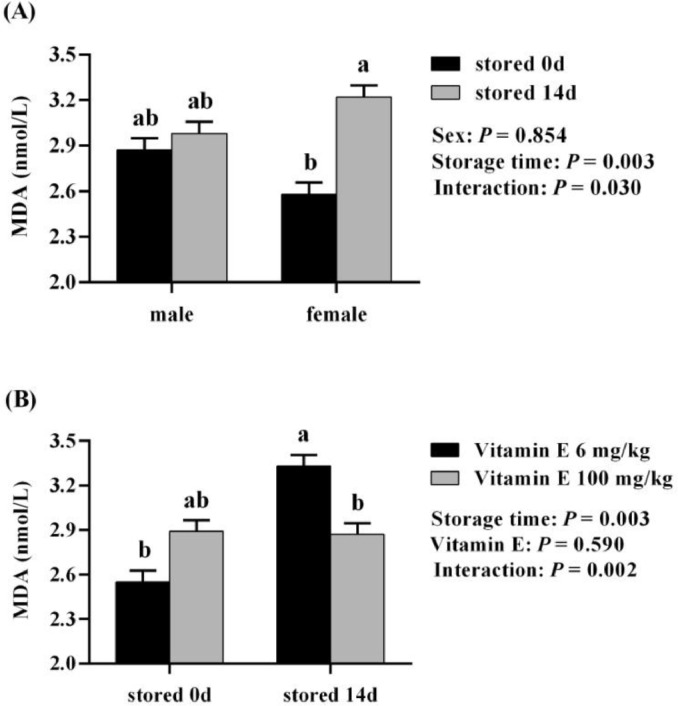
Two trials were designed to investigate the impacts of egg storage time and maternal dietary vitamin E (VE) supplementation on the growth performance and antioxidant capacity of progeny chicks. In total 512 Ross 308 broiler breeder hens (71-wk-old) were assigned to 2 dietary VE treatments (6 and 100 mg/kg) for 14 wk. Progeny chicks used in trials 1 and 2 were originated from eggs laid at week 10 (stored 0 d) and week 8 (stored 14 d), and week 14 (stored 0 d) and week 12 (stored 14 d), respectively. The 4 groups in trial 1 consisted of 2 levels of maternal VE (6 and 100 mg/kg) and 2 egg storage time (0 and 14 d). The 8 groups in trial 2 consisted of 2 levels of maternal VE (6 and 100 mg/kg), 2 egg storage time (0 and 14 d) and progeny sex (male and female). In trial 1, egg storage decreased the body weight, the liver total superoxide dismutase and total antioxidant capacity of 21-day-old offspring (P < 0.05), and the body weight gain and feed intake from 8 to 21 d and 1 to 21 d (P < 0.05); and increased the serum and liver malonaldehyde (MDA) of 7-day-old offspring and the ratio of feed: gain (F/G) from 1 to 7 d (P < 0.05). Maternal VE (100 vs. 6 mg/kg) decreased the F/G from 1 to 7 d and increased the serum total superoxide dismutase of 21-day-old offspring (P < 0.05). In trial 2, egg storage decreased the body weight of 42-day-old offspring, and the body weight gain and feed intake from 22 to 42 d and 1 to 42 d (P < 0.05); and increased the serum and liver MDA of 21- and 42-day-old offspring (P < 0.05). Maternal VE (100 vs. 6 mg/kg) reduced the serum MDA of 7-day-old offspring (P < 0.05). Interactively, maternal VE (100 vs. 6 mg/kg) reduced the serum MDA of offspring originated from stored eggs (P < 0.05), but not for that of offspring originated from unstored eggs in the two trials. It can be concluded that egg storage (14 vs. 0 d) decreased the growth performance and antioxidant capacity of offspring, while maternal dietary VE (100 vs. 6 mg/kg) supplementation could partly alleviate the reduction of antioxidant capacity (except for growth performance) of offspring induced by egg storage for the early phase post-hatch.
两项试验旨在研究种蛋贮存时间和母源日粮维生素 E(VE)添加水平对后代雏鸡生长性能和抗氧化能力的影响。选用 512 只 71 周龄罗斯 308 肉种鸡随机分为 2 个 VE 处理组(6 和 100 mg/kg),预饲 14 d。试验 1 中,雏鸡分别来自于第 10 周(贮存 0 d)和第 8 周(贮存 14 d)收集的种蛋,以及第 14 周(贮存 0 d)和第 12 周(贮存 14 d)收集的种蛋;试验 2 中,雏鸡分别来自于第 14 周(贮存 0 d)和第 10 周(贮存 14 d)收集的种蛋。试验 1 中,种蛋贮存降低了 21 日龄雏鸡的体重、肝脏总超氧化物歧化酶和总抗氧化能力(P < 0.05),821 日龄和 121 日龄的体重增重和采食量(P < 0.05),7 日龄雏鸡血清和肝脏丙二醛(MDA)含量以及 17 日龄的料重比(F/G)升高(P < 0.05);母源 VE(100 比 6 mg/kg)降低了 17 日龄的 F/G,并增加了 21 日龄雏鸡的血清总超氧化物歧化酶(P < 0.05)。试验 2 中,种蛋贮存降低了 42 日龄雏鸡的体重,以及 2242 日龄和 142 日龄的体重增重和采食量(P < 0.05),21 日龄和 42 日龄雏鸡血清和肝脏 MDA 含量升高(P < 0.05)。母源 VE(100 比 6 mg/kg)降低了 7 日龄雏鸡血清 MDA 含量(P < 0.05)。交互作用分析表明,母源 VE(100 比 6 mg/kg)降低了贮存种蛋来源的后代雏鸡血清 MDA 含量(P < 0.05),但对非贮存种蛋来源的后代雏鸡血清 MDA 含量没有影响。由此可见,种蛋贮存(14 比 0 d)降低了后代雏鸡的生长性能和抗氧化能力,而母源日粮 VE(100 比 6 mg/kg)添加可部分缓解早期出雏后种蛋贮存对后代抗氧化能力(除生长性能外)的降低。