Kraus Ludwig, Loy Johanna K, Wilms Nicolas, Starker Anne
IFT Institut für Therapieforschung, Leopoldstr. 175, 80804, München, Deutschland.
Department of Public Health Sciences, Centre for Social Research on Alcohol and Drugs, Stockholm University, Stockholm, Schweden.
Bundesgesundheitsblatt Gesundheitsforschung Gesundheitsschutz. 2021 Jun;64(6):652-659. doi: 10.1007/s00103-021-03328-7. Epub 2021 May 12.
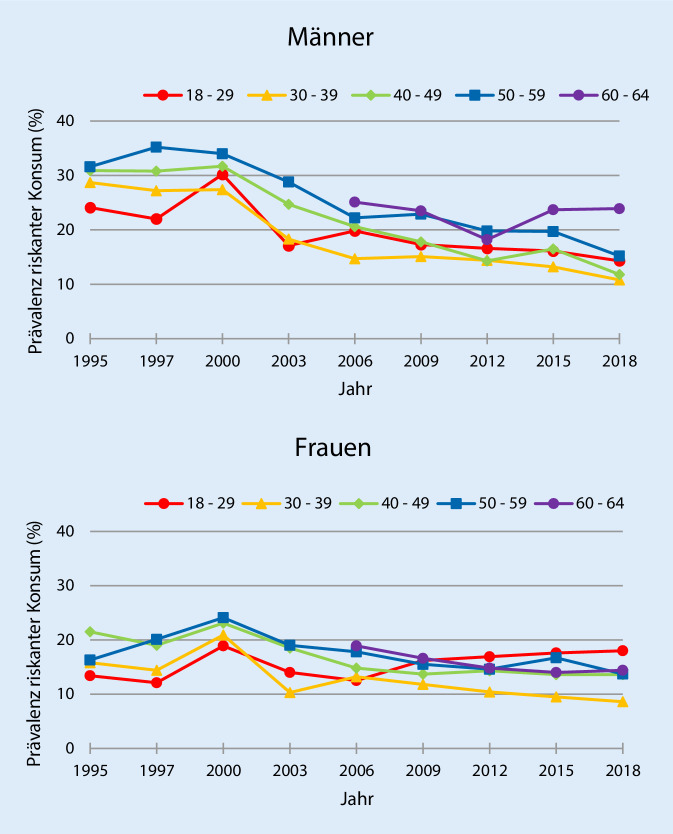
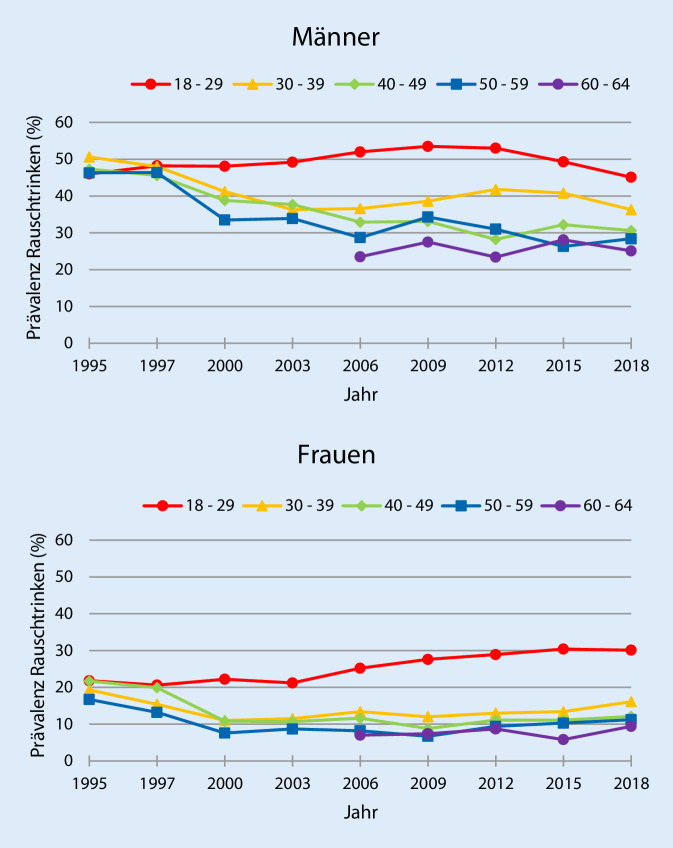
According to Skog's collectivity of drinking cultures theory, changes in alcohol consumption in all groups and strata of the population take place as parallel displacement in the distribution of consumption. The aims of the present paper are (1) to illustrate temporal trends in risky drinking and episodic heavy drinking by age and gender and (2) to examine whether the trends are parallel in all age groups ("collectivity") or diverge between age groups ("polarisation").
The data are based on nine surveys of the Epidemiological Survey of Addiction (ESA) between 1995 and 2018. Risky drinking was defined as daily consumption of more than 12 g (for women) or 24 g (for men) of pure alcohol and episodic heavy drinking as consumption of five or more glasses of alcohol (about 70 g pure alcohol) on at least one day in the past 30 days. Linear regressions were calculated separately for age groups (18-29, 30-39, 40-49, and 50-59 years) and gender to predict the temporal effect on risky drinking or episodic heavy drinking and to test trends for differences.
The temporal changes of risky drinking by age group show soft collectivity among men and polarisation among women. Trends in episodic heavy drinking indicate polarisation for both genders; while the prevalence increased in the youngest and oldest age groups, it decreased in all other age groups.
In light of a general decrease, the increasing trends in risky drinking in specific groups indicate the need for strengthening behavioural prevention. For the positive development to continue and to avoid a trend reversal, public health measures such as alcohol tax increases and reductions of alcohol availability need to be intensified.
根据斯科格的饮酒文化集体性理论,全体人口中所有群体和阶层的酒精消费变化表现为消费分布的平行位移。本文的目的是:(1)按年龄和性别说明危险饮酒和偶尔大量饮酒的时间趋势;(2)研究这些趋势在所有年龄组中是否平行(“集体性”),或者在不同年龄组之间是否存在差异(“两极分化”)。
数据基于1995年至2018年期间进行的九项成瘾流行病学调查(ESA)。危险饮酒被定义为每日纯酒精消费量超过12克(女性)或24克(男性),偶尔大量饮酒被定义为在过去30天内至少有一天饮用五杯或更多酒精饮料(约70克纯酒精)。分别针对年龄组(18 - 29岁、30 - 39岁、40 - 49岁和50 - 59岁)和性别进行线性回归,以预测对危险饮酒或偶尔大量饮酒的时间效应,并检验趋势差异。
按年龄组划分的危险饮酒时间变化显示,男性呈现温和的集体性,女性则呈现两极分化。偶尔大量饮酒的趋势表明,两性均存在两极分化;最年轻和最年长年龄组的患病率上升,而其他所有年龄组的患病率下降。
鉴于总体下降趋势,特定群体中危险饮酒的上升趋势表明需要加强行为预防。为了使积极发展持续下去并避免趋势逆转,需要加强提高酒精税和减少酒精可得性等公共卫生措施。