IQVIA Solutions Italy S.r.l., RWS, Via Fabio Filzi 29, 20124, Milan, Italy.
BMC Public Health. 2021 May 12;21(1):902. doi: 10.1186/s12889-021-10949-9.
Several studies have been focusing on the potential role of atmospheric pollutants in the diffusion and impact on health of Covid-19. This study's objective was to estimate the association between ≤10 μm diameter particulate matter (PM) exposure and the likelihood of experiencing pneumonia due to Covid-19 using individual-level data in Italy.
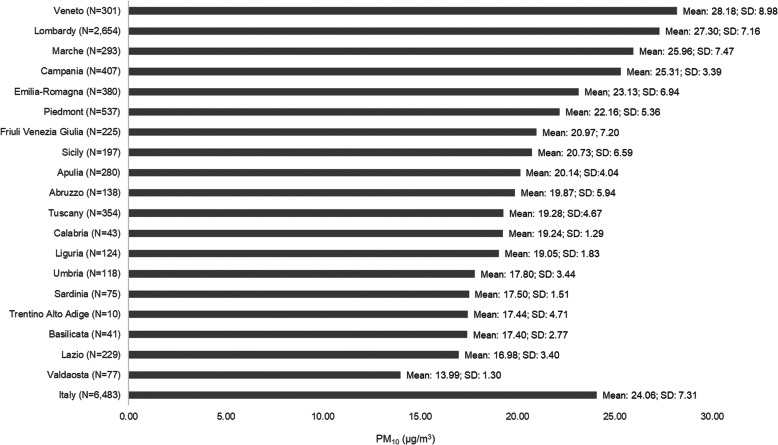
Information on Covid-19 patients was retrieved from the Italian IQVIA® Longitudinal Patient Database (LPD), a computerized network of general practitioners (GPs) including anonymous data on patients' consultations and treatments. All patients with a Covid-19 diagnosis during March 18th, 2020 - June 30th, 2020 were included in the study. The date of first Covid-19 registration was the starting point of the 3-month follow-up (Index Date). Patients were classified based on Covid-19-related pneumonia registrations on the Index date and/or during follow-up presence/absence. Each patient was assigned individual exposure by calculating average PM during the 30-day period preceding the Index Date, and according to GP's office province. A multiple generalized linear mixed model, mixed-effects logistic regression, was used to assess the association between PM exposure tertiles and the likelihood of experiencing pneumonia.
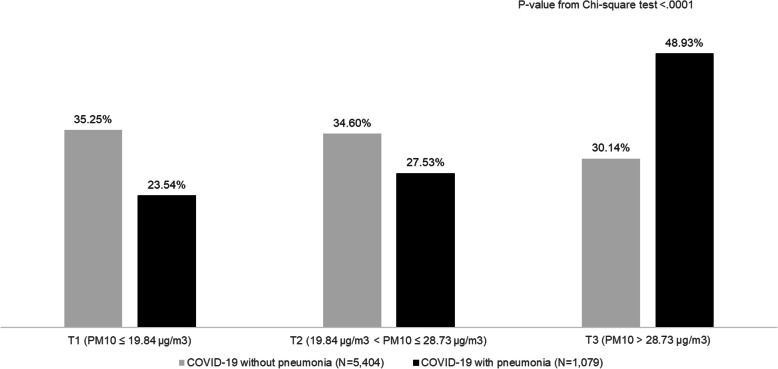
Among 6483 Covid-19 patients included, 1079 (16.6%) had a diagnosis of pneumonia. Pneumonia patients were older, more frequently men, more health-impaired, and had a higher individual-level exposure to PM during the month preceding Covid-19 diagnosis. The mixed-effects model showed that patients whose PM exposure level fell in the second tertile had a 30% higher likelihood of having pneumonia than that of first tertile patients, and the risk for those who were in the third tertile was almost doubled.
The consistent findings toward a positive association between PM levels and the likelihood of experiencing pneumonia due to Covid-19 make the implementation of new strategies to reduce air pollution more and more urgent.
多项研究关注大气污染物在新冠病毒传播和对健康影响方面的潜在作用。本研究旨在使用意大利的个体水平数据,估算直径≤10μm 的颗粒物(PM)暴露与新冠病毒肺炎发病的关联性。
从意大利 IQVIA®纵向患者数据库(LPD)中检索新冠病毒患者的信息,该数据库是一个由全科医生组成的计算机网络,包含患者就诊和治疗的匿名数据。将 2020 年 3 月 18 日至 2020 年 6 月 30 日期间确诊为新冠病毒的所有患者纳入研究。首次新冠病毒登记日期为 3 个月随访的起始点(索引日期)。根据索引日期和/或随访期间有无新冠病毒肺炎登记情况,对患者进行分类。根据 GP 办公室所在省份,在索引日期前 30 天内计算平均 PM 值,为每位患者分配个体暴露值。采用多变量广义线性混合模型、混合效应逻辑回归评估 PM 暴露三分位数与肺炎发病可能性之间的关联。
在纳入的 6483 例新冠病毒患者中,1079 例(16.6%)患有肺炎。肺炎患者年龄较大,男性居多,健康状况较差,在新冠病毒诊断前一个月的个体 PM 暴露水平更高。混合效应模型显示,与第一三分位患者相比,第二三分位患者患肺炎的可能性高 30%,而第三三分位患者的风险几乎增加了一倍。
PM 水平与新冠病毒肺炎发病的关联性一致,提示实施新的降低空气污染策略迫在眉睫。