Hunan Provincial Key Laboratory of Environmental Catalysis & Waste Regeneration, College of Materials and Chemical Engineering, Hunan Institute of Engineering, Xiangtan, 411104, Hunan, China.
Sci Rep. 2021 May 12;11(1):10076. doi: 10.1038/s41598-021-89587-5.
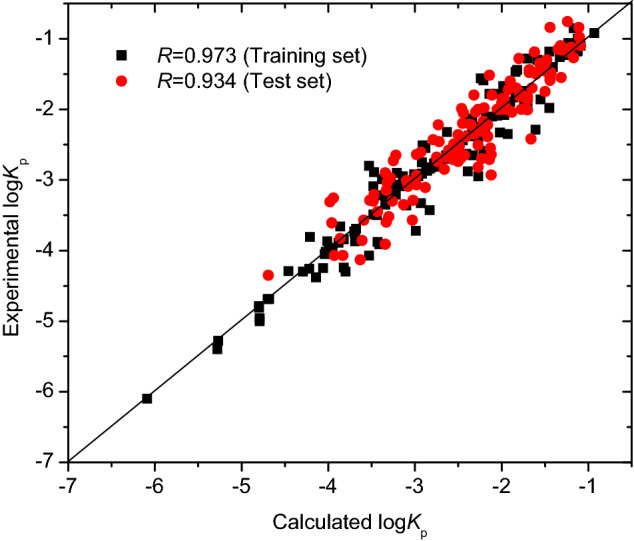
A three-descriptor quantitative structure-activity/toxicity relationship (QSAR/QSTR) model was developed for the skin permeability of a sufficiently large data set consisting of 274 compounds, by applying support vector machine (SVM) together with genetic algorithm. The optimal SVM model possesses the coefficient of determination R of 0.946 and root mean square (rms) error of 0.253 for the training set of 139 compounds; and a R of 0.872 and rms of 0.302 for the test set of 135 compounds. Compared with other models reported in the literature, our SVM model shows better statistical performance in a model that deals with more samples in the test set. Therefore, applying a SVM algorithm to develop a nonlinear QSAR model for skin permeability was achieved.
采用支持向量机(SVM)结合遗传算法,为包含 274 个化合物的足够大的数据集建立了一个三描述符定量构效关系(QSAR/QSTR)模型,用于皮肤渗透性。最优 SVM 模型对 139 个化合物的训练集具有 0.946 的决定系数 R 和 0.253 的均方根误差(rms);对 135 个化合物的测试集具有 0.872 的 R 和 0.302 的 rms。与文献中报道的其他模型相比,我们的 SVM 模型在处理测试集中更多样本的模型中具有更好的统计性能。因此,成功地应用 SVM 算法为皮肤渗透性开发了一个非线性 QSAR 模型。