Farhan Firas-Abdulameer, Sahib Ali-Jameel-Abdul, Fatalla Abdalbseet-Ahmad
PhD. Senior Lecturer, Department of Prosthodontic, College of Dentistry, University of Baghdad, Bab Al-Muadham campus of the University of Baghdad, 1417, Baghdad, Iraq.
MSc. Assistant professor, Department of Prosthodontic, College of Dentistry, University of Baghdad, Bab Al-Muadham campus of the University of Baghdad, 1417, Baghdad, Iraq.
J Clin Exp Dent. 2021 May 1;13(5):e487-e492. doi: 10.4317/jced.57926. eCollection 2021 May.
Several impression techniques, especially in combination with computer-aided design and computer-aided manufacturing (CAD/CAM), are used in increasing the accuracy of dental implantology and decreasing patient discomfort. The study was designed to examine the accuracy of the digital impression (DI) of multiple implants with an intraoral scanner (IOS) and compared with that of a conventional impression (CI).
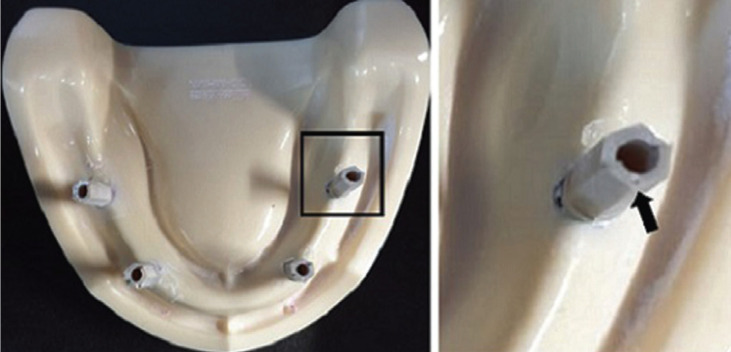
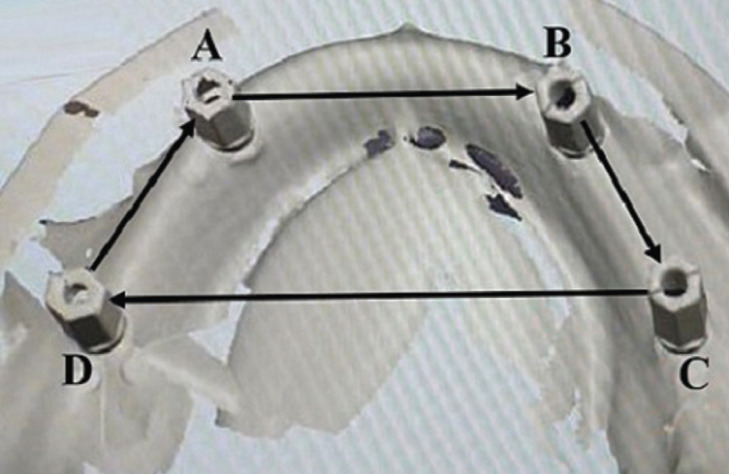
Four dental implants were placed in teeth area #33, #36, #43 and 46# of the mandibular full-arch model. The implanted model was replicated by IOS and CI after fitting of scannable abutments over the implant screws. Then, a small hole was made on the scan region (as a reference point). Two types of CI techniques were used; dual-phase (DP) and monophase (MP). Stone casts were produced through a conventional close tray impression technique using die stone. The casts were scanned with a laboratory scanner. DI was attained by scanning the implanted model with the IOS. The control sample was accomplished by scanning the implanted model directly with a laboratory scanner. Dimensional accuracy was calculated by measuring the distances between the reference points of four measuring parameters as follows; A-B, B-C, C-D, and A-D using CAD software.
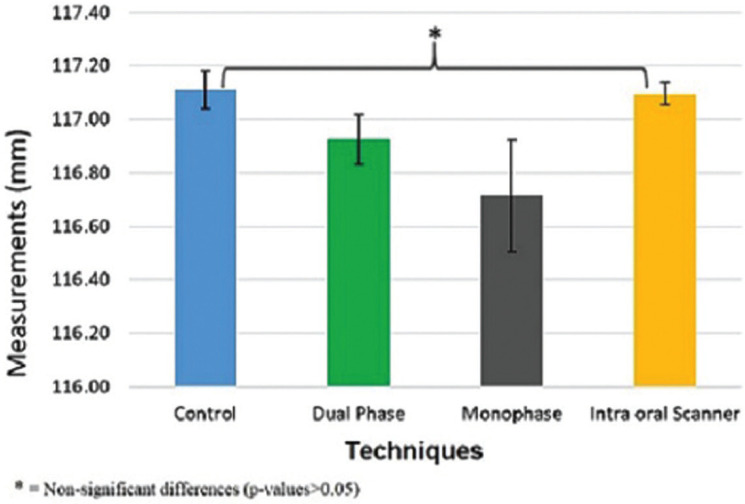
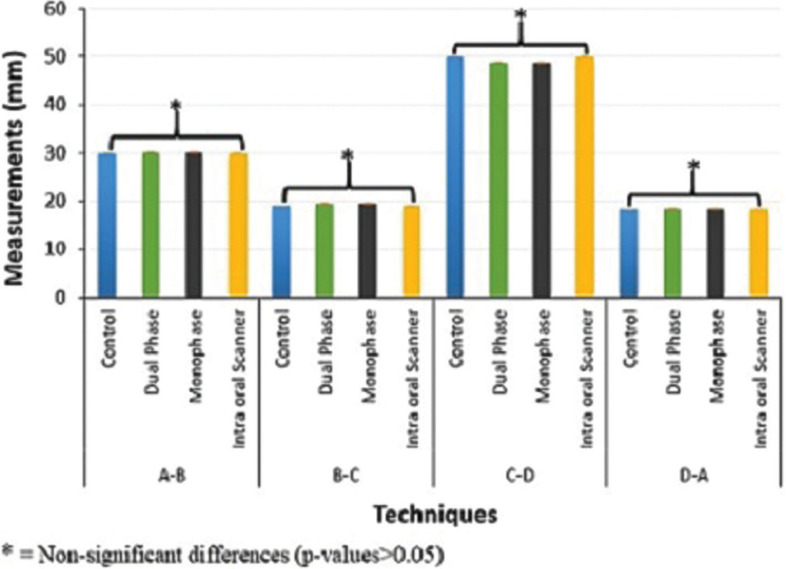
The mean values and standard deviation between the four parameters of different impression techniques (CI and DI) and the control group showed convergent value. One-way ANOVA test showed all CI techniques, except IOS, showed a significant differences from the control group.
Compared with CI, the IOS was more accurate because no differences were observed between its measurements and those of the control model. CI is simple and reduces patient discomfort when used in fabricating multiple implants and allowing communication with dental technicians. Dimension accuracy, conventional impressions, digital impressions, multiple implants.
多种印模技术,尤其是与计算机辅助设计和计算机辅助制造(CAD/CAM)相结合时,被用于提高牙种植学的准确性并减少患者不适。本研究旨在检查使用口腔内扫描仪(IOS)进行多颗种植体数字印模(DI)的准确性,并与传统印模(CI)进行比较。
在下颌全牙弓模型的33#、36#、43#和46#牙位区域植入四颗牙种植体。在种植体螺钉上安装可扫描基台后,通过IOS和CI复制植入模型。然后,在扫描区域制作一个小孔(作为参考点)。使用了两种CI技术;双相(DP)和单相(MP)。通过使用石膏模型材料的传统封闭托盘印模技术制作石膏模型。使用实验室扫描仪对模型进行扫描。通过使用IOS扫描植入模型获得DI。通过使用实验室扫描仪直接扫描植入模型完成对照样本。使用CAD软件测量四个测量参数(如下:A-B、B-C、C-D和A-D)的参考点之间的距离来计算尺寸精度。
不同印模技术(CI和DI)和对照组的四个参数之间的平均值和标准差显示出收敛值。单因素方差分析测试显示,除IOS外,所有CI技术与对照组均存在显著差异。
与CI相比,IOS更准确,因为其测量值与对照模型的测量值之间未观察到差异。CI简单,在制作多颗种植体并与牙科技师沟通时可减少患者不适。尺寸精度、传统印模、数字印模、多颗种植体。